Envisioning Status as a Regional Power
"This Houthi force now poses a direct, existential threat to Israeli navigation and sovereignty, consistently targeting US naval assets in the Red Sea and disrupting global maritime commerce." "From a strategic perspective, the principal beneficiary of this conflict is undeniably Iran. The Houthis, initially a disparate, indigenous rebel group, have been transformed into Tehran’s most potent and aggressive non-state actor in the Arab world. They now possess a sophisticated arsenal of Iranian-supplied ballistic missiles and advanced drones, extending Iran’s arc of influence far beyond its immediate borders."
 |
| Houthi protesters hold weapons during a demonstration in Sanaa, Yemen, May 30, 2025 (credit: REUTERS/Adel Al Khader) |
"[The attacks represent a] power move [enabling the Houthis to] project more power regionally and internationally.""[In comparison with their [missile and drone] attacks on Israel, with limited success, the Houthis' attacks on shipping had proved] a very efficient way to make the entire West, and most of the east, bleed."Farea Al-Muslimi, research fellow, Chatham House, British think tank"They've ensured that their presence is always felt [achieving a high profile].""Transit via the Bab al-Mandeb Strait remains low compared to 2023 -- a drop by over 50 percent.""The Houthis appear to have more freedom now to assault freedom of navigation."Noam Raydan, Washington Institute for Near East Policy
 |
Attacks
on Red Sea shipping have been resumed by Yemen's Houthi terrorists who
claim their aim is to force Israel to declare a ceasefire in Gaza.
According to the Iranian proxy terrorists, the two vessels they attacked
earlier in the week -- the Magic Seas and the Eternity C -- were linked
to trade with Israel and therefore, in their mindset, legitimate
targets. Their motivation to resume attacks on maritime shipping after a
six-month hiatus appears puzzling.
Since
Israel's invasion of Gaza to conduct its hunt for Hamas terrorist
operatives following the October 7 2023 storming of Israeli farming
communities in southern Israel by thousands of Palestinians dispatched
by Gaza's Hamas leaders to commit mass murder, rape, mutilation and
hostage-taking, Yemen's Houthis, part of the Islamic Republic of Iran's
"axis of resistance" joined Hamas and Hezbollah in their campaign to
destroy Israel at the behest of their sponsor and beneficiary, Iran.
From
their marine piracy's inception, the Houthis launched over 100 attacks
on vessels in the Red Sea and Gulf of Aden, since November of 2023,
according to the Joint Maritime Information Centre operated by navies of
the West. Their aim, they assert, is the support of Palestinians in
Gaza. Hamas negotiators in Doha were encouraged by the Houthi political
leader Mahdi al-Mashat to "negotiate with your heads held high, for we are with you and all the resources of our people will support you" until the conflict is finished.
 |
| Protesters, mainly Houthi supporters, hold weapons to mark the annual al-Quds Day on the last Friday of Ramadan, in Sana'a, Yemen, March 28, 2025 (credit: REUTERS/KHALED ABDULLAH) |
Analysts
of the situation appear to have come to a conclusion that diverges from
the general assumption that the Houthi activities relate specifically
to defence of Hamas, pointing instead to the high likelihood of yet
another entirely different reasoning. One that surfaced in the wake of
the 12-day Israeli aerial bombardment of Iran when the Republic's allies
failed to come to its aid. A hugely reduced Hamas and Hezbollah
capability to launch assistive reaction against the pounding that Iran
took demonstrated the extent of the devastation suffered by both in
challenging Israel militarily.
A
revelation of a larger role in world affairs has come to the fore, it
seems, an ambition revealed that the Houthi leadership envisions a much
grander role for itself than merely a proxy of Iran. With Iran in
decline along with Hamas and Hezbollah, why not prepare for a larger
role within the region as an unstoppable force gaining the attention of
world powers frustrated at the disruption of global shipping and the
consequential diminished trade and profit accompanying it?
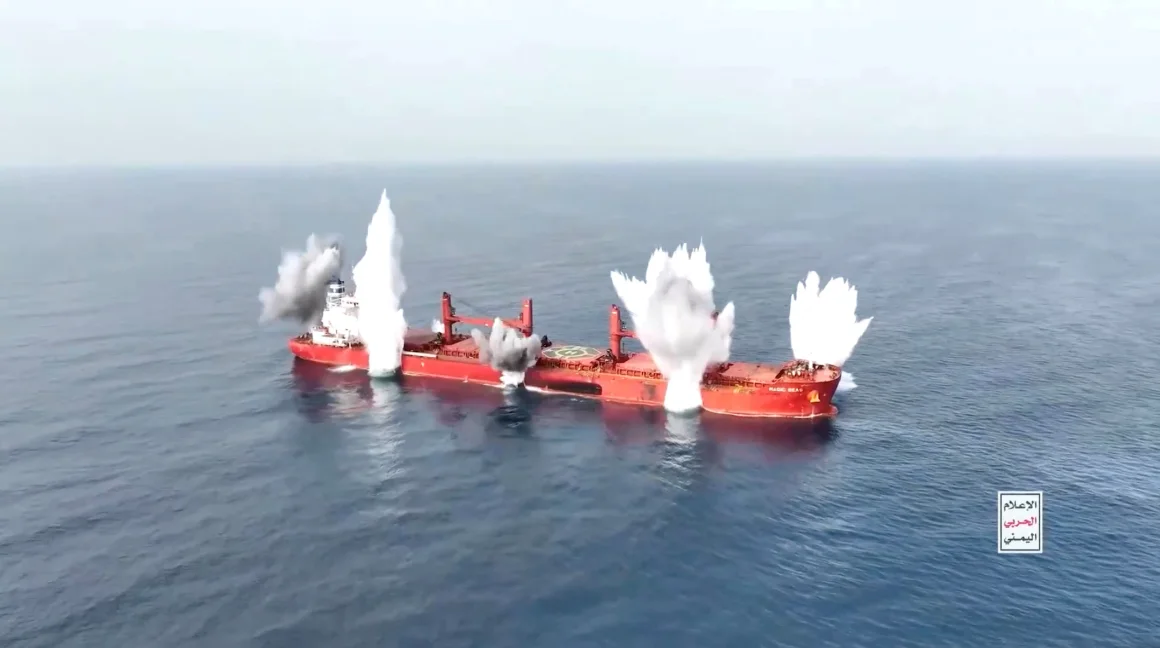 |
Plumes
of smoke rise from what is said to be Liberia-flagged, Greek-operated
bulk carrier, the MV Magic Seas. This screen grab is taken from a
handout video released on July 8, 2025.
|
The Houthis have been left as the sole member of the "axis of resistance"
to have emerged from its confrontation with Israel and the United
States unchastened and unscathed. Slammed by repeated Israeli airstrikes
in response to their drone and missile attacks. Surviving an intensive
U.S. bombing campaign earlier before reaching an agreement to ceasefire
in return for an end to Houthi attacks on shipping, the Yemenite
terrorists see an opportunity for themselves to impress upon the
international community their prowess in disturbing world marine
commerce, worthy of the respect of caution and concern in dealing with
them.
The
major disruptions to vital shipping lanes through the Bab al-Mandeb
Strait and the Red Sea where about 12 percent of global trade is carried
through is a reflection of the power and success of the Houthis whose
reputation is now that of a major disrupter in world affairs, a heady
aphrodisiac for the Yemenites who feel entitled to recognition for their
exceptional status in world affairs as a regional powerhouse yet to be
recognized.
 |
Labels: "Axis of Resistance", Challenging Israel, Delusions of Grandeur, Islamic Republic Proxy, Piracy on the Red Sea, United States, Yemen's Houthis
posted by Pieface @ 9:26 PM


0 Comments:
Post a Comment
<< Home