To Reduce Drug Overdose and Public Drug Use, Close Supervised Injection Sites
 |
| Bill 103 bars supervised drug use sites from operating within 150 metres of a school or daycare. The bill will require two of these sites to move, including the Maison Benoît-Labre in Montreal. CBC |
"Within 50 metres of Maison Benoit Labre, emergency calls were up 1,967 percent [from six calls to 124] after the facility opened. Within 250 metres of the centre, mischief calls were up 800 percent [and there was] a 93 percent increase, or near doubling, in crimes against people.""Even overdose incidents were up 300 percent. Giving the lie to the claims from Maison Benoit Labre that they went to where the need was already existing and are preventing overdoses in the area."Michael MacKenzie, professor of social work and pediatrics, McGill University, Canad Research Chair in child well-being"Remarkably, the fact that overdose rates in Toronto have gone down, not up, since four of the city's drug-use sites closed at the end of March was completely absent from a recent story in the Toronto Star about a 'staggering increase' in overdoses at ten of the city's drop-in centres since those closings.""Arguing that consumption sites are reducing overdoses and public drug use while neglecting to mention that they are also facilitating it on a large scale is a misleading representation of the facts to those who live, work and raise children near these facilities."Derek Finkle, National Post
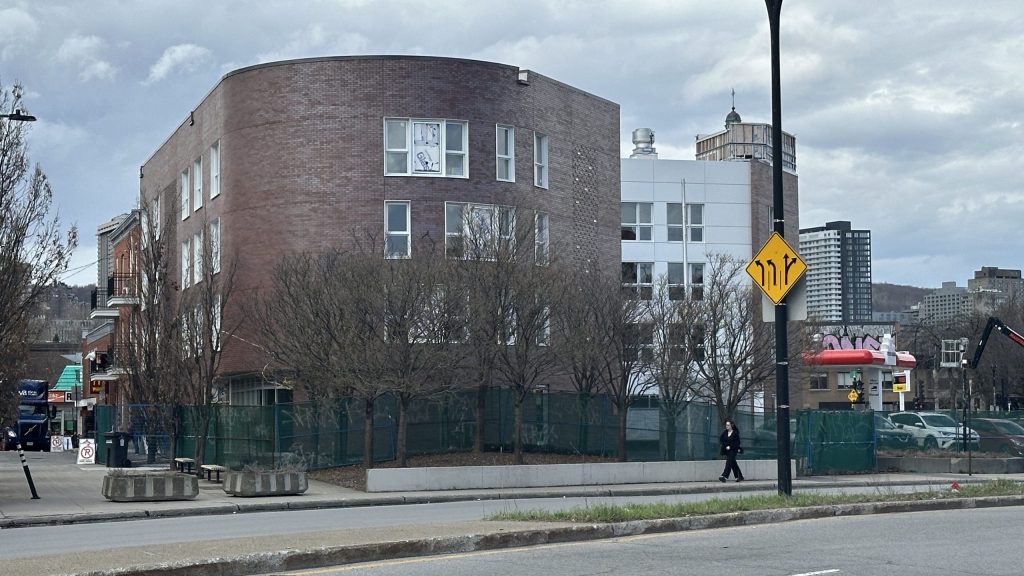 |
| Maison Benoît-Labre, a supervised drug inhalation site, in Saint-Henri on April 13, 2024. (Gareth Madoc-Jones, CityNews) |
Last summer, Victor-Rousselot Park in Montreal was at the centre of the national debate over supervised injection sites. Maison Benoit Labre, a facility including drug consumption services along with a drop-in centre for homeless people had opened mere metres from the park. This is a park that serves as a playground for an elementary school located nearby where students at recess and lunch breaks view it as their outdoor recreational centre.
It took just weeks for the newly-located facility to attract new drug activity and with that, assaults and public sex acts. The extent to which was sufficiently intimidating and alarmingly dangerous that police escorts were required to enable the children to access the park in safety. Then in May of 2024 the Quebec government tabled legislation to prevent drug-consumption sites from opening within 150 metres of schools and daycares; a similar set of laws had been passed in law in Ontario the year before.
What Quebec did to prepare for the legislation was to consult with the public, as stakeholders who should have a say in the proceedings. One resident of the impacted St.Henri neighbourhood who spoke before Social Services Minister Lionel Carmant, was area resident Professor Michael MacKenzie of McGill University. Professor MacKenzie introduced the committee in his presentation to a 2021 systematic review of injection site literature which found a mere 22 studies "that examined actual outcomes".
 |
| Social Planning Toronto |
"Within the program evaluation field, it is notable that 22 studies does not represent a deep evidence base". Just one site -- Vancouver's Insite -- took up 15 of those 22 studies with another three of a site in Australia. "In other words, 19 of the 22 studies (86 percent) represented just two sites, neither of which were located near schools and daycares". Insite "was in deep and protracted community crisis before the centre was implemented", explaining why "any intervention in a neighbourhood in the throes of real crisis was likely to show some positive short-term change".
As for Toronto, overdoses dropped noticeably in April once half of the city's drug-use sites were ordered closed by the province. Toronto Paramedic Services reported that fatal and non-fatal overdoses were about 50 percent lower than what was reported in 2024. There were more people using outside the site than within it, particularly in warmer months, admitted the former chief executive of the closed South Riverdale drug-consumption site in east-end Toronto. Evidently about "400 to 500 sterile crack kits a day" were distributed against expectations that users would opt for supervision.
"More people are choosing to use outside", as the site has three booths for supervision which can "sometimes lead to longer wait times", according to the manager of the South Riverdale drug-consumption site in Toronto. As well, at the Toronto Kensington safe-consumption site, visits for drug equipment for use off-site vastly outnumbered the number of visits for supervised consumption; only 64 of 413 visits were for safe consumption in July of 2024.
Staff at the site noted: "We are still seeing clients coming in for supplies rather than using the site. Many of those visits were for supplies." Their argument remains that consumption sites reduce overdoses and public drug use -- somehow overlooking any mention that drug use is being facilitated on a large scale -- a misrepresentation of facts familiar to those who live, work and raise children close to these facilities.
 |
| A board showing drug checking information is displayed in the consumption room at the Parkdale Queen West Community Health Centre in Toronto days before the site transitioned into a homelessness and addiction recovery hub. (Chris Young/The Canadian Press) |
Labels: Drug Equipment, Off-Site Use Neighbourhood Impact, Overdoses, Supervised Drug Injection Sites, The Myth of Harm Reduction
posted by Pieface @ 8:07 PM


0 Comments:
Post a Comment
<< Home