The August Royal Spanish Academy
"[The Spanish Royal Academy frequently finds itself embroiled in debates about] inclusive [Spanish, which might mean addressing a group of men and women with the feminine] todas [instead of the male] todos to mean] everyone.""[It is a] political manifestation [an emerging trend to make the language gender-neutral — for instance, replacing] niño [boy] and niña [girl] with niñe [child].""It is not part of the grammar, it is not orthodox, and probably in many places it will not be understood. It is an expression with no practical reality.""No one doubts that the language is called Spanish or Castilian. Our constitution says Castilian, and in the Americas they say Castilian or Spanish."Santiago Muñoz Machado, director, Spanish Royal Academy
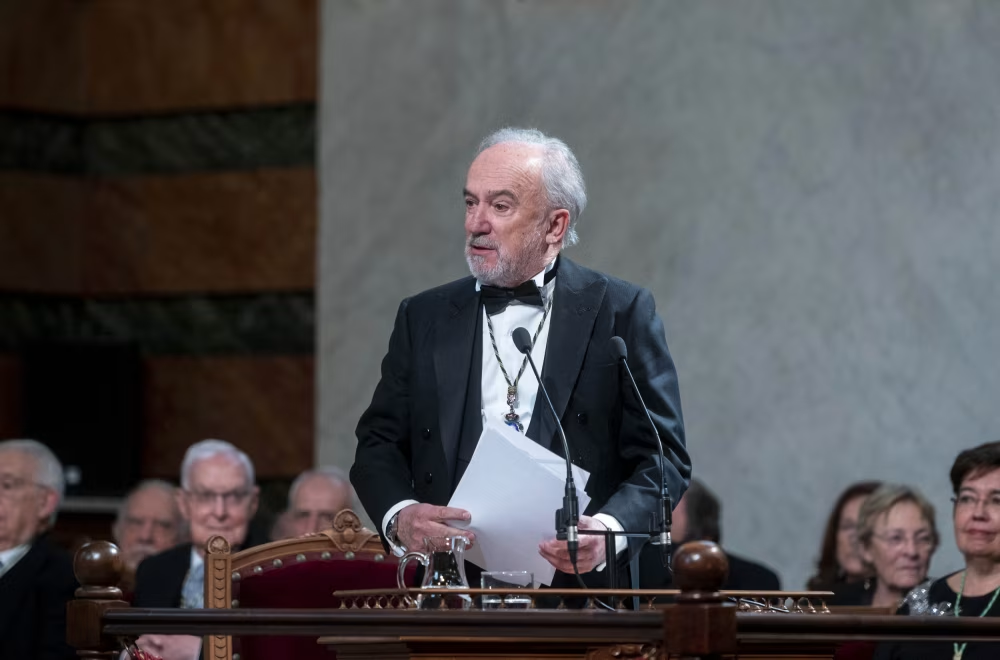 |
| Santiago Muñoz Machado speaks at the Real Academia Española in Madrid on May 21. Alberto Ortega / Europa Press via Getty Images |
"The Royal Spanish Academy (RAE) is the official institution responsible for regulating Spanish Language, in order to keep its unity up in the Spanish territories. The RAE began establishing rules for the orthography of Spanish language in 1741 and they were also gradually adopted by the Spanish speaking countries of Latin America. It is affiliated with national language academies in twenty-one other hispanophone nations through the Association of Spanish Language Academies.""The Academy was founded in 1713 by initiative of Juan Manuel Fernández Pachego, Marquis of Villena and Duque de Escalona and was modelled both on the Italian Accademia della Crusca (1582) and the Académie française (1635), with the purpose “to fix the voices and vocabularies of the Castilian language with propriety, elegance, and purity”. King Philip V approved its constitution on 3 October 1714, placing it under the Crown’s protection.RAE’s authority was recognized on the language, because it is an hard work to regulate a so-spread language as Spanish is. It is often seen as a conservative, however, strives to maintain the formal language in tune with today, but not “close the door” to admission of new words."info@inmsoL.com
 |
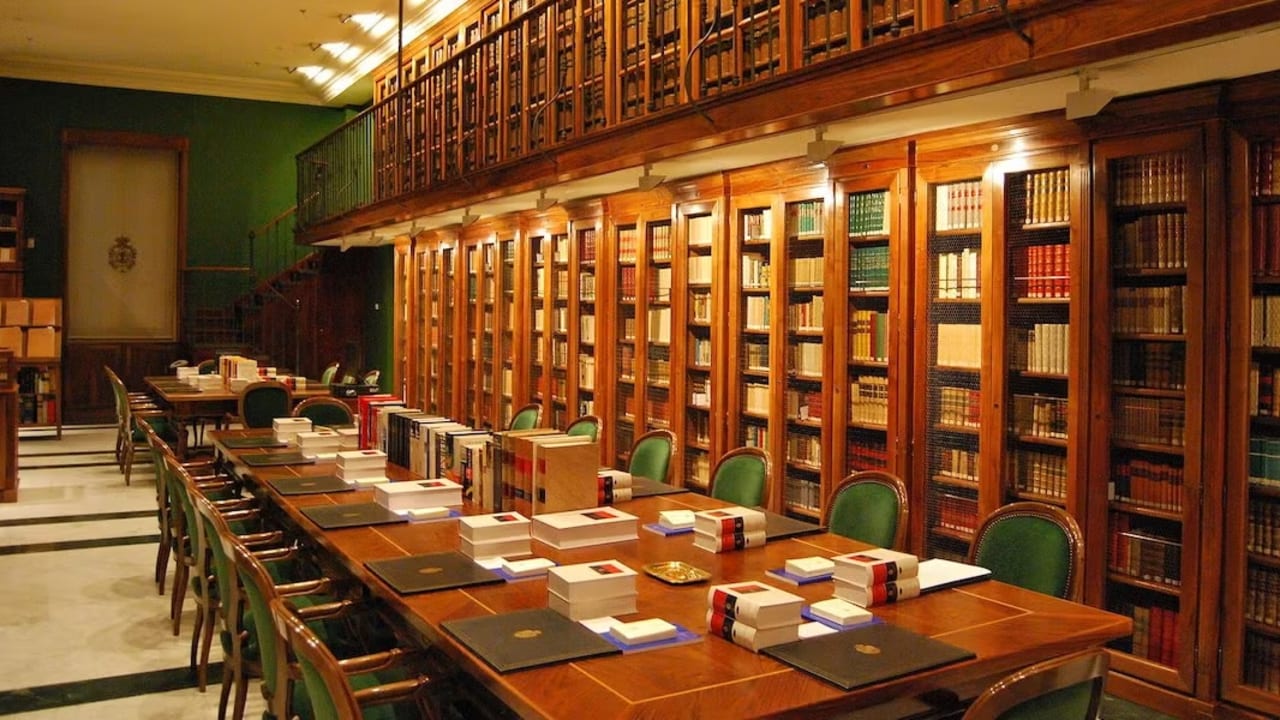
| The Royal Spanish Academy building in Madrid, Spain |
"Dictionaries have the task of reflecting language use and evolution, and their content is based on linguistic and academic criteria.""In a context where Spanish and Ibero-American society is increasingly sensitive to diverse identities, and disrespect in defining groups is widely rejected, we believe that these definitions should be updated to accurately reflect the language’s usage in our times""We understand that dictionary definitions reflect language usage and do not inherently promote hate, but they should be corrected as they are entirely outdated in the social and cultural reality of the 21st century. We appeal to the sensitivity of the RAE to promote a respectful and inclusive language."Borja Luján Lago, lawyer
The Royal Spanish Academy legislates the Spanish language's orthography (spelling), syntax and punctuation as it has since its inception in 1713. Its dictionary reflects words the Academy feels Spanish speakers should make use of. The self-proclaimed supreme authority on the Spanish language holds sway for millions of Spanish-speakers around the world. Over the past several years, Spanish-speaking Jews have attempted to persuade the Academy's authorities that its definition of the Spanish word for Jew -- 'Judio' is unworthy of an institution of its great renown and influence.
For according to the official dictionary of the Royal Spanish Academy 'Judio is "a miserly or usurious person". An Argentine judge ordered the academy based in Madrid to remove the definition in 2024. It did this in response to a campaign launched in Latin America by Jewish organizations who took exception to the pejorative definition attached to Jews. For their part, the Academy linguistic authorities saw no need to make such a change and simply refused the order.
And nor is it just the word 'Jew' alone that is included in the dictionary, for there are others of similarly offensive slurs that implicate the Academy in aiding a climate of antipathy toward Jews in Spanish-speaking enclaves of the world. The dictionary also includes 'judaizar', meaning "to practice Judaism in secret", clearly a holdover of the Spanish Inquisition when Jews called marranos and conversos were persecuted by the Catholic Church. There is also the dictionary word of 'hebraizante', to accuse someone of being a secret Jew.
The academy's director was direct in his response, that if the dictionary defines 'Jew' as 'miserly' it is a reflection of its actual use, given that people are wont to use the word in that vein -- flatly stated Santiago Munoz Machada, director of the Academy. Even while the Academy acknowledges the offensive nature of the definition, it retains its position within the dictionary. Behind all of this is the historic influence of the Catholic Church in Spanish-speaking areas of the world.
The rationale being that the definition is a mirror image of the manner in which the word is understood by the wider public, thus giving it credibility. Not that the definition renders credit to the usage, encouraging the public to use it in that offensive manner. The Academy has it both ways: its august position as a first-and-last-position arbiter of matching words to its correct usage is not to be questioned; yet it is the public and populist use of the word that gives the dictionary's definition authenticity.
Therefore, any offence taken at the word's definition is not the Academy's concern, nor could it be at fault for refusing to make any soothing alterations in its suggestibility. Besides which, asserted Mr. Munoz Machado, an Argentine judge had no possible jurisdiction over the Academy's dictionary and to suggest it does is an intolerable impudence.
This, at a time when antisemitism in Spain and throughout Latin America is not only deeply entrenched but aflame with a fiery renaissance, and if the hugely assertive and respected dictionary validates such views of Jews, who is to question it? Simply by considering its position and the blatant nuances of definition, the Academy is doing justice to its performance as a custodian of correct language; how the public chooses to interpret the definition is of no concern to the Academy; it has fulfilled its dictionary obligation.
The Jewish Community of Panama, has the support of the entire Spanish-speaking Jewish community, represented by its representative organizations: the Federation of Jewish Communities of Spain, the Delegation of Israeli Associations in Argentina, the Israeli Circle of Bolivia, the Jewish Community of Chile, the Sephardic Hebrew Community of Bogotá, the Zionist Israeli Center of Costa Rica, the Board of the House of the Hebrew Community of Cuba, the Jewish Community of Ecuador, the Israeli Community of El Salvador, the Jewish Community of Guatemala, the Hebrew Community of Tegucigalpa, the Central Committee of the Jewish Community of Mexico, the Israeli Community of Nicaragua, the Jewish Community of Paraguay, the Jewish Association of Peru, the Israeli Center of the Dominican Republic, the Central Israeli Committee of Uruguay, and the Confederation of Israeli Associations of Venezuela, as well as non-governmental organizations such as the American Jewish Committee (AJC), B’nai B’rith International (BBI), the Simon Wiesenthal Center (SWC), the Combat Antisemitism Movement (CAM), the Latin American Jewish Congress (CJL), and the Anti-Defamation League (ADL).Document submitted to the RAE’s registry requests the complete removal of the entry “Judiada,” defined as “a dirty trick or action that harms someone.”Press release published by LL&HH Abogados, a multidisciplinary law firm specializing in key areas of law: criminal, administrative, civil, labor, tax, and immigration. Founded in 2015, the firm, led by Juan Carlos Luján Lago and Borja Luján Lago, is headquartered in Galapagar (Madrid) and operates throughout the Spanish territory.
 |
Labels: Antipathy to Jews, Definitions of Jew, Dictionary, Judaism, Objectionable Institutional Antisemitism, Royal Spanish Academy, Spain, Spanish Inquisition
posted by Pieface @ 8:36 PM


0 Comments:
Post a Comment
<< Home