Nuclear Non-Proliferation Treaty Flouted by Iran
"I do think that the centrifuges, the actual ability of Iran to perform enrichment and to convert enriched uranium to metal has been severely damaged, if not very, very close to being completely destroyed.""But the question is, what happened to the enriched uranium? According to Rafael Grossi, the director general of the IAEA, Iran informed the IEA that they were moving enriched uranium. They didn’t give details. They didn’t give a final destination.""But that suggests that material has been moved from Fordow and possibly from Isfahan. Isfahan is the facility where they were keeping the most highly enriched uranium.""But as you’ve seen in this [satellite] imagery, the trucks moving stuff from Fordow would probably include the material that was most recently enriched, which would be a smaller amount, as well as some of the most sensitive centrifuges and other equipment that they can get out of that facility and move into other secret facilities, that we might not be able to find."William Alberque, Senior Adjunct Fellow, Pacific Forum – previously Director of NATO’s Arms Control, Disarmament, and Non-Proliferation Centre"There needs to be a cessation of hostilities for the necessary safety and security conditions to prevail so that Iran can let IAEA teams into the sites to assess the situation."IAEA Director General Rafael Mariano Grossi

The mystery left after the U.S. bunker-buster strikes on the three nuclear sites, Fordow, Isfahan and Natanz, is where the Iranian enriched uranium stocks have been taken to by the regime, prior to the strikes; the near-bomb-grade uranium whose enrichment and presence leading to the potential of the production of atomic bombs led Israel to attack Iran's nuclear sites last Friday, and the U.S. to join the aerial bombardment a day later.
The International Atomic Energy Agency reflected on the situation where five days after the conflict began, its inspectors had lost track of the 409 kilograms of highly enriched uranium. Should Iran's Supreme Leader Ayatollah Ali Khamenei give orders to continue with its weaponization program, the concern is that the spirited-away enriched uranium would provide the means by which nine bombs could be produced following enrichment upgraded to 90 percent.
The uranium in question could be stored in 15 cylinders measuring 91.4 centimetres in height; each roughly the size of a large scuba-diving tank. At 25 kg in weight for each of the containers, they would be sufficiently lightweight to be taken to a secret location, carried on foot or in a small vehicle. Assuming Israel and the U.S. effectively destroyed the enrichment infrastructure, the risk remains whether the uranium, close to near-weapons grade, could be indefinitely hidden. Prior to the attacks that Israel launched on Iran's nuclear sites, monitors with the IAEA maintained meticulous track records of Iran's declared inventory of uranium. Over one site daily was inspected to ensure the material was accounted for, not diverted for use in weapons. Israel's June 13 strikes led Iran to relocate the material to an undeclared facility, before the U.S. joined with more advanced bombing technology.
Prior to the attacks that Israel launched on Iran's nuclear sites, monitors with the IAEA maintained meticulous track records of Iran's declared inventory of uranium. Over one site daily was inspected to ensure the material was accounted for, not diverted for use in weapons. Israel's June 13 strikes led Iran to relocate the material to an undeclared facility, before the U.S. joined with more advanced bombing technology.Although IAEA head Grossi has demanded that the Islamic Republic inform his inspectors of the new location, the expectation is that they will not be granted access. This week the Iranian parliament's National Security and Foreign Policy Commission approved the draft of a bill to require the government to suspend its cooperation with the IAEA; a halt to all engagement with the atomic watchdog "until the security of the country's nuclear facilities is guaranteed".
Iran signed on to the nuclear Non-Proliferation Treaty, an international agreement to prevent the spread of atomic weapons. Signatories like Iran were given access to nuclear technologies conditioned on the premise they would not attempt to produce weapons. Much of that technology is dual use; applications in civilian or military lines of work. The treaty empowers the IAEA with ensuring nuclear material is appropriately maintained and used.
"The existing NPT framework has been rendered ineffective", stated Tehran's IAEA envoy Reza Najafi, since the accord integrity had been dealt an "irreparable blow" by the decision of Israel and the U.S. to bomb Iran's nuclear sites. Despite of course, that Iran had itself rendered the framework ineffective by refusing inspection of some of its nuclear facilities to IAEA inspectors,but above all, in enriching uranium to a level it was absolutely forbidden to achieve under the framework guidelines, reinforced by the 2015 deal.
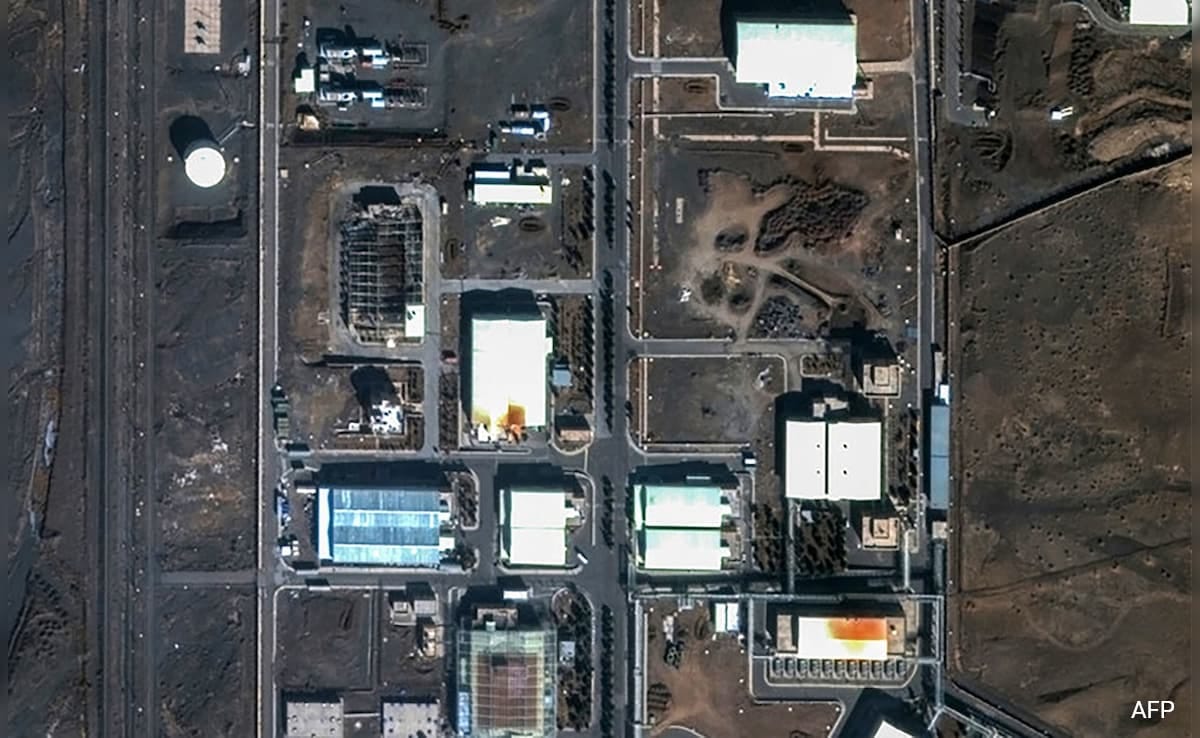 |
| Aerial view of an Iranian nuclear facility |
Labels: Highly Enriched Uranium, IAEA, Iranian Nuclear Program, Israel Aerial Bombardment of Iranian Nuclear Sites, Secreted Away from Inspection, U.S. Bunker-Buster Attack on Fordow
posted by Pieface @ 9:38 PM


0 Comments:
Post a Comment
<< Home