Europe's Russian Threat
"Russia is already a direct threat to the European Union.""[Moscow is spending more on defence than the EU's 27 member states combined, and this year will invest more on defence than [on] its own health care, education and social policy combined.""This is a long-term plan for a long-term aggression. You don't spend that much on [the] military, if you do not plan to use it.""Europe is under attack and our continent sits in a world becoming more dangerous.""Today, against NATO and the EU, Russia doesn’t stand a chance. But we must stick together.""When NATO leaders meet next week, keeping unity in the alliance is as much a priority as spending more on defence."EU Foreign Policy chief Kaja Kallas
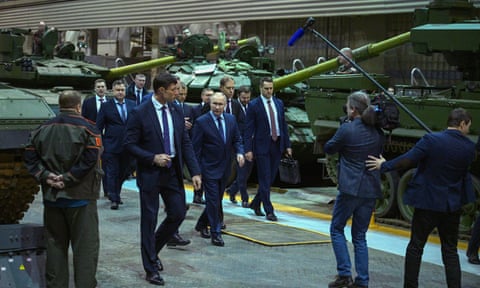 |
| Vladimir Putin during a visit to the Urakvagizavid factory, Russia's largest producer of tanks: Photo: Sputnik/Kremlin Pool/EPA |
Acts of sabotage and cyberattacks by Russia toward members of the European Union have not endeared them to Moscow in their studied opinion of the Kremlin's plans post-Ukraine war. That Russian President Vladimir Putin has overseen a massive military spending spree leads to the conclusion that relations with Russia stand the potential of degrading even further than merely criticizing it for invading and annexing parts of territorial Ukraine. That, if in the final analysis, Moscow achieves at least a part of its territorial aggression in Ukraine, it will continue to cast its malevolent eye on its squirming 'near abroad' seems inevitable.
There is a fairly general consensus among most EU members that Mr. Putin has plans for future use of his armed forces. Its ongoing airspace violations, provocative military exercises and energy grid attacks, on pipelines and undersea cables, represent in their opinion a testing of the waters, so to speak, as well as a deliberate move to deliver a message for the future. No one in Europe, they feel, can feel securely immune from Putin's roving eye and his territorial ambitions to make Greater Russia even greater at their expense.
According to NATO Secretary-General Mark Rutte, Russia is producing weapons and ammunition in three months in a quantity and of technical efficiency rivalling the entire output of the 32 allies combined can produce in a year. Russia, he believes, could be in a position to launch attacks on NATO allies come the end of the decade. Europe is becoming increasingly alarmed over the potential of Russia's capacity for mischief.
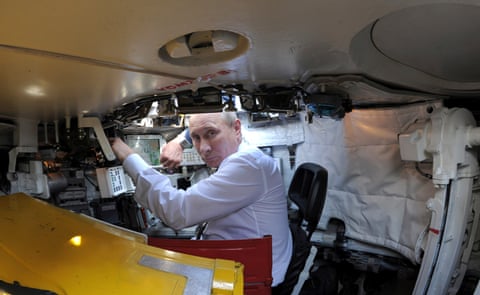 |
| Vladimir Putin sits in a T-90AM tank at the Russian Expo Arms in the Urals city of Nizhniy Tagil in 2011. Photograph: Alexei Druzhinin/AP |
Even to the extent that Russia might wish to test the organization's Article 5 security guarantee, the assurance to its members that should any one of their members come under attack, NATO would act as one in response; the entire 32-member alliance would be committed to militarily defend any one of their members coming under a military attack by an outside source. This is a pact that is taken seriously, presumably acting as a clear deterrent to any member-state of the alliance coming under attack from malign forces.
NATO allies officially recognized that significant and cumulative cyberattacks could be viewed as representing a situation analogous to an armed attack, and as such could lead to an invocation of Article 5. Although that recognition of a prevailing situation was formally accepted in 2021, those same attacks have continued, with the alliance making no move to counteract them collectively. A malign actor perceiving sound and fury but no reaction could very well make their own conclusions based on probing the intent and analyzing the lack of response.
Europe finds itself somewhat rudderless of late, with new realities brought to the fore under the Trump administration in the United States, their foremost sponsor for decades. Reliance on the steady commitment of the United States to guide and direct the alliance has come under the sharp new lens of an altered political environment, leaving Europe adrift in indecision, a quandary propelling it to commit to greater responsibility for the outcomes of its relations with outlier nations.
Europe feels more vulnerable without the assured military canopy of the United States under the Trump administration that blows hot and cold with conflicting positions and alarming statements issuing from the American president. It is learning to fend for itself. Its support for Ukraine in its battle against predatory Russia remains firm, albeit weary; a general feeling of reduced assurance in the precarious position it now finds itself in, makes the alliance both nervous and defiant.
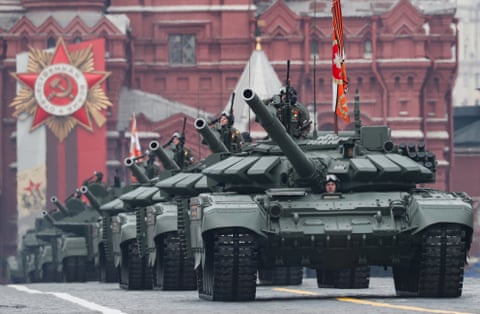 |
| Military hardware in Red Square during Russia’s annual Victory Day military parade in May 2022. Photograph: Yuri Kochetkov/EPA |
"We are very certain, and we have intelligence evidence for this, that Ukraine is just a step on the path to the West.""[Russia's goal is to expand its sphere of influence westward]. They want to catapult NATO back to the state it was in at the end of the 1990s.""They want to kick America out of Europe, and they'll use any means to achieve that."Bruno Kahl, German's Foreign Intelligence Service chief
Labels: European Union, NATO, Russia's Endgame, Russian Invasion of Ukraine
posted by Pieface @ 8:27 PM


0 Comments:
Post a Comment
<< Home