Chinese Domination, Occupation, Deaths by Imperialist Japan
"In contrast, when Chinese people think of the Anti-Japanese War, what comes to mind is a sequence of defeats and desperate endurance rather than decisive victories. The war began with the loss of Northeast China in 1931, when the Northeastern Army withdrew without meaningful resistance. The 1937 Nanjing Massacre followed the fall of the national capital after a brief defense. Even moments of fierce resistance are remembered more for tragic heroism than strategic triumph—the desperate struggle at Changsha in 1941 exemplifies this pattern.""Most painfully, even in 1944, when Japanese forces were already overstretched and facing inevitable defeat, Nationalist armies still suffered devastating losses in the Henan-Hunan-Guangxi campaign (Operation Ichi-Go), losing vast territories including crucial airfields. At the end of the war, Japan surrendered after the atomic bombings and Soviet land attacks, not after a decisive land defeat by Chinese forces.""The onset of the Cold War then rendered moot Allied plans for coordinated occupation, leaving China without even symbolic participation in Japan's reconstruction. China, despite being officially recognized as a victorious Allied power, emerged with a historical memory dominated by suffering endured."Fred Gao, Inside ChinaResponse to Premier Xi's remarks that remembering the war is] not to perpetuate hatred but to awaken a yearning [for peace].""It's a double-edged sword. You're showing people the Japanese being so brutal.""As long as you encourage people to hate another nation, that's the consequences you have to bear."Yinan He, associate professor, Lehigh University, Pennsylvania"China is trying to say that it was a key member leading the establishment of the postwar global order.""And that it has now reached a stage where it is catching up with and overtaking the United States."Shin Kawashima, China expert, University of Tokyo
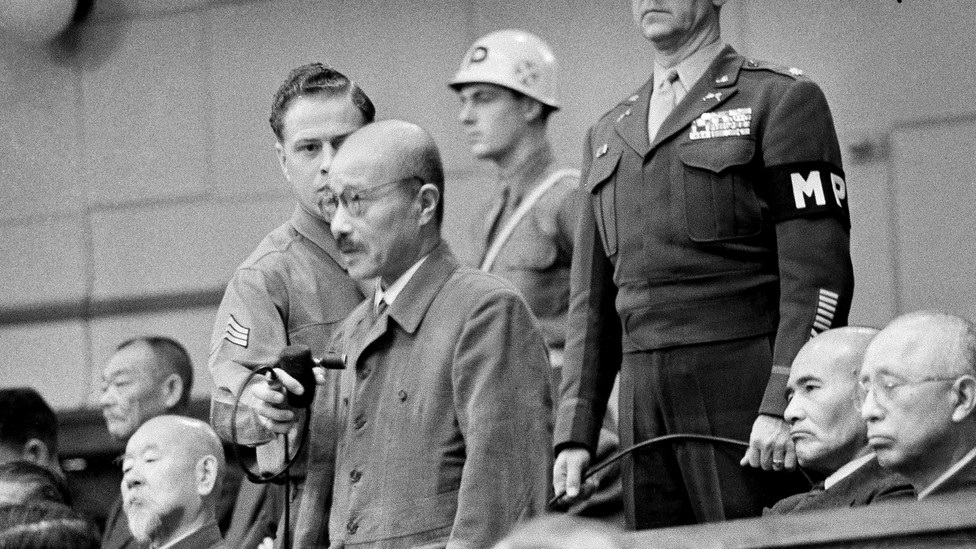 |
| Japanese General Hideki Tojo pleads not guilty during a war-crimes trial in Tokyo in 1948. (Associated Press) |
Multipart specials on military tactics and wartime songs, and the role played by the Soviet Union are being featured by China's state broadcaster. Almost one hundred films related to the Second World War are being played on television channels in China, through to the end of the year. This, apart from the 80th anniversary of the war's end, commemorated on September 3 with a military parade in Beijing headed by Xi JinPing and attended by Presidents Vladimir Putin and Kim Jong un. Featured were fighter jets, missiles and other weapons, an elaborate display of China's military might and power.
"It’s a really important part of the Communist Party’s legitimizing narrative as the leader of the Chinese people.""This is a new nationalism in that it begins to include not just the Chinese proletariat but the whole Chinese nation."Professor Emily Matson, modern Chinese history, Georgetown and George Washington universities
The campaign of recalling Japanese imperialism has, as its final chapter, the rise of China as a superpower on the right side of history. It is also, however, an instrument of Beijing's Communist government to draw public attention in China away from targeting the government for criticism in dissatisfaction with conditions in the country and decisions by the ruling party that have backfired. True, these are events that occurred in a war that killed up to 20 million people in China, where films focus on the courage of everyday Chinese.
Of the films on display the most popular has been "Dead to Rights", about the Nanking Massacre, known familiarly as "Nanking Photo Studio" in Chinese, which has produced some $380 million at the box office, its popularity guaranteeing its extension. "Dongji Rescue" is another generating interest; following Chinese fishermen who rescued over 300 British prisoners of war their Japanese captors had left to drown. The third film of great popular appeal titled "731", alluding to Unit 731, a secret biological warfare program of the Japanese Imperial Army that had conducted horrific experiments on the Chinese.
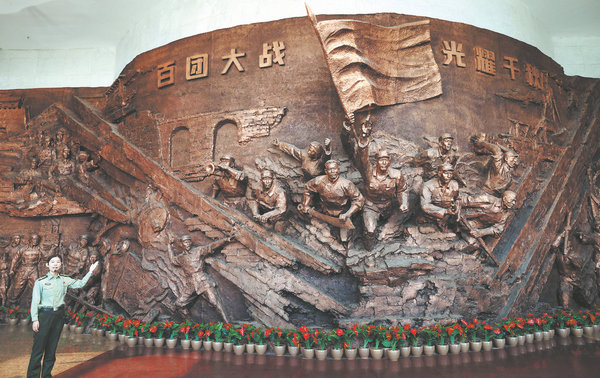 |
| A tour guide introduces the entrance lobby of the Hundred Regiments Offensive Memorial Hall in Yangquan, Shanxi province. [Photo by ZHU XINGXIN/CHINA DAILY] |
These are films representing the latest productions in a long lineup of Chinese wartime films that are, like most such films produced anywhere in the world, partially propaganda, part entertainment with an aim to promote the party's agenda. Earlier wartime movies focused on the United States and the Nationalist Party (the Kuomintang) which governed China before its defeat by the Communists as a main rival, leading it to flee to Taiwan.
As Beijing's relations with the United States improved during the 1980s and 1990s, Japan became a new focus for China and new tensions appeared with Tokyo over Japanese reluctance to admit its wartime atrocities and its efforts to minimize responsibility as a violently aggressive threat during its invasion of China. Over 300 films have been produced altogether by Chinese film studies, focusing on what is known in China as the War of Resistance against Japanese Aggression. Chinese censors are quick to approve these dramas, and the public is receptive.
Social Media discussions have been dominated by "Dead to Rights", sweeping and action-packed, with moviegoers posting videos of their theatre experiences. "For the younger generation, this is far more than a movie. It's a history lesson etched into their lives", wrote Tong Liya, a Chinese actress. There is a thoughtful awareness of the risk involved in the kind of fervor that accompanies nationalism. Japan's Ministry of Foreign Affairs put overseas Japanese on notice to be "especially careful about a rise in anti-Japanese sentiment".
 |
| Female soldiers from the People's Liberation Army stand in formation as they practice for an upcoming military parade to mark the 80th Anniversary of the end of World War II and Japan's surrender, at a military base on August 20, 2025 in Beijing. Image: Kevin Frayer/Getty Images/Getty Images AsiaPac |
There have been voices raised in caution. Questioning whether the movies' purpose is to teach the next generation to hate -- whether children should be watching such violent content. Features such as piles of corpses in streets and the killing of children in "Dead to Rights", that depicts Japanese soldiers gleefully raising bets over who can kill more Chinese. Videos of children destroying trading cards of the Japanese superhero Ultraman have been posted on social media. "I want to kill all Japanese", one little girl says tearfully in one clip.
While encouraging parents to take their children to see the films, State media attempted to urge moderation. Remarks by President Xi have been quoted by outlets, that recalling the war is "not to perpetuate hatred but to awaken a earning" for peace have been highlighted in an effort to ameliorate the aroused emotions that set in when people are exposed to the invariably gruesome aspects of the Japanese invasion and occupation.
 |
| (MA XUEJING / CHINA DAILY) |
Labels: China Remembers, Commemorating Victory in WWII, Imperialist Japan, Inciting Revulsion/Hatred, Propaganda Films
posted by Pieface @ 8:08 PM


0 Comments:
Post a Comment
<< Home