Economist Extraordinaire : Mark Carney for PM to Solve Canada's Economic Woes
 |
"Canada’s federal government has experienced significant fiscal challenges in recent years. The COVID-19 pandemic saw revenues decline and expenditures rise dramatically. Prior to that, the 2009 financial crisis had brought similar shifts, albeit on a smaller scale. But even outside of these extraordinary events, expenditures have consistently exceeded revenues, with the federal government running a budget deficit in each of the past 18 years.""One might naturally wonder what potential paths lie ahead for returning to balance. The present study describes the current state of the federal budget and explores possible paths to balance by 2035. If the budget is balanced at that point, then the string of deficits that began in 2008 would be tied for the longest stretch of deficits ever recorded since 1867.""The scale of the challenge is beyond what many Canadians may appreciate. Returning to balance over this relatively prudent time horizon, while fulfilling Canada’s new international commitments to increase military spending, requires large and fundamentally new approaches to major areas of federal finances that have been mostly absent from public debate. Considering available options sooner rather than later is important, as the longer that fiscal adjustments are delayed, the larger and more difficult they will need to be to ensure the long-run sustainability of federal finances.""Together, these pressures will cause overall federal spending to grow faster than revenues in the years ahead unless policy adjustments are made.""On its current course, Canada's finances run the] looming risk of a 1990s rerun, [falling back to a fiscal position where] debt-servicing costs consumed roughly one-third of federal revenues, and overall public net debt ... was both high and rising, at roughly two-thirds of GDP.""Even if we hold the amount of direct defence spending at two percent of GDP, we still end up with a deficit in 2035 roughly as large as what we're seeing over the next five years."Economists Trevor Tombe/Gabriel Giguere, University of Calgary

A new study produced for the Montreal Economic Institute reports that, should current fiscal policy hold, by 2035 the baseline federal deficit will balloon to $227 billion. The liberal largess over the past decade has lofted Canada's deficit year over year, impacting the federal debt to a point of staggering proportions. Under the leadership of a man whose formidable reputation as a highly experienced central banker, serving as governor of both the Bank of Canada and that of the U.K., his decision to enter politics at the elite level as new leader of the governing Liberal Party of Canada, resurrected that party from its doldrums at the prospective polls, with the unmasking of the inadequacy, profligacy, and errant ideology of Justin Trudeau.
 |
| Prime Minister Mark Carney holds up a copy of the budget as he and Minister of Finance and National Revenue François-Philippe Champagne make their way to the House of Commons for the tabling of the federal budget on Nov. 4, 2025. Photo by Justin Tang/The Canadian Press/File |
 |
In the 2025-26 federal budget, a $78.3-billion deficit was projected, representing the largest such deficit in the history of Canada, COVID-19 pandemic-era aside. The authors of the newly-published study, economists Trevor Tombe and Gabriel Giguere, forecasted federal finances would be impacted hugely in pressure exerted as a reflection of new international commitments to significantly raise military spending, to reflect NATO's latest target of 3.5 percent to be spent by member-states on core defence spending by 2035. That rise in military spending was targeted at 10 percent annually, some $100 billion.
Within the next decade it is anticipated that federal spending will rise by 50 percent for elderly benefits, as Canadians continue to grey and a larger proportion of the population will be above 65 years of age at a time in medical history when people are living longer and more healthily. Add to that health transfers, equalization and debt interest payments where the federal revenue stream will not be expected to match those onerous expenditures (elderly benefits alone projected to rise to $45 B), and more.
"Trimming" elderly benefits to match the rate of economic growth might be considered as one measure to help bring some balance back to the deficit, suggested Mr. Tombe. "It wouldn't be an outright cut. We'd still see elderly benefits grow every single year, but they wouldn't grow more quickly than the GDP". Back when Paul Martin was Canada's Finance Minister under Prime Minister Jean Chretien, and together they embarked on a hugely successful mission to bring the deficit under control in 1998, while musing about senior benefit cutbacks, there was a public outcry from seniors that forced a rethink of that solution.
Reducing regulatory burdens on businesses, Economist Tombe offered, as another deficit-reducing initiative as an exercise in spending restraint to promote economic growth. A 0.5 percent annual increase would result in additional revenue of some $20 billion by 2035, he stated. The last 18 years saw Canada run budget deficits, but it's fairly safe to say that it was only in the last decade, beginning in 2015, when Justin Trudeau became prime minister and the Liberals played fast and loose with government treasury that deficits really began to bloom and boom. And under this new economics-guru prime minister they continue to soar...
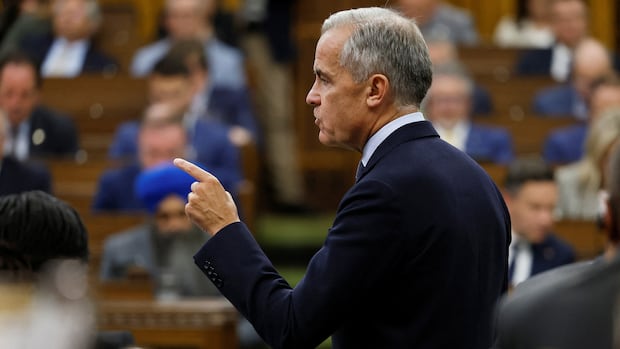 |
| On the first day of a new sitting of Parliament, Prime Minister Mark Carney faced questions about how the fall budget will cover the cost of recent government spending, which has created a ‘substantial’ deficit. Still from video, CBC |
"There are no easy options for balancing the federal budget by 2035. Tax increases alone are certainly not a credible option. To balance by 2035 with no changes in federal spending, and assuming currently planned spending restraint ended in 2029, the GST would need to gradually rise to 12.5% from its current rate of 5%. That is far beyond a reasonable policy option.""Some combination of faster economic growth, revenue changes, substantial reforms to major transfers to persons, and reductions in non-defence direct expenditures will therefore need to be considered in order to correct the current, unsustainable trajectory of the federal debt. The sooner these difficult conversations begin, and the sooner the public understands the challenge and buys into potential options, the lower the cost of those adjustments will be."Paths to Balancing the Federal Budget by 2035, Montreal Economic Institute
Labels: 2015 to 2026, Economic Shock Waves, Epic Deficits, Liberal Governments, Prime Minister Mark Carney, Rising Debt
posted by Pieface @ 8:22 PM


0 Comments:
Post a Comment
<< Home