Ruminations

Blog dedicated primarily to randomly selected news items; comments reflecting personal perceptions

Thursday, April 09, 2026

Economist Extraordinaire : Mark Carney for PM to Solve Canada's Economic Woes


"Canada’s federal government has experienced significant fiscal challenges in recent years. The COVID-19 pandemic saw revenues decline and expenditures rise dramatically. Prior to that, the 2009 financial crisis had brought similar shifts, albeit on a smaller scale. But even outside of these extraordinary events, expenditures have consistently exceeded revenues, with the federal government running a budget deficit in each of the past 18 years."
"One might naturally wonder what potential paths lie ahead for returning to balance. The present study describes the current state of the federal budget and explores possible paths to balance by 2035. If the budget is balanced at that point, then the string of deficits that began in 2008 would be tied for the longest stretch of deficits ever recorded since 1867."
"The scale of the challenge is beyond what many Canadians may appreciate. Returning to balance over this relatively prudent time horizon, while fulfilling Canada’s new international commitments to increase military spending, requires large and fundamentally new approaches to major areas of federal finances that have been mostly absent from public debate. Considering available options sooner rather than later is important, as the longer that fiscal adjustments are delayed, the larger and more difficult they will need to be to ensure the long-run sustainability of federal finances."
"Together, these pressures will cause overall federal spending to grow faster than revenues in the years ahead unless policy adjustments are made."
"On its current course, Canada's finances run the] looming risk of a 1990s rerun, [falling back to a fiscal position where] debt-servicing costs consumed roughly one-third of federal revenues, and overall public net debt ... was both high and rising, at  roughly two-thirds of GDP."
"Even if we hold the amount of direct defence spending at two percent of GDP, we still end up with a deficit in 2035 roughly as large as what we're seeing over the next five years." 
Economists Trevor Tombe/Gabriel Giguere, University of Calgary
https://www.iedm.org/wp-content/uploads/2026/04/figure1economic-note-092026.jpg 
 
A new study produced for the Montreal Economic Institute reports that, should current fiscal policy hold, by 2035 the baseline federal deficit will balloon to $227 billion. The liberal largess over the past decade has lofted Canada's deficit year over year, impacting the federal debt to a point of staggering proportions. Under the leadership of a man whose formidable reputation as a highly experienced central banker, serving as governor of both the Bank of Canada and that of the U.K., his decision to enter politics at the elite level as new leader of the governing Liberal Party of Canada, resurrected that party from its doldrums at the prospective polls, with the unmasking of the inadequacy, profligacy, and errant ideology of Justin Trudeau.
 
https://smartcdn.gprod.postmedia.digital/nationalpost/wp-content/uploads/2026/04/1106-su-a3-federal-budget.su_299708428.jpg?quality=90&strip=all&w=564&h=423&type=webp&sig=v7l8yS5IJLRYJRn15kgZ1A
Prime Minister Mark Carney holds up a copy of the budget as he and Minister of Finance and National Revenue François-Philippe Champagne make their way to the House of Commons for the tabling of the federal budget on Nov. 4, 2025. Photo by Justin Tang/The Canadian Press/File
 
Up arrow

In the 2025-26 federal budget, a $78.3-billion deficit was projected, representing the largest such deficit in the history of Canada, COVID-19 pandemic-era aside. The  authors of the newly-published study, economists Trevor Tombe and Gabriel Giguere, forecasted federal finances would be impacted hugely in pressure exerted as a reflection of new international commitments to significantly raise military spending, to reflect NATO's latest target of 3.5 percent to be spent by member-states on core defence spending by 2035. That rise in military spending was targeted at 10 percent annually, some $100 billion.
 
Within the next decade it is anticipated that federal spending will rise by 50 percent for elderly benefits, as Canadians continue to grey and a larger proportion of the population will be above 65 years of age at a time in medical history when people are living longer and more healthily. Add to that health transfers, equalization and debt interest payments where the federal revenue stream will not be expected to match those onerous expenditures (elderly benefits alone projected to rise to $45 B), and more.  
 
"Trimming" elderly benefits to match the rate of economic growth might be considered as one measure to help bring some balance back to the deficit, suggested Mr. Tombe. "It wouldn't be an outright cut. We'd still see elderly benefits grow every single year, but they wouldn't grow more quickly than the GDP". Back when Paul Martin was Canada's Finance Minister under Prime Minister Jean Chretien, and together they embarked on a hugely successful mission to bring the deficit under control in 1998, while musing about senior benefit cutbacks, there was a public outcry from seniors that forced a rethink of that solution.
 
Reducing regulatory burdens on businesses, Economist Tombe offered, as another deficit-reducing initiative as an exercise in spending restraint to promote economic growth. A 0.5 percent annual increase would result in  additional revenue of some $20 billion by 2035, he stated. The last 18 years saw Canada run budget deficits, but it's fairly safe to say that it was only in the last decade, beginning in 2015, when Justin Trudeau became prime minister and the Liberals played fast and loose with government treasury that deficits really began to bloom and boom. And under this new economics-guru prime minister they continue to soar...
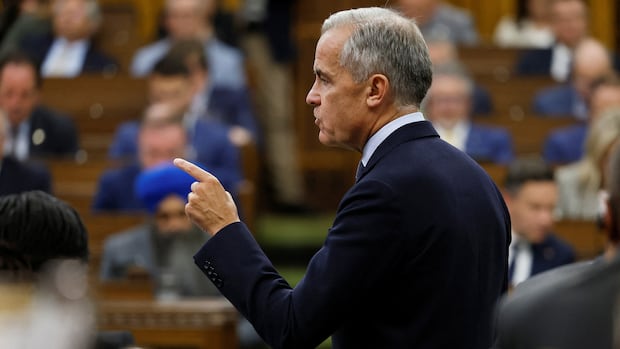
 
https://i.cbc.ca/ais/f24bdc1b-7f32-4e30-b6ef-094b96b3f30e,1757977469132/full/max/0/default.jpg?im=Crop%2Crect%3D%280%2C0%2C1920%2C1080%29%3BResize%3D620
On the first day of a new sitting of Parliament, Prime Minister Mark Carney faced questions about how the fall budget will cover the cost of recent government spending, which has created a ‘substantial’ deficit. Still from video, CBC
"There are no easy options for balancing the federal budget by 2035. Tax increases alone are certainly not a credible option. To balance by 2035 with no changes in federal spending, and assuming currently planned spending restraint ended in 2029, the GST would need to gradually rise to 12.5% from its current rate of 5%. That is far beyond a reasonable policy option."
"Some combination of faster economic growth, revenue changes, substantial reforms to major transfers to persons, and reductions in non-defence direct expenditures will therefore need to be considered in order to correct the current, unsustainable trajectory of the federal debt. The sooner these difficult conversations begin, and the sooner the public understands the challenge and buys into potential options, the lower the cost of those adjustments will be."
Paths to Balancing the Federal Budget by 2035, Montreal Economic Institute

Labels: , , , , ,

Wednesday, January 21, 2026

Tainted, Self-Serving Advice : From the Frying Pan Into the Fire

"[There is danger when middle powers like Canada remain silent or close their economies while] hegemons [and superpowers tear away at the] rules-based international order."
"More recently, great powers began using economic integration as weapons. Tariffs as leverage, financial infrastructure as coercion, supply chains as vulnerabilities to be exploited."
"Middle powers must act together because if you are not at the table, you are on the menu."
"Apply the same standards to allies and rivals. When middle powers criticize economic intimidation from one direction but stay silent when it comes from another, we are keeping the sign in the window."
"A world of fortresses will be poorer, more fragile and less sustainable."
"When we only negotiate bilaterally with a hegemon, we negotiate from weakness. We accept what is offered. We compete with each other to be the most accommodating."
"This is not sovereignty. It is the performance of sovereignty while accepting subordination."
"[Canada is stable, democratic and] a pluralistic society that works".
Canadian Prime Minister Mark Carney
A man speaks into a microphone at a podium.
Prime Minister Mark Carney speaks during the Annual Meeting of the World Economic Forum in Davos, Switzerland, on Tuesday. (Markus Schreiber/The Associated Press)
 
At a plenary session of the World Economic Forum's annual meeting in Davos, Switzerland on Tuesday, Canada's prime minister delivered a speech that should have left listeners speechless at the level of its hypocrisy. This is a man who just visited Beijing, cap in hand, to grovel before Chinese Premier Xi Jinping, none other than one of the two hegemons that Mr. Carney spoke of, yet daintily bypassed naming, lest he raise the hackles of a man with whom he had just signed a trade agreement that would allow 50,000 Chinese-produced EVs into Canada for starters, in exchange for better tariff rates for Canadian canola and hogs.
 
Two men shaking hands and smiling at each other, in front of Canadian and Chinese flags.
Mark Carney — pictured with Chinese President Xi Jinping — reached a 'landmark' trade deal with China on Friday. (Sean Kilpatrick/Reuters)
 
The advanced electronics in those Chinese-made EVs will enter Canada at a new low tariff rate to undersell Canadian-produced gas-powered vehicles, the former more or less dumped as excess production hugely financed by the Chinese state to keep prices low. Each one of these vehicles also represents a listening device, immensely useful to a state known for its cyber-intrusion into other countries' affairs as well as its penchant for illegally lifting trade secrets in technical advances, military and political eavesdropping to keep Beijing up-to-date on everything from production assets to nation security.
 
"Today I will talk about the breakdown of the world order, about the end of a pleasant fiction and the beginning of a brutal reality where the geopolitics of the superpowers is not subject to any constraints", he began his speech. Yet, on behalf of Canada, the Liberal government of which Mr. Carney is head, chose to strike a trade agreement with a clearly hostile-to-Canada hegemon, one which has over the years interfered in Canadian elections, harassed expatriate Chinese-Canadians to act on Beijing's behalf, and invested in universities in 'shared' research projects backed by the People's Liberation Army.
 
Mr. Carney's previous life as a global banker and his executive-level work as vice-chairman with Brookfield Asset Management which has billions in investment in Chinese real estate also means he has a vested interest in trade relations with China, since his contacts there will remember  how he steered Canada back into China's trade orbit, and when he leaves government he can just pick up where he left off, with Brookfield Management. His shares in the massive real estate giant stand to gain value with the decisive trade moves he engages in -- in 'Canada's interest'.
 
https://substackcdn.com/image/fetch/$s_!c7wE!,w_1456,c_limit,f_webp,q_auto:good,fl_progressive:steep/https%3A%2F%2Fsubstack-post-media.s3.amazonaws.com%2Fpublic%2Fimages%2F274cb7e5-0cb8-4c7f-8b45-c5801c833018_770x712.png
Carney, with Brookfield Asset Management, in business with China. March 2024, The Telegraph
 
Speaking in Davis to an estimated several hundred politicians, business leaders and journalists on the first day of the annual gathering, he appears to have impressed his audience. An audience which, like Canada itself, has most recently witnessed the president of the United States of America's whimsical decision-making in imposing stiff tariffs on goods and services from allies and foes alike, aggressively declaring that America will no longer financially support other nations' economies at the cost of its own. For them, his speech resonated.
 
The lack of conscience and immorality of responding to the aggression of one hegemon who has roiled world markets, by choosing to do business with another one that seeks to control world markets after having destroyed production in those markets through the use of their own techniques upgrading China's to produce lower-cost consumer goods isn't being questioned at Davos. Nor that in choosing China as a trade partner its human rights abuses must be overlooked in favour of making deals. 
 
At one time, this former central banker was on the World Economic Forum's top governing body; he knows to whom he speaks. Cautioning his audience against negotiating with superpowers, Mr. Carney revealed the extent of his hypocrisy in his craven submission to Beijing's grasping rules. Other countries, he said, should follow Canada's example to forge new international relations to boost their economies and diversify trading partners. In this way they will be seen as an investment destination. This, from a man and a political party that has closed off Canada's vast natural resources in gas and oil, leading to investment leaving Canada. 
 
Man in long wool coat, suit and tie, inspecting an Asian honour guard after disembarking from a plane on a tarmac.
Carney inspecting the honour guard. It's the first visit by a Canadian PM since China detained two Canadians for nearly three years starting in 2019, in retaliation for the arrest of a Chinese tech executive in Vancouver on a U.S. extradition warrant. (Carlos Osorio/Reuters)
 

Labels: , , , ,

Tuesday, July 15, 2025

What Conflict of Interest?!!!

"That's the largest scope I've ever heard of. I think that they're going to have to get creative to make administration of this screen efficient." 
"This is going to be a new challenge for this institution to monitor in a way that ensures public confidence. Someone in this position with this robust of a portfolio."
"If you have the chief of staff and the clerk watching for 103 different companies ... at all times, they're not going to get anything else done."
"So there's going to have to be a little bit of self-policing on his [prime minister Mark Carney's] part.
"[It is not immediately clear that represents a] disproportionate [interest]." 
Ian Stedman, government ethics specialist, associate professor York University
 
"This screen will prevent me from giving preferential treatment to any of the Companies while I exercise my official powers, duties, and functions as a reporting public office holder."
"I'm complying with all the rules." 
Prime Minister Mark Carney declaration
https://i.cbc.ca/1.7583458.1752268920!/cpImage/httpImage/image.jpg_gen/derivatives/16x9_1180/canada-day-20250701.jpg?im=Resize%3D780
Prime Minister Mark Carney has put his financial assets into a blind trust, meaning he no longer has control over them. (Spencer Colby/The Canadian Press)
 
Canada's new Liberal prime minister who assured the electorate that his extensive private holdings would not interfere with the judgement he is beholden to practise as prime minister, and his conscience was clear that he would perform to the utmost high standard in the office of administering Canada's affairs were he to be successfully elected, has been outed. His previous experience as Governor of the Bank of Canada and of the United Kingdom, his chairmanship of Brookfield Asset Management with its $1 trillion in assets and his multiplicity of board member appointments would never interfere with his political obligations, he vowed.
 
Conflict of interest? Perish the thought! The screen of which he speaks is to prevent  him from involvement in "any official matters or decision-making processes" with the potential to further his pecuniary interests in his investments in the 103 companies revealed to complicate the promises he made pre-election. Mr. Carney's chief of staff, Marc-Andre Blanchard and Michael Sabia, Clerk of the Privy Council are to comprise the 'screen', two high-placed officials tasked with their own onerous duties.
 
During the election, Mr. Carney revealed he had set up a blind trust. "I actually don't own -- directly -- any stocks in these companies". "I own nothing but cash and personal real estate", he assured a doubtful but trusting electorate. Moreover, he stated, he had no financial connection to Brookfield Asset Management any longer and he had no knowledge of the details of what his blind trust consists of that might advance his or the interests of the 103 companies he is engaged with.
 
https://smartcdn.gprod.postmedia.digital/nationalpost/wp-content/uploads/2025/07/Pierre-Poilievre-2.jpg?quality=90&strip=all&w=564&h=423&type=webp&sig=HPr6woCAW4deeJAIjY0TZA
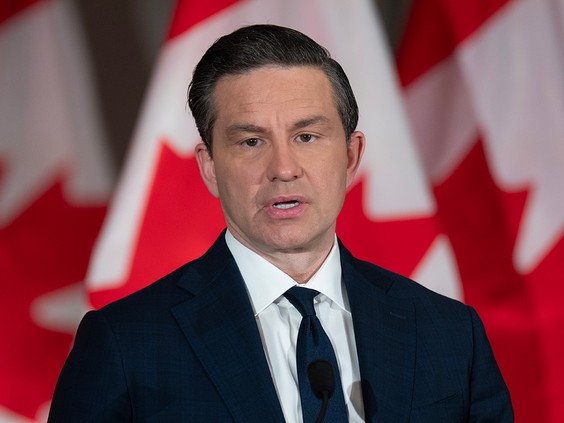
Conservative Leader Pierre Poilievre speaks during a news conference in Ottawa on Monday, July 14, 2025. Photo by Adrian Wyld/The Canadian Press
 
Opposition Conservative leader Pierre Poilievre made quick work of digesting the newest revelations, accusing the prime minister of having committed "numerous falsehoods" regarding his financial portfolio following the ethics commissioner's opinion on a report relating to the conflicts of interest involving no fewer than 103 companies he is financially linked to. Leading Mr. Carney to agree with the commissioner's advice/ruling to establish an extensive conflict-of-interest screen, recusing himself from any discussions involving any of them. 
 
Never before has Canada been faced with a prime minister saddled with such a bevy of potential conflicts. "Mr. Carney was not upfront or honest with Canadians", charged the opposition leader. The disclosure of assets contains 15 pages listing companies, of shares and share options owned by Mr. Carney held in an investment account managed by a third party or divested in a blind trust. Shares of North of 60 Advisors, Stripe, Partners Value Investments, Cultivo Land, Watershed Technology options and deferred share units of Brookfield Corporation and Brookfield Asset Management.
 
The Brookfield annual report reveals that Mr. Carney is entitled to 298,300 stock options and 200,000 options, with a market value of over $6.8 million with an expiration option date 2033 or 2034. Assets held by an investment account managed by a third party include shares from Airbub, Amazon, American Express, Apple, Blackrock, Coca-Cola, Costco, DoorDash, Lockheed Martin, Lululemon, Moderna, Netflix, Palantir Technologies, Pfizer and Uber. 
 
Westinghouse, one of the world's largest nuclear companies, with a majority ownership share acquired by Brookfield Asset Management while Mr. Carney was co-head of the investment fund, is one of the screens the prime minister will be subject to. During a leader's debate during the election, Carney name-dropped Westinghouse in praising nuclear energy; a slip that did not go unnoticed.
 
https://smartcdn.gprod.postmedia.digital/nationalpost/wp-content/uploads/2025/06/Mark-Carney-1.jpg?quality=90&strip=all&w=564&h=423&type=webp&sig=G74v9pKZN0pVTUvB0huHtw
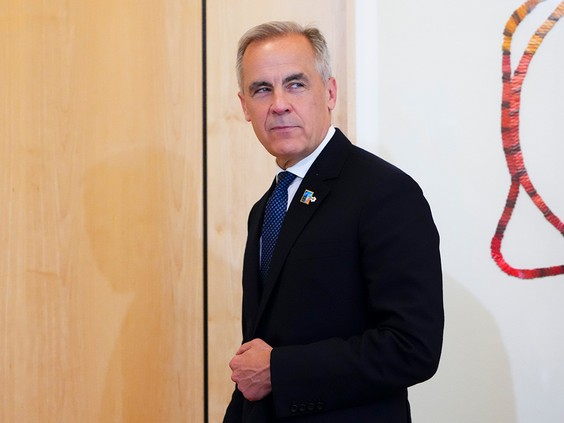
Prime Minister Mark Carney arrives for a meeting during the NATO Summit in The Hague, Netherlands on Tuesday, June 24, 2025. Photo by Sean Kilpatrick/The Canadian Press
 

Labels: , , , ,

 
()() Follow @rheytah Tweet