Deadly Haemorrhagic Fever Outbreak in Democratic Republic of Congo
The latest outbreak of the Ebola virus in the eastern Democratic Republic of the Congo (DRC)—the country’s 17th since 1976—has resulted in more than 1,000 confirmed cases and over 250 deaths. The number of cases has risen faster for this outbreak than any other Ebola outbreak to date. The Red Cross says that the epidemic has not yet peaked and could last a year. The United States Centers for Disease Control projected the outbreak could reach at least 20,000 cases in a worst-case scenario without intervention. Areas at greatest risk are nearby provinces in eastern DRC, neighboring South Sudan, and the border regions of Uganda.The outbreak is concentrated in northeastern DRC, with more than 97 percent of all cases in Ituri, North Kivu, and South Kivu Provinces. Only 19 cases have been reported in neighboring Uganda, and they are largely associated with individuals who traveled from the affected regions in the DRC. Uganda’s public health system has actively responded to the outbreak—both in Uganda and across the border in the DRC—by supporting surveillance, testing, and care.In addition to the lack of a proven vaccine for the Bundibugyo variant, the current Ebola response is particularly challenging because of the region’s remoteness and the ongoing insecurity caused by dozens of armed groups operating in the area. The outbreak is estimated to have circulated within the community for weeks—and possibly months–before it was detected and confirmed on May 15, 2026. Now, public health officials are racing to contain the spread, provide care, trace and monitor contacts, and deploy public health messaging campaigns throughout the region and neighboring countries.Africa Center for Strategic Studies
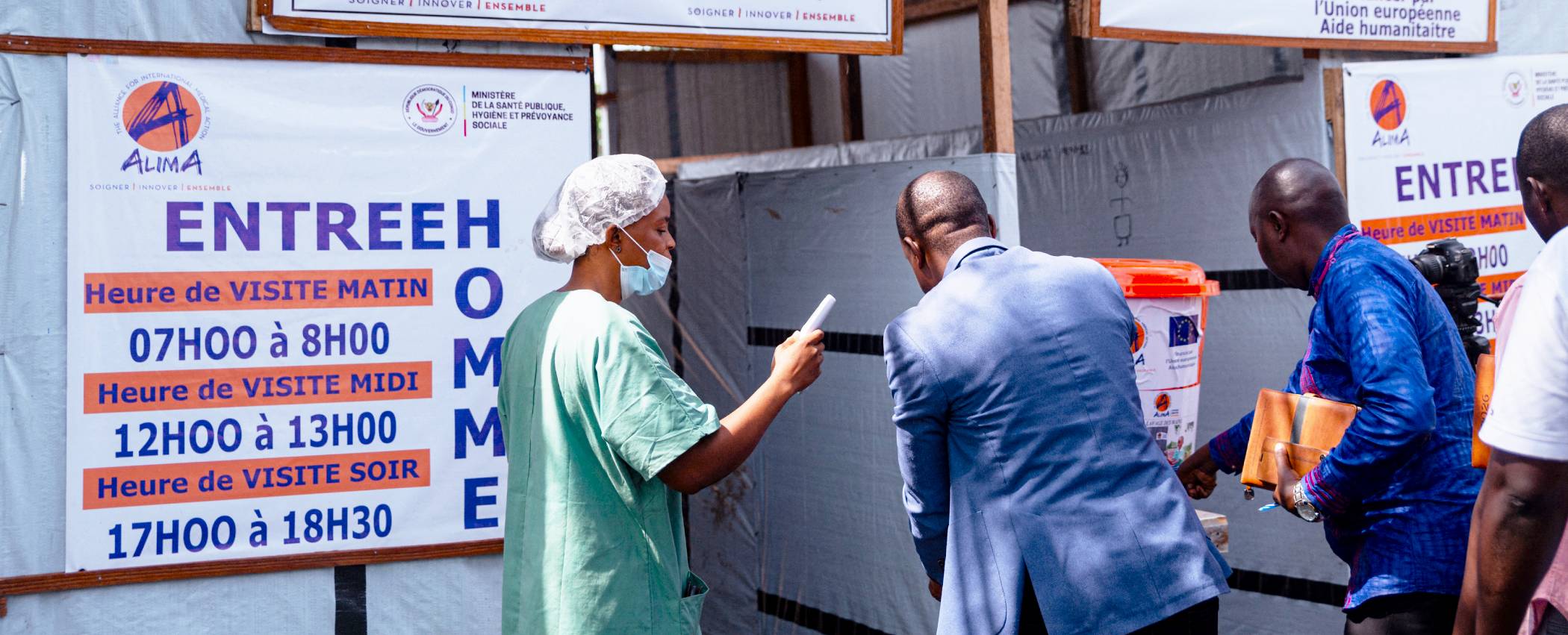 |
| Health officials and humanitarian workers undergo temperature screening and handwashing before entering an Ebola treatment center in Rwampara, Ituri. (Photo: AFP/Jospin Mwisha) |
"[Figures on the number of patients who have recovered and those being treated, as well as deaths, indicate 297 people who tested positive are unaccounted for]. This is a concern that we have. Where are these people?""[30% of new cases are among known contacts of confirmed cases, indicating] huge, huge community transmission.""[Bed occupancy in Ebola treatment centres is at 95% and] we didn’t reach the peak yet.""[Camps in which displaced people were living] have cases, and because we don’t have access to these camps, we cannot have the contact tracing. We cannot have a photo of what’s happening there.""We cannot stop this outbreak, without resolving the humanitarian issue."Dr Jean Kaseya, director general of the Africa Centers for Disease Control and Prevention
In a little over a month after the Ebola epidemic was declared in the Democratic Republic of Congo, over 300 lives have been lost to the virus. Spreading through direct contact with bodily fluids, the deadly viral disease causes severe bleeding and organ failure in many of those morbidly afflicted. Out of 1,115 confirmed infections since its detection as an outbreak on May 15, 304 people have died in the Congo. This represents a mortality rate of 26.3 percent, according to the National Public Health Institute, an increase from the 202 deaths confirmed on June 18. At that time, the African Union's health agency confirmed 875 infections with a mortality rate of 23 percent.
The deadly haemorrhagic fever outbreak has yet to peak and it may continue to wreak havoc for up to a year as efforts to contain it are pursued, cautions the Red Cross. Hopeful news came in the form of an announcement by Congolese authorities in early June that treatment of seven Ebola patients had resulted in a cure for that number. This is the 17th epidemic to wreak havoc on the huge, destabilized central African country. There are no approved vaccines or treatment for the Bundibugyo strain of the virus implicated in this latest Congo outbreak.
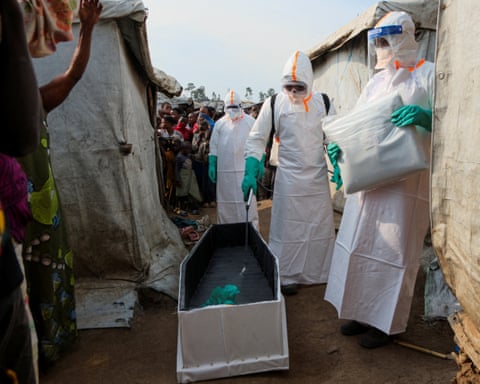 |
| Health workers disinfect a coffin at Kigonze displaced persons camp in Bunia, DRC last week. More than 1 million people live in similar camps to which health workers have no access. Photograph: Gradel Muyisa Mumbere/Reuters |
The situation has been hugely exacerbated by the fact that Ituri, North Kivu and South Kivu, the three outbreak-afflicted provinces in eastern Congo, have been for the past three decades mired in conflict resulting in miss displacement of people. A total of a million people living in refugee camps, many inaccessible to health workers, are vulnerable, given the circumstances. Neighbouring Uganda has employed successful containment measures after the outbreak spread there. Twenty confirmed cases were reported countrywide, including two deaths, since May 15; those infected mostly Congolese nationals travelling to Uganda.
A French-Congolese doctor working in the Congo for the international medical aid NGO ALIMA, became the outbreak's first confirmed case of Ebola outside Africa, France reported. Despite which according to the World Health Organization, there is minimal risk of the virus spreading in Europe, and no need to declare travel restrictions, which still led Air France to suspend all flights for several days to Kinshasa.
The mineral-rich province of Ituri is where the vast majority of Congolese cases have been detected; an area plagued with unrest linked to a bevy of rival armed groups causing frequent population movements. Creating the perfect storm to hasten the spread of the disease where over 91 percent of all infections have been registered in the provincial capital, Bunia, along with over 82 percent of all deaths.
Health care facilities in Ituri lack basic equipment and supplies, including personal protective equipment and chlorine. Clinics organized by the WHO and aid agencies, are close to being overwhelmed by ebola patients. Up to 78 health care workers were infected with the virus, 18 of whom died of its effects. To complicate matters even further, leading to preventable transmission, medical aid workers have been confronted with deep mistrust from local communities.
Families which have demanded that hospitals release the bodies of the deceased, failing to comprehend that even touching the body places them at risk of contamination. In such environments, the readily-communicable virus is set to thrive as it moves from host to victim.
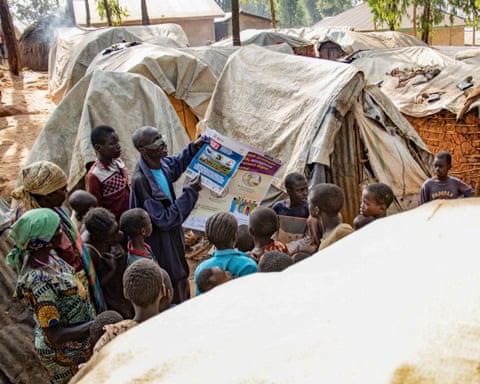 |
| Dz’na Lipe Jean‑Marie, secretary of Kpangba displacement camp in the DRC, holds an Ebola awareness session on 13 June 2026. Photograph: Gradel Muyisa Mumbere/Reuters |
Labels: Congo, Deadly Outbreak, Displaced Persons Camps, Ebola, Haemorrhagic Fever, Infections Among Conflict-Torn Internally Displaced, Ituri, North Kivu, South Kivu Provinces, Uganda, Unstable Armed Gangs
posted by Pieface @ 8:45 PM


0 Comments:
Post a Comment
<< Home