The Endless Flywheel of Nature's Designs
"[Advances made in modeling these tides over the last 15 years have enabled the study's authors to show that] the dissipation is lower than previously expected.""A better understanding of tidal physics and the most advanced constraints we have on mass loss allow us to say that -- in the current state of knowledge -- Earth could move away from the Sun, contrary to what was predicted before."Stephane Mathis, astrophysicist, Paris-Saclay centre, France"Earth's fate depends on a delicate balance between these two effects [increased size of sun's gravitational force pulling Earth closer to the Sun, compounded by oceanic tidal energy pushing the Moon further from Earth].""If tidal interactions predominate, Earth is engulfed by the sun. If the sun's mass loss predominates, Earth escapes into an orbit larger than the radius of its star."Mats Esseldeurs, astrophysicist, University of Leuven, Belgium
 |
| A new lease of life: Our planet may escape a fatal spiral into the exploding fireball of the Sun. Phys.Org |
Up to the present time, and until the publication of a study published in the journal Astronomy & Astrophysics, of which Mats Esseldeurs was lead author, it was thought among astrophysicists that Earth's distant fate into the far future would be its absorption into the sun and thus complete annihilation. An almost-similar fate that has obliterated many stars in the firmament of the heavens over millions of years, as their stars became giants, then red dwarfs and then black holes vacuuming all that surrounded them into the nothingness of their depths.
As huge as our sun is in comparison to the planets in its orbit, its size does not qualify it in that direction. It will ultimately, in the space of five billion years, become a white dwarf, a fireball of a dying star which it was assumed would consume Earth in its quest for energy to sustain itself before expiring. First the Sun must burn through all the hydrogen in its core, following which two immense expansion phases occur; becoming a red giant, and then an AGB star when it has spent all its helium.
An Asymptotic Giant Branch (AGB) star is a late stage in the evolution of low-to-intermediate mass stars
(about 0.8 to 8 times the mass of the Sun). It represents the final
bloated phase of a star's life before it sheds its outer layers and
collapses into a dense white dwarf.
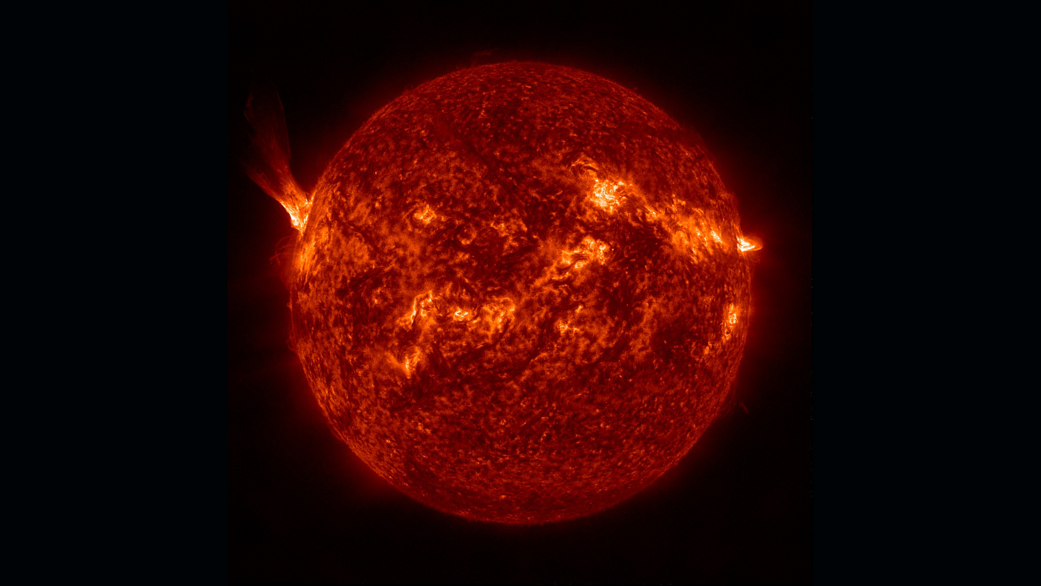 |
| Will the Sun become a black hole? No, it's too small for that! The Sun would need to be about 20 times more massive to end its life as a black hole. NASA |
As the Sun expands there will be significant effects seen on Earth as the Sun's increasing gravitational forces pull the Earth toward it. This force creates the push and pull of ocean tides on the Earth, energy from which dissipates at the ocean bottoms, which in turn slows Earth's rotation, while gradually moving the Moon further from Earth. Intense tidal waves stir within the Sun as it expands and its blistering surface moves closer to Earth. It is when those tides dissipate that Earth would be pulled into the Sun's dying embrace.
On the other hand, due to stellar wind, the growing Sun will also lose much of its mass, pushing planet Earth further distant. The new calculations reached by the authors of the newly-published study, places the initial hypothesis of the Earth being swallowed by the dying Sun in question. These are calculations reliant on relatively simple descriptions of tidal dissipation within giant stars.
The study's authors took advantage of advances in modelling tides over the last 15 years to demonstrate "the dissipation is lower than previously expected", as explained by Dr. Mathis of the CEA Paris-Saclay centre. Mars is also affected by escaping, like Earth a death spiral into the Sun, according to the new modelling. Mercury and Venus, closest to the Sun, are less fortunate. Their fate will be that the expanding fireball will inexorably swallow them both.
Of course, nature's plans can be inscrutable, and even while scientists feel they have achieved a fuller understanding of her formulated designs and the unfolding of the universe as it continues to age into eternity, new discoveries will emerge that will add layers on to what has already been surmised, hypothesized, synthesized and 'proven'. None of us, regardless, need spend sleepless nights concerned over how our lives will change as these forces of nature unfold, other than to marvel at the wonders of a universe that is vast and for the most part unknowable.
 |
| A view of the sunrise from Earth's horizon. Zelch Csaba/Pexels |
Labels: Astrophysicists, Cataclysmic Aging, Earth, Sun, The Endless Flywheel of Nature's Designs
posted by Pieface @ 8:04 PM


0 Comments:
Post a Comment
<< Home