Remembering the 1989 Tiananmen Massacre
"In the very beginning when I arrived in Canada, I didn't think I could be a lawyer again. The worst case is I would not pass [the exams].""I told myself, if some young people sacrifice their future for Hong Kong, why could I not do this? So I was not afraid of being arrested or being injured ... or even dying or having my licence [to practice law] removed. That was my first concern.""I was not afraid because I could not see. If you see the police, they are running toward you, your direct reaction is to leave. But I could not see."Expatriate Chinese-Canadian Joy Luk
 |
| Lawyer Joy Luk at her Markham, Ont., offices, Oct. 14, 2026. Photo by Peter J. Thompson /National Post |
Now 47 years of age, Joy Luk has been blind since birth. Believing while still young that the rights of the disabled should be protected under the law, she had visions of herself becoming a lawyer. In China, she passed law school, obtaining a master's degree in human-rights law. She became an advocate for the disabled while practising general law in Hong Kong. As a resident of Hong Kong she valued the special freedoms that made the city different from the mainland.
Until Beijing decided to cut short the agreement China had made with Britain to retain that special status for Hong Kong reflective of British rule in the colony. Loyal to Beijing, the Hong Kong government of the day proposed a new law to permit extradition from Hong Kong to the mainland, a signal to dissidents and others who professed their loyalty to a democratic regime, becoming vulnerable to a system that would make them outcasts, ending up in China's oppressive system of justice.
It was that legislation that led to the 2019 historic protests when up to a million Hong Kongers flooded the streets in protests. Despite the mostly peaceful nature of the protests, violent clashes with police ensued, leading to a crackdown that served to obliterate most of the traditional political freedoms customary in Hong Kong before it was handed back to China. Blind, or not, Joy Luk joined the maelstrom of dissent giving legal advice to demonstrators.
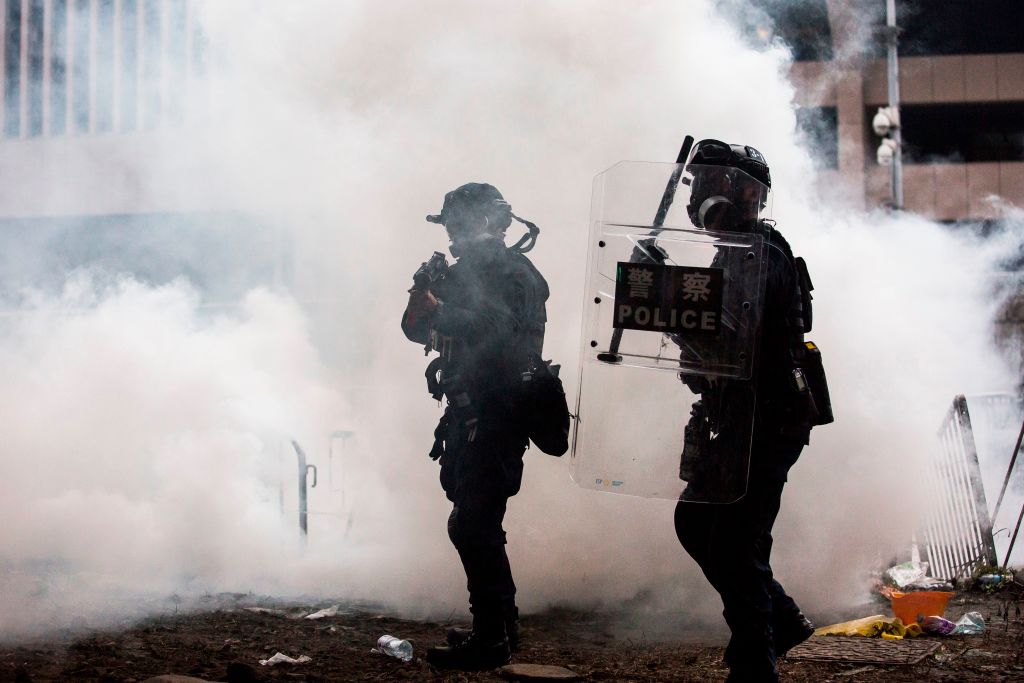 |
| Violent clashes broke out in Hong Kong on June 12 as police tried to stop protesters storming the city’s parliament, while tens of thousands of people blocked key arteries in a show of strength against government plans to allow extraditions to China. (Photo by ISAAC LAWRENCE / AFP) |
Joy Luk's involvement as a blind woman in the protests made her a recognized figure in the movement. "She stood out. Despite all the oppression and suppression by the police, she was willing to stand up front and be counted", narrated Cheuk Kwan of the Toronto Association for Democracy in China. Finally, government forces and the police prevailed, the protesters dispersed, many had been arrested, and the protests came to an end.
The experience Joy Luk recalls was not pleasant in its immediate personal consequences, which saw her home undergoing repeated searches. She was arrested without charges being laid at a demonstration that had taken place in close proximity to a police station. She recalls standing in the street arguing with police to ensure that demonstrators were able to leave before being taken into custody on warrantless charges. On one occasion, police rushing toward the crowd crashed into the blind woman standing at the front, breaking her arm.
 |
| Since April 2019, up to 2 million people came out to protest in Hong Kong Jimmy Lam/everydayaphoto |
Seven years later she left Hong Kong, hoping to spare her parents any further notice from police. Living in Toronto, she still has nightmares of night-time knocking at her apartment door. In Canada, she speaks at commemoration vigils for the Tiananmen Square vigils, of the 'criminalization' of dissent. She has picketed outside the Chinese consulate in Toronto.
In the interim, she succeeded in obtaining a Global Professional Master of Laws degree at University of Toronto, passing bar-admission exams as a blind woman, and now set to practice law in Ontario. She expresses her gratitude at being accepted as an immigrant to Canada and the assistance given her as she settled in. What she finds it difficult to come to terms with is the current federal government's initiatives toward trade relations with Beijing.
"I guess they [Canadian Liberal government led by Mark Carney] are not eager to fight for freedom of the people in Hong Kong and other parts of China under that kind of tyranny.""Because they want to sell some things to China ... ""We are very disappointed by this."Joy Luk
She found help as a newly-arrived immigrant starting life over anew as a blind person with aspirations to practice law again in her new home, with a particular focus on human rights and support for the disabled, though the Toronto Association for Democracy in China. On her arrival in 2021, she was gifted with 18 months of free rent in a Toronto apartment by one of the association's members, while others helped with her living expenses and the legal costs associated with her immigration status.
In 2024 she was accepted into the University of Toronto Masters program and finally sat for the exams for bar-admission. She made use of a computer program that converted the exam text to speech through an electronic voice. "I had to ask AI ... 'Using a blind person's perspective, describe this picture, this figure to me and let me know what it's showing'", as part of an exam question requiring an applicant to peruse an image.
She is now employed part-time at a Markham law firm, north of Toronto. Even with her attention focused on her new life in Canada, she is adamant that the world remember what she and thousands like her fought for seven years ago, in Hong Kong.
"We believe that after several years, if we do not do anything, then people will forget what happened in 2019 [just like the 1989 Tiananmen massacre].""We have no choice but to do something."Joy Luk
Labels: 1989 Tiananmen Massacre, Chinese Expatriate, Hong Kong 2019 democracy riots, Practising Law in Ontario
posted by Pieface @ 8:36 PM


0 Comments:
Post a Comment
<< Home