Immigration: Mark Carney's Smoke and Mirrors
The immigration plan released as part of Budget 2026 raises serious questions about whether the Liberal government is truly committed to reducing immigration.The targets for the next three years remain at 380,000 new permanent resident admissions, which is the same target set last year for 2026. However, the plan indicates that this target is actually just a midway point in projected admissions, which could potentially reach 422,000 each year for the next three years. If so, this level is not considerably lower than the 483,640 individuals who became permanent residents in 2024 or the former targets for 2025 and 2026, which had been set at 500,000 annually in the 2023 plan.But are these numbers telling the whole story?In last year’s plan, the government also included a so-called “one-time” initiative to grant permanent residence to up to 148,000 people already living in Canada (mostly protected persons and temporary workers) during 2026 and 2027. It seems that plan will not, in fact, be a one-off. Last week’s budget included another “time-limited” additional allotment of 200,000 permanent residence spots for people already in Canada by the end of 2027.In that case, isn’t the real number 580,000 permanent residence admissions for next year?Canadians were told that our country would “return to sustainable immigration levels through continued decreases to temporary resident arrivals and stabilized permanent resident admissions.” But when permanent resident admissions, temporary residents, asylum claimants and expanded citizenship by descent are considered together, the picture is considerably more complicated.It appears that substantial population growth remains part of Canada’s foreseeable future. The question is whether the government has a credible plan to ensure that housing, infrastructure, healthcare and public services can keep pace — and whether Canadians have had a meaningful say in how quickly their country should grow.David Thomas, Chair, Canadian Human Rights Tribunal, senior fellow, MacDonald-Laurier Institute
 |
| Photo by Daniel Pereira, via pm.gc.ca |
Canada, incontestably, is a nation that grew through traditional immigration. Its citizens' forbears were born elsewhere than in Canada with the exception of Canada's First Nations peoples. Many of those now in Canada are descendants to the first, second, third and fourth generation. Canada has an immense land mass, the second largest in the world. With its current population of 40 million people, the population is relatively sparsely dispersed throughout its geography rich in plains and mountains, forests and prairies, lakes and rivers, landscapes of transcendental beauty infused with a wealth of massive natural resources.
There was a time in the living memory of many of Canada's oldest generation when immigrants had to depend on their own resources to make their way to a living wage as they began to accommodate themselves and their families to the new prospects for the future that Canada engaged them with, toward prosperity. Canada is now in its modern era, considered a social welfare state in recognition of its universal social welfare programs, where vital social services such as universal health care, welfare and unemployment benefits, assisted social housing, primary education, and other societal benefits are available to its residents.
In the past decade, under two successive Liberal-led governments, Canada's intake of new immigrants, refugees and migrants have far outstripped previous governments' and years of steady immigration uptake which averaged in the 300,000 on an annual basis. In the past decade Canada's population rose steadily at a rate outstripping that of any G7 country, from 36-million to 40-million achieved in several years' acceptance of a million additional people, a rate that proved unsustainable, when the health care system was deleteriously impacted, along with assisted housing, as the general cost of living began to rise critically.
 |
| As Canada's population continues to grow, the country's housing supply has struggled to keep up. (Ben Nelms/CBC) |
In recognition of haste making waste of the country's social services under the weight of an unsustainable number of new residents, the government promised to cut back its intake of new people through a reduction in rates of immigration, refugee and migrant applications, foreign workers' programs and international study visas. Yet the current Liberal government under Prime Minister Mark Carney under the new 2026 Budget proposes to increase the number of permanent residents admitted to Canada. At a time when most Canadians no longer champion a steady stream of new entrants to the country.
In the government's new plans, new permanent residents in 2027 will peak to 657,250 in total. The government's argument is the need for new skilled workers. Despite a rather large rate of unemployment. The trouble is, that while once immigration acceptance relied on a number of prospective factors: education, age, experience, language, health, as well as representing a trade or profession required in Canada, those metrics are no longer in use. As well, each applicant's background would undergo a basic search to assure suitability. Anyone who made false claims on an application would be viewed as being disqualified.
The much more recent immigration intake no longer takes due consideration of those metrics that would benefit Canada by the entrance of individuals who can be guaranteed to be in good health, professionally capable, able to support themselves without government assistance, and in compliance with Canadian values. Moreover, background checks to ensure that entrants into the intake system have no criminal record, are not associated with groups hostile to democracy, were members of governments or police units known to have committed gross human rights violations, or are members of terrorist groups being properly vetted.
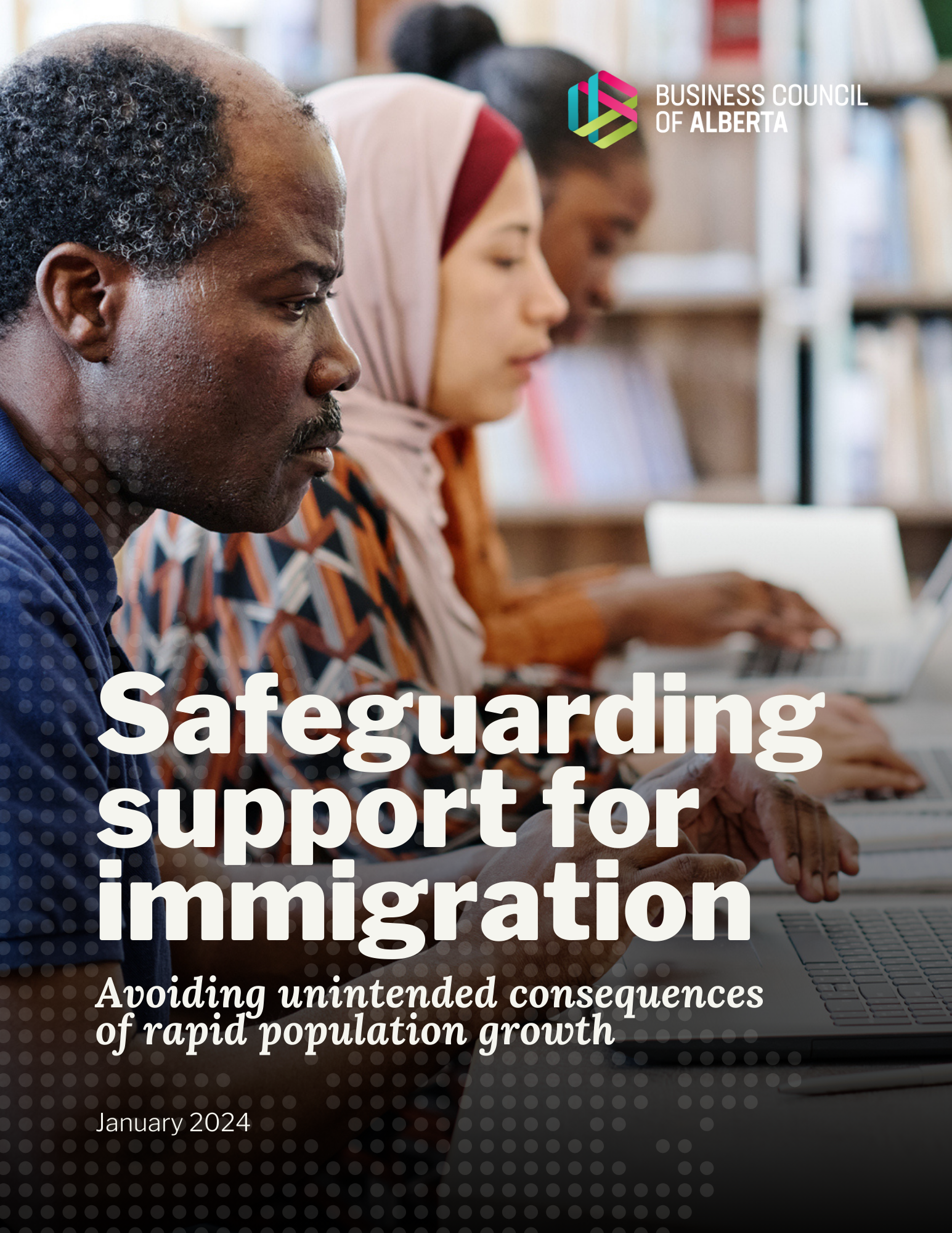 |
| Business Council of Alberta |
Poor vetting in the past decade has resulted in a crumbling health care system, housing and accommodation becoming too costly for most Canadians to afford, and education systems strained to accommodate the needs of non-English and -French-speaking children and their parents. The costs associated with supporting new residents of Canada are massive, considering all the social services now provided, even for migrants whose applications may not be completed for acceptance or rejection for years, reflecting a processing backlog.
The per capita cost of providing health care, education and other social supports according to data from Statistics Canada now totals well over $16,000, exclusive of housing supports, public safety and other measures of government assistance. Although the average Canadian now fully comprehends that the country is at a breaking point in its services provisions, and is no longer supportive of unrestricted immigration, the government itself has not yet reached that point of recognizing the imperative of restraint in its full-throttled continuation of growing the Canadian population.
It is no small thing, when Canada's vaunted 'multiculturalism' enriching the fabric of Canadian society results in a growing population of radicalized ideological groups bringing with them their home country culture of racism and antisemitism, when their weight in numbers feel their entitlement under the Democratic system of protection of free speech, while disrespecting freedom, and a respect for others, organize demonstrations meant to harass, demonize and threaten Jewish Canadians in their own homeland. This government has much to answer for.
 |
| Canadians welcome Syrian refugees to Toronto. (Photo: stacey_newman/iStock.com |
Labels: Health Care Disrupted, Housing Costs Inflated, Immigration, International Student Visas, Migrant Intake, Refugee Intake, Temporary Foreign Workforce, Unsuitable Values for Integration
posted by Pieface @ 8:32 PM


0 Comments:
Post a Comment
<< Home