O, Joy To The World ... Islam On The Move!!
"It's just striking that there was such a dramatic change in a ten-year period.""During this time, the Muslim and Christian populations grew closer in size. Muslims grew faster than any other major religion.""Among young adults, for every person around the world who becomes Christian, there are three people who are raised Christian who leave.""[About 31 percent of Christians are found in sub-Saharan Africa] And that's the result of high fertility, youthfulness and rapid growth in general of sub-Saharan Africa."Conrad Hackett, lead author, Pew Research Center report
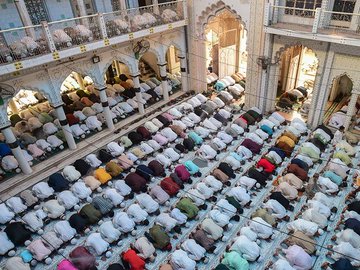
"Our estimates covered 201 countries and territories that are home to 99.98% of the world’s population. We focused on seven groups of people: Christians, Muslims, Hindus, Buddhists, Jews, adherents of all other religions, and people who do not identify with any religion.""Muslims added more people during the decade (347 million) than all non-Muslim religions combined (248 million). In fact, the growth in the Muslim population exceeded the total number of Buddhists worldwide in 2020 (324 million).""As a result of the rapid growth of the Muslim population, the gap between the global number of Muslims and Christians is shrinking. In 2010, Muslims made up 23.9% of the world’s population and Christians accounted for 30.6%. By 2020, Muslims accounted for 25.6% and Christians 28.8%. Growth in the number of Christians was slowed by high rates of disaffiliation."Pew Research Center
According to the conclusions reached by the Pew Research Center, Christianity is fast losing its prominence as the leading world religion. It still holds that position, but Islam is moving up swiftly -- recognized as the world's fastest growing religion -- to take the number one position in due time if matters proceed as they have for the last few decades.
While Christianity's overall numbers across denominations, continued its climb to reach 2.3 billion, its share of the world's population of faith saw a decrease by 1.8 percentage points, to 28.8 percent. This is recognized as a falloff driven mostly by disaffiliation -- people leaving the Church. On the other hand, the Muslim population saw an increase of 1.8 percentage points, to 25.6 percent after the Pew report examined changes in religious demographics, analyzing over 2,700 censuses and surveys.

Growth in Islam was attributed in the report to a younger Muslim population; an average age of roughly 24, while the global average age among non-Muslims was 33 as of 2020, demonstrating the contrast. Higher fertility rates are seen in some areas and lower rates of disaffiliation, in comparison to other religions, including Christianity. Of course, apostasy in Islam is viewed as a crime, one punishable in theory, by death.
 |
| African clergy across several Christian denominations are spreading the Gospel in the West. (Unsplash photo) |
And where traditionally the bulk of Christian belief was prominent in Europe, it has since moved to Africa. There was noted a global rise of unaffiliated people -- those who subscribe to no religion at all. Close to a quarter of the world population does not identify with any religion as of 2020 (24.2 percent in comparison to 23.3 percent in 2010).
China is estimated to hold the world's largest unaffiliated population: 1.3 billion people, out of its 1.4 billion in total population. The United States followed China, with 101 million disaffiliated in a population of 331.5 million. Japan came in third in that category, with 73 million disaffiliated out of an entire population of 126.3 million people.
The sole religion with fewer members in 2020 than in 2010 (324 million and 343 million respectively) was Buddhism, due to disaffiliation and a low birth rate. Populations identifying as Hindu and Jewish saw steady rates within the world's population.

Labels: Christianity Still Leads, Islam Close Behind, Religious Affiliation, World Population
posted by Pieface @ 7:41 PM


0 Comments:
Post a Comment
<< Home