Canada's Gross Mismanagement Under Trudeau Liberals : OECD
"Rapid population growth has exacerbated previous housing affordability challenges. Housing supply should keep pace with immigration targets.""The skill composition of recent immigration, which included many students and temporary workers, has also likely reduced average labour productivity.""[Canada's] GDP per capita growth has lagged in recent years, particularly compared to its close neighbour, the United States.""Canada's population grew rapidly, by 3.0 percent in 2023 and 2.5 percent in 2024. This is much faster than in other OECD countries such as the United States or countries in Europe."Organisation for Economic Co-operation and Development (OECD)
 |
| A Canadian flag is shown near the GM Oshawa assembly plant in Oshawa, Ont. (Carlos Osorio/Reuters) |
A group of 38 countries representing the developed world, the OECD conducts a comprehensive "economic survey" of each of its members, produced by economists from within the OECD every two years, presenting the completed survey to the member-country for its edification. In the latest issue of its survey for Canada, the report was anything but flattering to the way in which the Canadian government under the Liberal Party under the leadership of its former prime minister Justin Trudeau had governed the country. Under that leadership productivity suffered; openly excess immigration resulted in a crippling of the country's universal health care system, and its unaffordable housing stock, all the while doing its utmost to conceal from the Canadian public the state of economic growth in Canada.
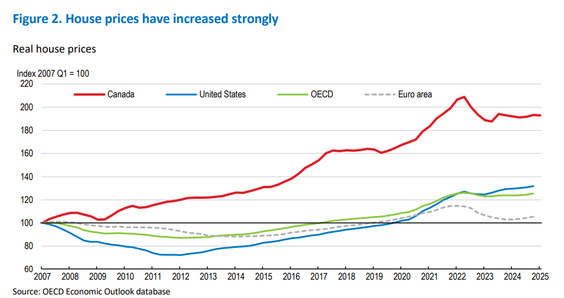
The most recent survey presented to Canada placed a particular focus on housing, goods affordability and worker productivity, areas where the country now ranks with the developing world's most laggardly. Record high immigration was singled out for its effect on worsening the problems. Canada, warns the OECD, has accepted millions of new immigrant workers into its labour force, lacking comparable increases in "productivity-enhancing investment". The stagnant economy that has resulted relates to workers in Canada receiving an increasingly short share of the economic pie in total.
Canada's previous immigration intake system prioritized high-skilled immigrants in professions such as medicine and engineering. In contrast, migration flows now are mostly comprised of low-skilled workers. Statistics have indicated that Canada has become an outlier on housing affordability, placing in the OECD's most recent tally of "price to income" ratio the regrettable situation that identifies Canadian housing to be the highest of all member states other than Portugal.
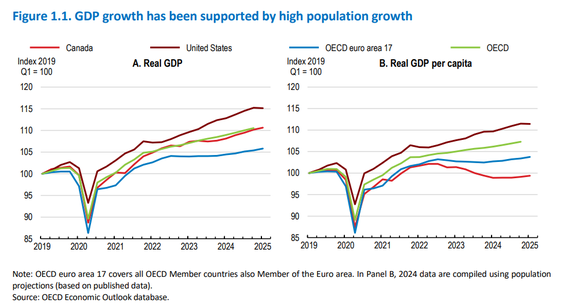
In OECD rankings of gross-domestic-product growth per capita, Canada has been identified as one of the worst performers over the past ten years that correlate with the governance of the Trudeau Liberals. For comparison, GDP growth per capita from 2014 to 2022 was close to three times higher than Canada's in the United States, at 1.7 percent. A note of optimism appeared in the report in its summary with the declaration that Canada's economy is "resilient", endowed with "robust public finances".
Canada's immigrant intake represented a million newcomers absorbed annually. In 2022 the Canadian population was about 38.5 million; three years later it stands at 41.6 million, increased by over three million, judged to be some six times faster than its peers in the OECD where in 2023 the average OECD country grew by 0.5 percent, in comparison. The report confirms as well a phenomenon Canadian analysts have warned of since 2023: that Canada has been in a "per capita" recession for several years.
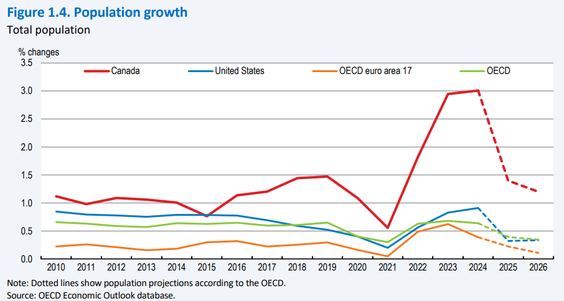 |
| This worked out to about one million newcomers entering Canada each year. At the beginning of 2022, the Canadian population stood at about 38.5 million. Now, it’s at 41.6 million, an increase of more than three million. |
While the injection of three million people appeared to increase GDP, given their impact on the economy paying rent, buying groceries and thus contributing to the amount of money circulating within the economy, on an individual basis the reality is that the average Canadian's wealth and purchasing power has been notably dropping. When ranked by "real GDP per capita", Canada's economic performance falls behind dramatically. The subtitle of the report aptly reads: "GDP growth has been supported by high population growth".
"Inflationary pressures from higher tariffs will require a more cautious approach to lowering interest rates.""Increased government spending, particularly on housing affordability and new social programs, has recently worsened the general government balance, although it had previously been in surplus." Organisation for Economic Co-operation and Development
Labels: Canadian GDP, Economy, Immigration, Labour Productivity, Liberal Government Mismanagement, OECD, Report
posted by Pieface @ 8:23 PM


0 Comments:
Post a Comment
<< Home