A Potential Solution to Offset Dementia Onset
 |
| Pascal Geldsetzer |
"All these associational studies suffer from the basic problem that people who go get vaccinated have different health behaviors than those who don’t.""In general, they’re seen as not being solid enough evidence to make any recommendations on.""Because of the unique way in which the vaccine was rolled out, bias in the analysis is much less likely than would usually be the case.""What makes the study so powerful is that it’s essentially like a randomized trial with a control group — those a little bit too old to be eligible for the vaccine — and an intervention group — those just young enough to be eligible.""It was a really striking finding. This huge protective signal was there, any which way you looked at the data.""The most exciting part is that this really suggests the shingles vaccine doesn’t have only preventive, delaying benefits for dementia, but also therapeutic potential for those who already have dementia."Pascal Geldsetzer, senior study author, assistant professor, Division of Primary Care and Population Health, Stanford University
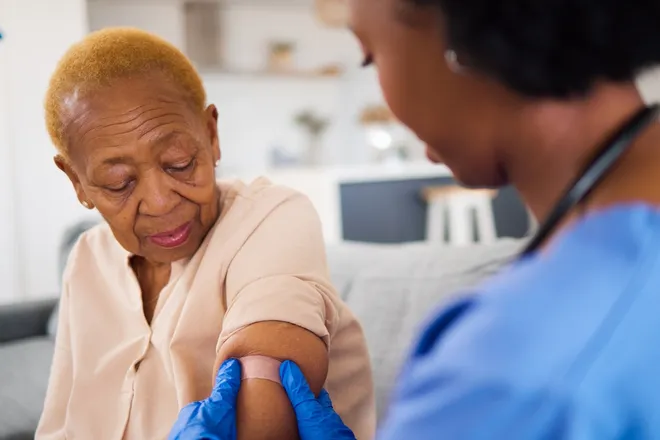 |
| (Image Credit: PeopleImages/Shutterstock) |
"These findings are promising because they suggest that something can be done.""Obviously the vaccine was not designed or optimized to prevent dementia, so this is sort of an incidental finding.""In some ways, we are being lucky."Alberto Ascherio, professor of epidemiology and nutrition, Harvard School of Public Health
Researchers earlier this year reported that the risk of developing dementia can be cut by 20 percent over a seven-year period through vaccination with the shingles vaccine. Shingles vaccination was found by a large follow-up study to protect against risks at various stages of dementia, including for those people already diagnosed with the disease. Published in the journal Cell on Tuesday, the research found that cognitively healthy people who were vaccinated were less likely to develop mild cognitive impairment, an early symptomatic preceding dementia onset.
The study suggest that the shingles vaccine which consists of two doses -- recommended for adults age 40 and older or for individuals 19 and older with a weakened immune system -- may help those who already have been affected with dementia. Over a nine-year period, those who received the vaccine were some 30 percent less likely to die of dementia. Which suggests that the vaccine may slow the neurodegenerative syndrome's progression.
Anupa Jena, a professor of health care policy at Harvard Medical School, and a physician practising at Massachusetts General Hospital who reviewed the paper, remarked that "It appears to be protective along the spectrum or the trajectory of the disease". Researchers are reacting with cautious optimism and excitement over these results.
Maxime Taquet, an associate professor at Oxford University who has conducted research into shingles vaccination and dementia risk, lauded the research, explaining that "If the findings are confirmed, then this would be groundbreaking for dementia. I think there's no other word for it", he went on.
The scientists who conducted the research took advantage of an age cutoff in how Wales rolled out its shingles vaccination program in 2013 to measure dementia impact, in view of the fact that randomized controlled trials -- the gold standard in medical research -- are often unfeasible in the real world. The conclusion that a common vaccine may succeed in protecting the brain represents a bonanza finding.
When Wales introduced the shingles vaccine for older adults in 2013, while those 79 years of age were eligible to receive the vaccine, those who had turned 80 were deemed ineligible. "Just a
one-week difference across this date-of-birth cut-off means that you go
from essentially no one getting vaccinated to about half of the
population getting vaccinated," explained Professor Geldsetzer.
The Wales nationwide electronic health records meant that the researchers were able to study the entire population of Wales born between September 1925 and September 1942, to determine how dementia risk was affected by vaccine status. The researchers' focused analysis on those closest to either side of the eligibility for the shingles vaccine to ensure the study group was as close to the same age as possible.
"We
know that if you take a thousand people at random born in one week and a
thousand people at random, born a week later, there shouldn’t be
anything different about them on average. They are
similar to each other apart from this tiny difference in age. What
makes the study so powerful is that it’s essentially like a randomized
trial with a control group — those a little bit too old to be eligible
for the vaccine — and an intervention group — those just young enough to
be eligible", Professor Geldsetzer said.
 |
| A new study out of Wales has found those who received the shingles vaccine were 20 per cent less likely to develop dementia over the next seven years than those who did not receive the vaccine. (Carsten Koall/Getty Images) |
"If the shingles vaccine really prevents or delays dementia, then this would be a hugely important finding for clinical medicine, population health, and research into the causes of dementia.""There is a growing body of research showing that viruses that preferentially target your nervous system and hibernate in your nervous system for much of your life may be implicated in the development of dementia.""It suggests that from a clinical public health perspective, we should be providing this potentially at early stages, maybe on a regular basis."Professor Pascal Geldsetzer
Labels: 30 Percent Reduction in Dementia Onset, Research, Shingles Vaccine
posted by Pieface @ 7:49 PM


0 Comments:
Post a Comment
<< Home