"Harm Reduction" In Ontario
"You've basically got a doctor anywhere in the province telling a pharmacy somewhere else in the province to go ahead, give this person [hydromorphone] tablets.""It's not medicine. It's just wrong.""[There is] no way [that patients receive adequate care under this] predatory [form of telemedicine]."Dr. Lori Regenstreif, addiction physician, Hamilton, Ontario"Many [clinics] operate virtually, with physicians seeing patients every one to two minutes from within a pharmacy setting ... Pharmacies benefit financially through high dispensing and witnessing fees, while physicians incur virtually no overhead costs.""Urine drug testing is often performed on-site with kits supplied by the pharmacy, further blurring the lines of accountability.""There appears to be no consistent intake process, documentation standards, or clinical guidelines governing these practices."Dr. Janel Gracey, addiction physician, Ontario"It's laziness on behalf of the physician, and it's for financial reasons.""You can see a lot of patients by video link and get a video premium for conducting that service.""[The practice is] dangerous to society."Dr. Martyn Judson, addiction doctor, Ontario
 |
| The term 'safe supply' has been used colloquially by advocates and politicians to refer to the practice of providing people with opioid use disorder alternative drugs that are safer than the street supply. (Ben Nelms/CBC) |
Dr. Judson, as it happens, pioneered Ontario's use of methadone in the 1990s, reasoning that it would inevitably lead to weaning drug addicts away from their harsh addictions. It is the rationale behind most provinces in Canada establishing 'safe supply' prescribing free recreational drugs to addicts with minimal supervision, assuming that riskier street substances would no longer be attractive to those addicted to hard drugs of the opioid family when less harmful drugs were supplied to them free of charge.
This was a 'do-good', 'feel-good' initiative that gained traction as a result of rising overdose deaths throughout the country, when deadly fentanyl began to make an impact, often used by drug dealers as fillers with other drugs. British Columbia, where overdose deaths skyrocketed made liberal use of safe injection sites, believing that handing out drugs without supervision would lower the risk of street drug use, mostly fentanyl. Until reports began circulating that the free drugs were showing up on the street, where those receiving them sold them to finance the more harmful drugs the initiative meant to keep them from.
 |
| People take part in a rally in support of the Drug User Liberation Front after the arrest of two workers in Vancouver on Nov. 3, 2023. (Ben Nelms/CBC) |
The federal government had given its approval to the British Columbia experiment of legalizing all drugs meant for personal use under the safer supply pilot, and then withdrew from and defunded the project when evidence began to accumulate of the pilot's failure. Just as the government of British Columbia itself stepped back from the kind of 'harm reduction' that was fuelling greater drug use, even to impacting a younger demographic for whom the rejected drugs became an introductory course on drug use, at a more affordable street price than harder opioids.
Now, in British Columbia, safer supply doses must be consumed under medical supervision, minimizing diversion. In Alberta, safer supply prescribing is functionally banned. Yet in Ontario little attention is given to the money-making 'electronic pill mills' where some medical practitioners set themselves up as one-stop pill-prescribing agents in an easy approach to over-prescribing drugs to the addicted, in concert with certain pharmacies in coordinated protocols financially beneficial to prescriber and supplier, but deadly to their consumers.
 |
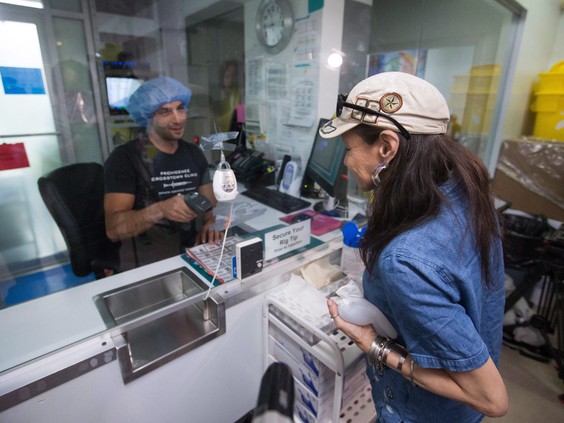
| Nauman Shaikh, a pharmacist and owner of the downtown Medpoint Care Pharmacy, says he's seen positive changes in patients who are prescribed opioids they would otherwise have to buy on the street. (Kate Dubinski/CBC) |
Video booth set-ups at pharmacies operate like confessionals; confess and forgiven. Safer supply in Ontario is being co-opted by tele-prescriptions. Drug users simply enter the premises at will to receive massive opioid prescriptions following several minutes of remote consultation; essentially rubber-stamping requests for drug supply, courtesy of the taxpayer. The user, on having their prescription filled at the pharmacy then is free to sell their drugs on the street for the formulaic transaction of resale funding a more desired drug acquired on the street.
These taxpayer-funded billings enrich both physician and pharmacy. And please the drug user no end for the freedom to dispense of the unwanted drug and alternately shop for the drug of choice. Large volumes of drug users simply pick up their prescriptions and they can be multiple times daily, while pharmacies collect extra dispensing fees to fatten their bottom line. Whereas in responsible addiction medicine, regular physical exams of patients and attention to psychosocial stabilization and recovery are bypassed.
Concerned physicians who treat the drug-addicted, aware of what is transpiring have attempted to report the issue to the College of Physicians and Surgeons of Ontario whose purpose is to regulate doctors operating in the province. Yet despite Addiction Medicine Canada, an advocacy group led by physicians having sent the College formal requests for safer supply reform, there has been no response.
 |
Labels: Corrupt Physicians/Pharmacies, Harm Reduction, Safer Supply Ontario, Telemedicine
posted by Pieface @ 7:52 PM


0 Comments:
Post a Comment
<< Home