India's Winters of Discontent
"Imagine the impact of that on a baby’s lungs. Children are forced to go to school in these circumstances, and even masks aren’t recommended for kids below 12." "We are literally killing our kids." "Our life expectancies are reduced by 5, 10 years, but the government is doing nothing about it. [Three-year-olds at her clinic struggle with a] cough that never goes away." Dr. Vandana Prasad, New Delhi pediatrician
"I want to tell Delhi’s citizens that the government has installed anti-smog guns on high-rise buildings, done dust mitigation with water sprinklers, we are monitoring ongoing constructions.""[However], ten years of damage [presumably by the previous government] cannot be undone in 7 months."Environment Minister Manjinder Singh Sirsa"Effective cloud seeding requires specific cloud conditions, which are generally absent during Delhi’s cold and dry winter months.""Even if suitable clouds were present, the dry atmospheric layer beneath them could cause any developed precipitation to evaporate before reaching the surface."Indian Meteorological Department
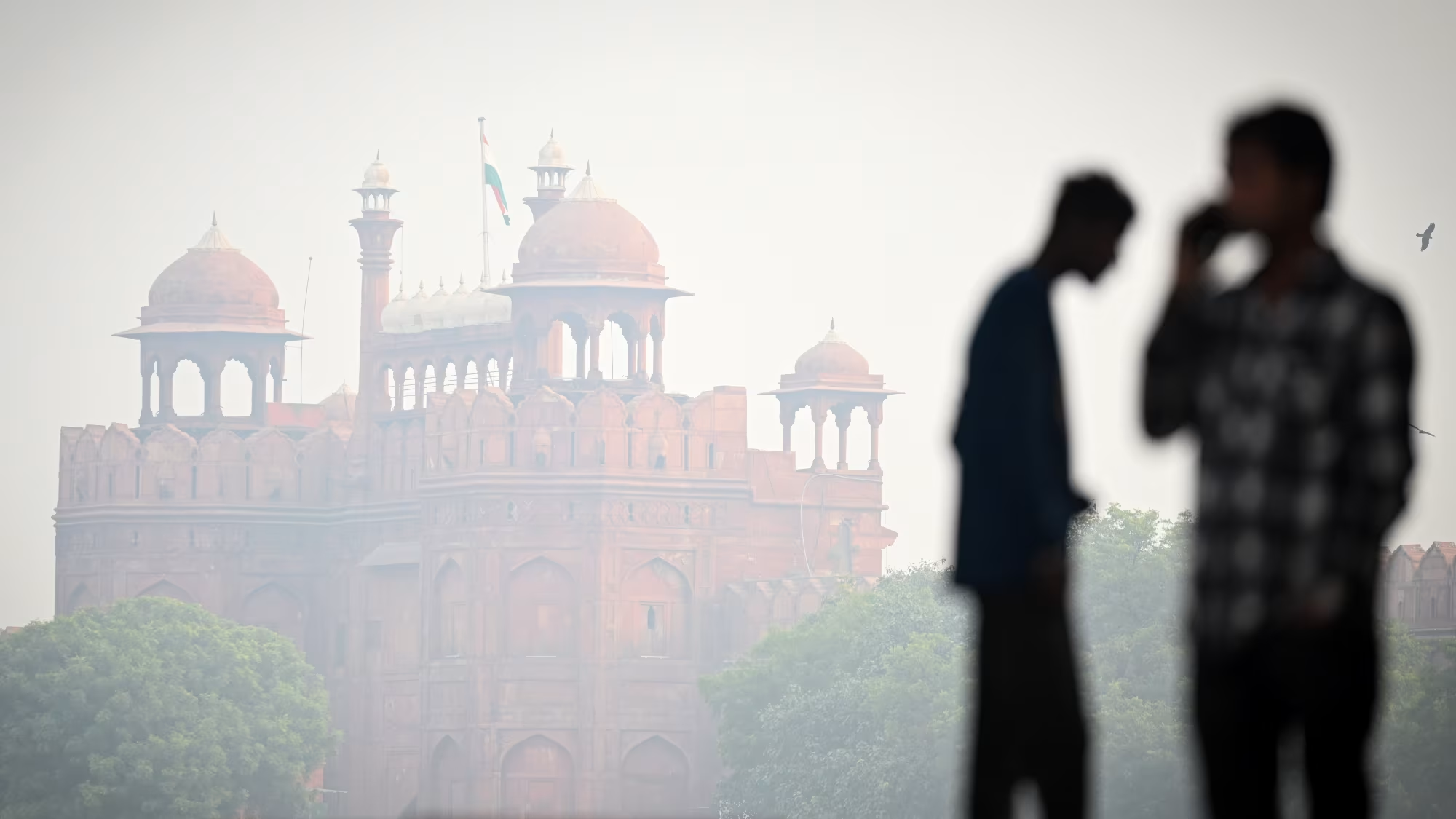 |
| Smog around Delhi's famous Red Fort Reuters |
Public health research groups in India publish statistics to the effect that air pollution may be linked to over 17,000 deaths in 2023 in New Delhi, representing about 15 percent of the city's fatalities in that year. Long-term exposure to air pollution, according to a recent study, may contribute up to 1.5 million deaths annually in the country. When winter arrives after months of stifling 40C summer heat, the cold brings no weather relief to New Delhi. Hundreds of millions of people in India suffer through three long months of suffocating air pollution.
New Delhi has gained the deserved reputation in the past several decades of being one of the most polluted major cities worldwide, wrapped in a dull fog of haze, the toxic odour of smog that burns the throat, suffuses lungs and stings the eyes. Pollution levels in India's capital city are like few others on Earth, each winter bringing anew a health crisis to the 30 million residents of the city. Pollution levels that repeatedly and frighteningly exceed the upper limits of the government's air quality index, becoming excessively health-hazardous when it is over a hundred times what global health authorities agree is safe.
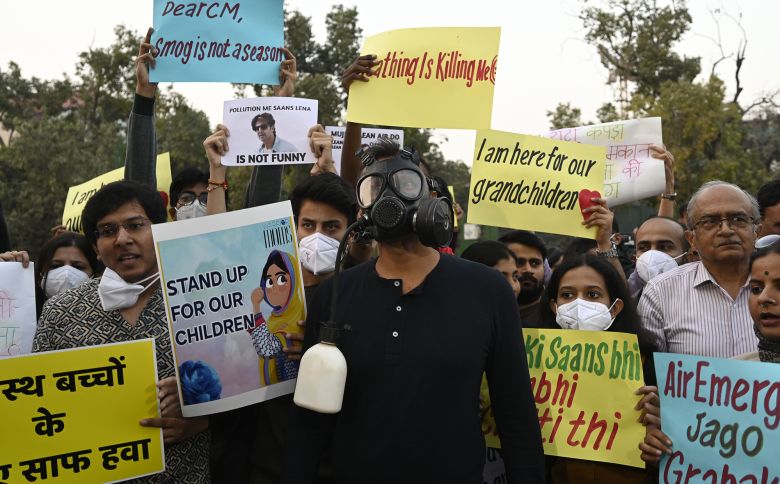 |
And for this first time, fed-up and fearful Delhi residents have launched protests to deliver a message to their government that the situation is unsustainable. That no citizens anywhere should have to live with a menace threatening their health and longevity. The breath-strangling smog forces people to remain indoors; windows closed shut with tape and air purifiers for those that can afford them, humming its tune of reassurance. The worst smog conditions are mornings, with slight clearing in early afternoon, when people break out of their homes in a mad dash to run errands before the resumption of the heavy, cloistering smog.
Those residents that of necessity can afford it, install pressurized clean air systems to create a sealed bubble in their apartments, with some people going so far as to carry with them wherever they go portable air quality monitors measuring particulate matter levels. Most people, however, simply cannot afford luxuries like that, with millions living in substandard housing, where open vents cannot be sealed. They have little choice but to face the outdoors to earn a living.
The wall of the Himalayas prevent polluted air from dispersing, compounding an already serious condition resulting from colder, heavier winter air unable to cope with construction site dust, and the exhaust of millions of Delhi cars making the haze ever denser. And then there is the traditional seasonal burning of crop residue in states nearby, choking the air with fine particulate matter, invading lungs and raising risks of heart disease, lung cancer, strokes and other threats to human health.
The government responds to the yearly winter crisis with sprinklers and water guns in the hope of bringing particulates to ground level where road sweepers go into action, along with dust-control measures for construction sites. A number of emergency response plans contribute their not-entirely-successful methods of tackling the staggering level of polluted air. Yet despite the danger posed by New Delhi's air pollution, citizen concerns first list jobs, inflation, economic growth and coping with soaring prices for consumer goods. Environmental concerns limp in at the very last.
 |
Labels: Critical Health Danger, Death-Causing Smog Conditions, India, New Delhi, Suffocating Environmental Air Pollution, Winter Smog
posted by Pieface @ 8:43 PM


0 Comments:
Post a Comment
<< Home