Statins for High Cholesterol Interacting With Muscle
"Not only do they [statins] bind, they actually drastically alter the function of that protein to a way that can actually cause muscle damage.""And the way we did that [discovered the binding process] is by using a visualization method where we can literally see the statins bind to that muscle protein and see what it does.""We know exactly what parts of the statin are important for inhibiting cholesterol synthesis, and now that we have very detailed 3D images of how the statins bind this critical muscle protein, we actually noticed that the way the statins interact is actually different between the two proteins.""There have been many theories before on why statins affect muscles. None was really proven. And I think there was always a lot of skepticism on what mechanism is really responsible, but I think now seeing it really bind, that's definitely a first."Professor Filip Van Petegem, faculty of medicine department of Biochemistry and molecular biology, University of British Columbia
 |
| UBC Study |
Most people diagnosed with high cholesterol levels where plaque builds up in the arteries (atherosclerosis) resulting in insufficient blood flow -- the result of which, left untreated, can lead to stroke and serious heart conditions -- are advised to change their diets to reflect a healthier food intake. If high cholesterol levels are paired with high blood pressure the risk of serious heart disease developing becomes more acute. Not all people diagnosed with high cholesterol however, owe their condition to diet, but to a genetic inheritance where their body fails to process cholesterol properly.
It is not only low-cholesterol diets that are prescribed for high cholesterol levels, but prescription drugs called statins, which lower cholesterol to reduce the risk of heart attack and stroke. For some people, statins can have a deleterious side effect where muscle pain and weakness can arise; in some cases the muscle pain can represent a tolerable condition, but for many people the severity of weakness and muscle pain caused by statins can be truly life-inhibiting.
A first-of-its-kind study was recently wrapped up and published in Nature Communications that focused on one of the most widely prescribed statins -- atorvastatin. The study was the brainchild of researchers at University of British Columbia and the University of Wisconsin-Madison that resulted in light finally being shed on the cause of this debilitating side effect along, with a pathway to resolve the issue.
For the study, cryo-electron microscopy, a powerful imaging technique
that reveals proteins at near-atomic detail, was used by the researchers, to capture how statins
interact with a critical muscle protein called the ryanodine receptor
(RyR1). A protein whose purpose is to act like a gatekeeper for calcium within muscle
cells, opening precisely when muscles need to contract. The 'gate' is forced open, however, causing calcium to leak continuously when statins bind to it—a
toxic effect that can damage muscle tissue.
Researchers in the study discovered the manner in which the statin binds to a protein essential for normal muscle function. The expectation now is that these findings will assist in eventually creating a category of statins that will not interact with muscle tissue. Over 200 million people globally rely on statins to maintain safe levels of cholesterol. Some 2.8 million in Canada alone. Dr. Van Petegem emphasizes that statins are considered life-saving drugs, in particular for that large contingent of any population with an inability to process cholesterol.
"In those cases, it almost doesn't matter how much cholesterol you take from the diet, your blood cholesterol will be high no matter what. There's no doubt statins save lives. If you have to choose between dying from cardiovascular disease or having muscle side-effects, obviously you should take the statins." The reality is that severe muscle pain can potentially lead to muscle breakdown, kidney failure and death. "In all other cases, it's just a matter of being very careful and following the guidelines", cautioned Dr. Van Petegem.
Dr. Van Petegem's team of researchers are set to begin to compare their research with variants of statins to determine which drugs can be relied upon to protect against high cholesterol while at the same time not complicating the issue with side-effects recognized for their painful side effects.
"We were able to see, almost atom by atom, how statins latch onto this channel.""That leak of calcium explains why some patients experience muscle pain or, in extreme cases, life-threatening complications."Dr. Steven Molinarolo, postdoctoral researcher, UBC department of biochemistry and molecular biology
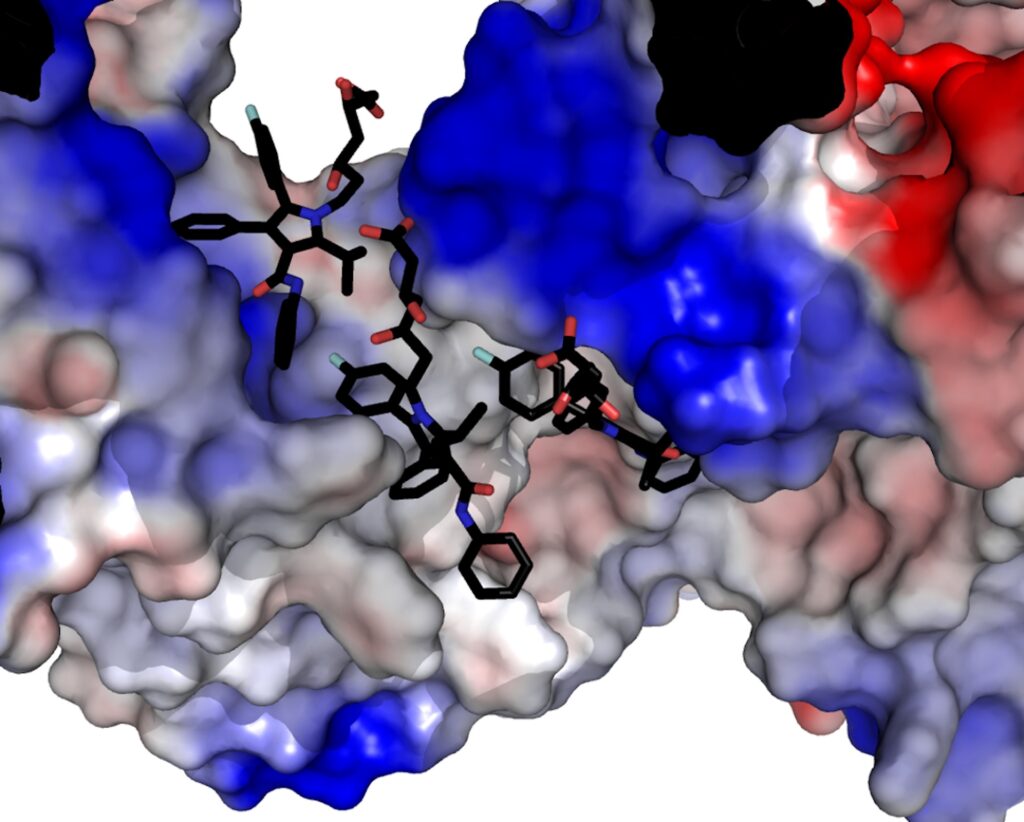 |
| This illustration, based on what researchers were able to observe using high-resolution macromolecular cryo-electron microscopy, shows statin moelcules in black binding to the RyR1 protein. (Source: The Bioelectricity Lab, UBC Life Sciences Institute) |
Labels: Genetically Inherited High Cholesterol, High Cholesterol, Low-Cholesterol Diet, Statins/Atorvastatin
posted by Pieface @ 8:13 PM


0 Comments:
Post a Comment
<< Home