When Cold-Induced Dormancy in Reptiles is Life-Saving
"When temperatures drop and sustain to near-freezing or below, reptiles and amphibians, including non-native green iguanas, can go into a state of torpor, where they temporarily lose muscle control and appear 'frozen' -- sometimes even falling out of trees.""Green iguanas cause damage to residential and commercial landscape vegetation and are often considered a nuisance by property owners.""Iguanas are attracted to trees with foliage or flowers, most fruits [except citrus] and almost any vegetable.""[They can also cause damage by digging burrows that] erode and collapse sidewalks, foundations, seawalls, berms and canal banks."Florida Fish and Wildlife Conservation Commission
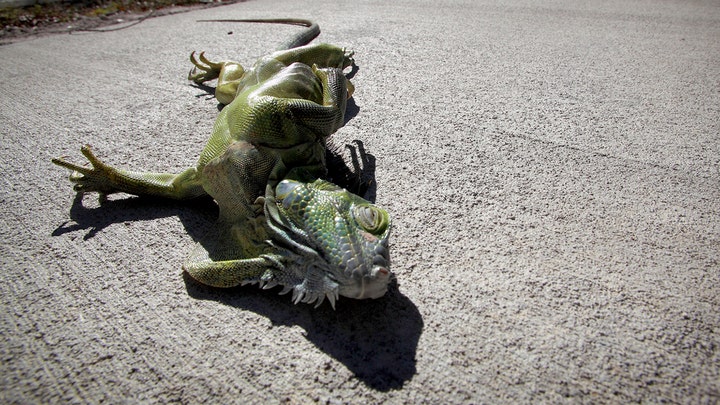 |
Cold-stunned iguanas may look dead, but they're just in a state of shock. (Cristobal Herrera/South Florida Sun Sentinel/Tribune News Service via Getty Images) |
Iguanas nonchalantly clutching tree trunks in Florida are a common sight. Not an unattractive sight by any means. The trees that grow in Florida are themselves out-of-the-ordinary in the view of northern dwellers, the addition of iguanas that have proliferated since the 1960s as 'transplanted' (foreign-'invasive') species of reptiles add an extremely exotic touch. For those people not repulsed by the sight of reptiles, it can be fascinating watching the iguanas as they make their home in the Florida greenscape.
Originally from the temporal range of Central and South America as well as some areas of the Caribbean where they inhabit rainforest canopies adjacent to water sources, all it took for them to spread and adjust themselves to the forgiving climate of Florida was their sales potential for people looking for exotic pets sold through the pet trade in Hawaii, Florida and Texas. The Florida Everglades is trying to cope with a wide influx of Burmese pythons, following a similar route to introduction away from their native habitat.
Now Floridians are being introduced to a new phenomenon, finding iguanas dropping from the trees, appearing dead, as a result of an cold snap, unusual for frigid temperatures below freezing hitting the Sunshine State. Iguanas in trees, clinging to tree trunks with their clinging claws, a fairly normal, unremarkable sight. Those same iguanas dropping from the trees, appearing lifeless marks a startling abnormality.
 |
The FWC says residents can take advantage of Florida's freeze by transporting cold-stunned green iguanas to one of its facilities, no permit required, to be euthanized. (Saul Martinez/Bloomberg via Getty Images) |
Unusual and unwelcome plunging temperatures in Florida have made the difference as Miami, Fort Lauderdale and West Palm Beach have been assailed with record-low temperatures, plummeting to -1C. The most frigid temperatures in 15 years in South Florida. To address the issue of iguanas suddenly becoming vulnerable to the unaccustomed cold, an executive order was issued by the Florida Fish and Wildlife Conservation Commission giving permission to area residents to gather the cold-stunned creatures without a permit to transfer them to five designated FWC offices.
Green iguanas are recognized as an invasive species in Florida. Their presence has "adverse impacts on Florida's environment and economy", according to the Florida Wildlife Commission. Under normal circumstances, residents are not allowed to possess green iguanas without a permit, even for transportation purposes. Those residents who do trouble themselves to 'rescue' the iguanas by taking them to any available FWC facility are enabling their disposal, as they are destined to either be killed humanely or transferred for live animal sales -- presumably to be used as meat for iguana-dining-preparations.
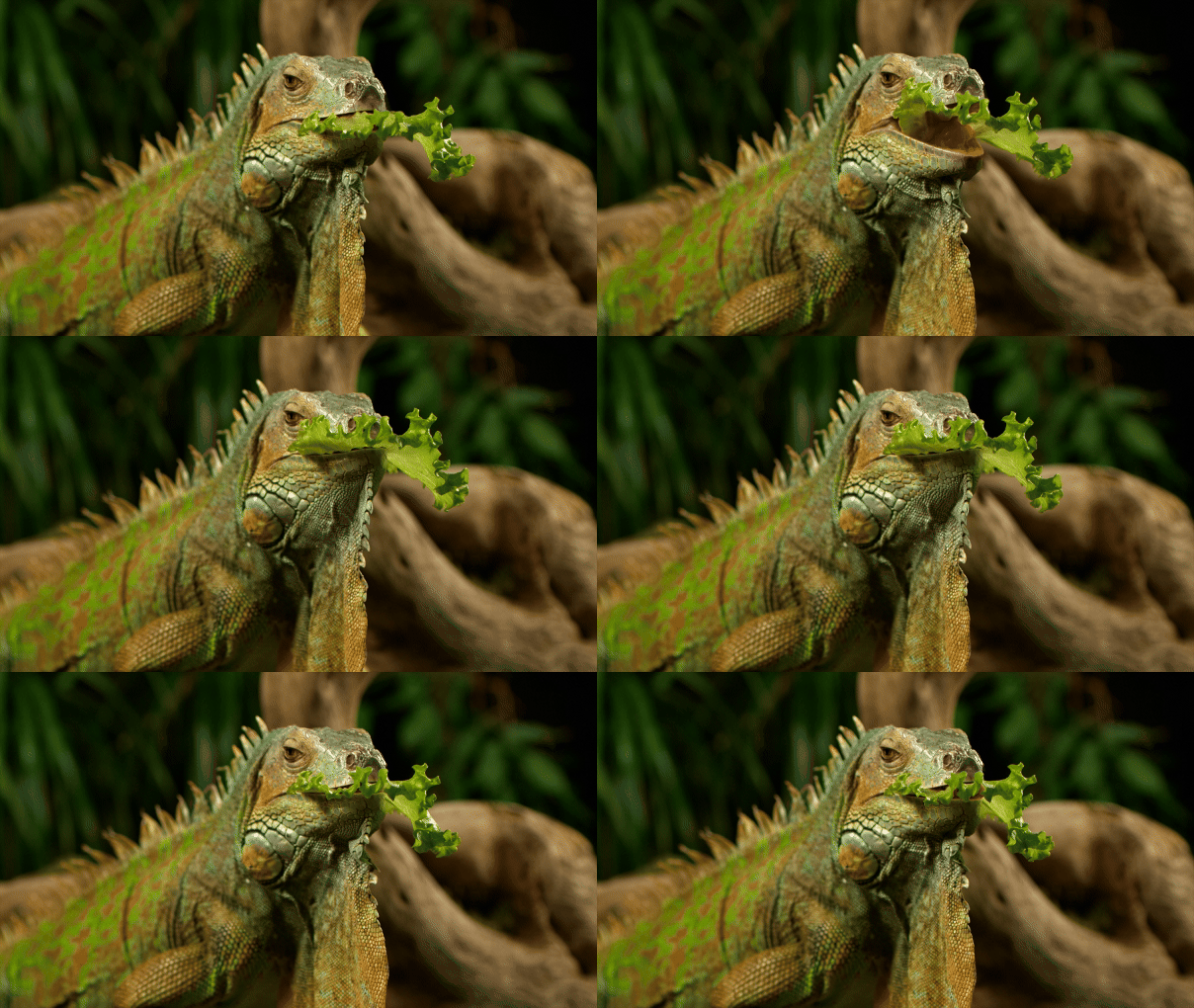 |
| A green iguana enjoys fresh leafy greens. These reptiles have thrived in Florida's generally warm climate. (iStock) |
Iguanas can reach impressive sizes in their maturity. Their life expectancy in the wild is up to ten years, but in captivity (maintained in a zoo or as a pet) they can live up to 19 years. Male iguanas have the potential of growing to five feet in length (including the tail) and can weigh up to 17 pounds. They can swim as semi-aquatic creatures in both saltwater and freshwater. They are able to accustom themselves to living in both rural and urban landscapes.
Ron Magill, Zoo Miami communications director, explains that the reptiles can revert to a lethargic state when temperatures fall below 10C. When nature steps in to provide an alternative state of protection through temporary musculature immobilization (semi-hibernation), to enable them to survive the cold, awaiting the return of more reptile-salubrious weather conditions.
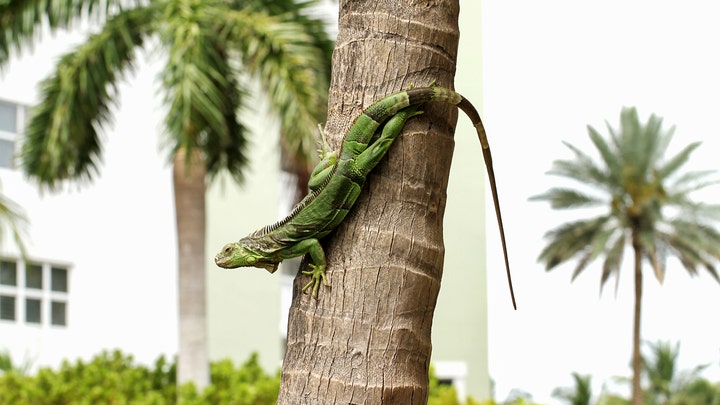 |
Green iguanas are an invasive species that threaten Florida's native wildlife and plants. (iStock) |
"When collecting live, cold-stunned green iguanas for removal, members of the public should wear protective gloves, pants and long-sleeved shirts to protect themselves from potential scratches.""The iguanas must be contained in a secure, escape-proof, cloth sack or bag. Only cloth sacks or bags may be used for primary containment to ensure breathability — and they must be securely closed shut.""Once transport has begun, collection bags or sacks must remain closed or sealed until they are transferred to FWC staff.""This is to both keep the iguanas from escaping into a new location and to prevent the iguanas from getting loose in your vehicle if they start to recover from torpor.""Iguanas can recover from cold-stunning more quickly than you might expect and, once recovered, can act defensively, with long tails that whip and sharp teeth and claws."Florida Fish and Wildlife Conservation Commission
Labels: Cold Snap, Florida, Green Iguanas, Survival Techniques
posted by Pieface @ 7:59 PM


0 Comments:
Post a Comment
<< Home