Blog dedicated primarily to randomly selected news items; comments reflecting personal perceptions
Tuesday, February 03, 2026
When Cold-Induced Dormancy in Reptiles is Life-Saving
"When temperatures drop and sustain to near-freezing or below, reptiles and amphibians, including non-native green iguanas, can go into a state of torpor, where they temporarily lose muscle control and appear 'frozen' -- sometimes even falling out of trees."
"Green iguanas cause damage to residential and commercial landscape vegetation and are often considered a nuisance by property owners."
"Iguanas are attracted to trees with foliage or flowers, most fruits [except citrus] and almost any vegetable."
"[They can also cause damage by digging burrows that] erode and collapse sidewalks, foundations, seawalls, berms and canal banks."
Florida Fish and Wildlife Conservation Commission
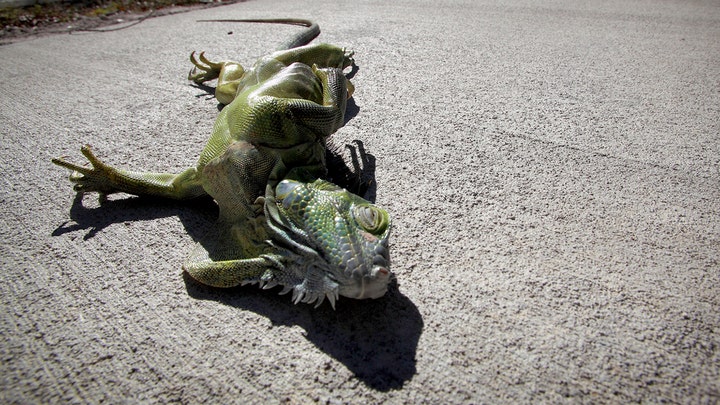
Cold-stunned iguanas may look dead, but they're just in a state of shock.(Cristobal Herrera/South Florida Sun Sentinel/Tribune News Service via Getty Images)
Iguanas nonchalantly clutching tree trunks in Florida are a common sight. Not an unattractive sight by any means. The trees that grow in Florida are themselves out-of-the-ordinary in the view of northern dwellers, the addition of iguanas that have proliferated since the 1960s as 'transplanted' (foreign-'invasive') species of reptiles add an extremely exotic touch. For those people not repulsed by the sight of reptiles, it can be fascinating watching the iguanas as they make their home in the Florida greenscape.
Originally from the temporal range of Central and South America as well as some areas of the Caribbean where they inhabit rainforest canopies adjacent to water sources, all it took for them to spread and adjust themselves to the forgiving climate of Florida was their sales potential for people looking for exotic pets sold through the pet trade in Hawaii, Florida and Texas. The Florida Everglades is trying to cope with a wide influx of Burmese pythons, following a similar route to introduction away from their native habitat.
Now Floridians are being introduced to a new phenomenon, finding iguanas dropping from the trees, appearing dead, as a result of an cold snap, unusual for frigid temperatures below freezing hitting the Sunshine State. Iguanas in trees, clinging to tree trunks with their clinging claws, a fairly normal, unremarkable sight. Those same iguanas dropping from the trees, appearing lifeless marks a startling abnormality.
The FWC says residents
can take advantage of Florida's freeze by transporting cold-stunned
green iguanas to one of its facilities, no permit required, to be
euthanized.(Saul Martinez/Bloomberg via Getty Images)
Unusual and unwelcome plunging temperatures in Florida have made the difference as Miami, Fort Lauderdale and West Palm Beach have been assailed with record-low temperatures, plummeting to -1C. The most frigid temperatures in 15 years in South Florida. To address the issue of iguanas suddenly becoming vulnerable to the unaccustomed cold, an executive order was issued by the Florida Fish and Wildlife Conservation Commission giving permission to area residents to gather the cold-stunned creatures without a permit to transfer them to five designated FWC offices.
Green iguanas are recognized as an invasive species in Florida. Their presence has "adverse impacts on Florida's environment and economy", according to the Florida Wildlife Commission. Under normal circumstances, residents are not allowed to possess green iguanas without a permit, even for transportation purposes. Those residents who do trouble themselves to 'rescue' the iguanas by taking them to any available FWC facility are enabling their disposal, as they are destined to either be killed humanely or transferred for live animal sales -- presumably to be used as meat for iguana-dining-preparations.
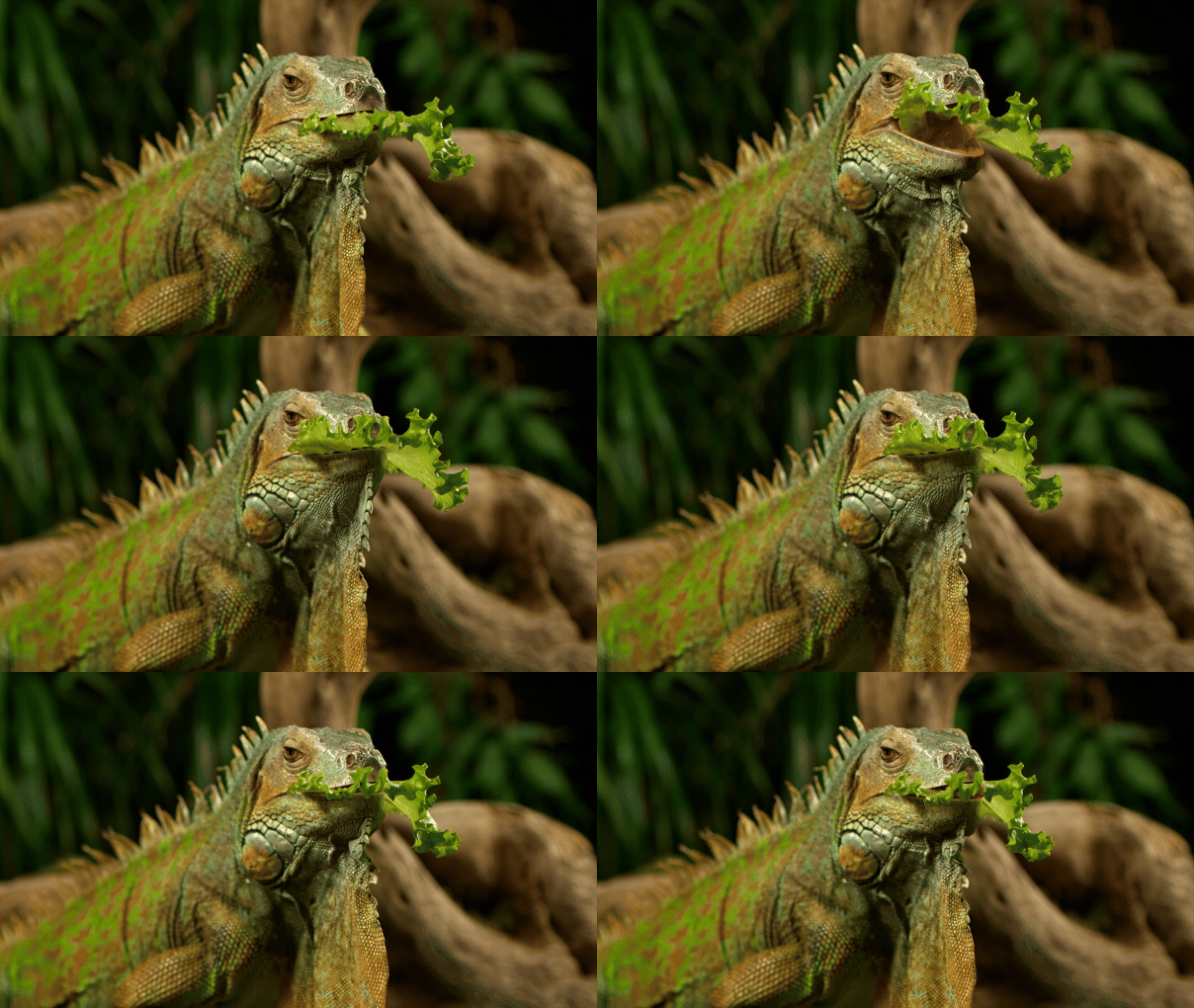
A green iguana enjoys fresh leafy greens. These reptiles have thrived in Florida's generally warm climate.(iStock)
Iguanas can reach impressive sizes in their maturity. Their life expectancy in the wild is up to ten years, but in captivity (maintained in a zoo or as a pet) they can live up to 19 years. Male iguanas have the potential of growing to five feet in length (including the tail) and can weigh up to 17 pounds. They can swim as semi-aquatic creatures in both saltwater and freshwater. They are able to accustom themselves to living in both rural and urban landscapes.
Ron Magill, Zoo Miami communications director, explains that the reptiles can revert to a lethargic state when temperatures fall below 10C. When nature steps in to provide an alternative state of protection through temporary musculature immobilization (semi-hibernation), to enable them to survive the cold, awaiting the return of more reptile-salubrious weather conditions.
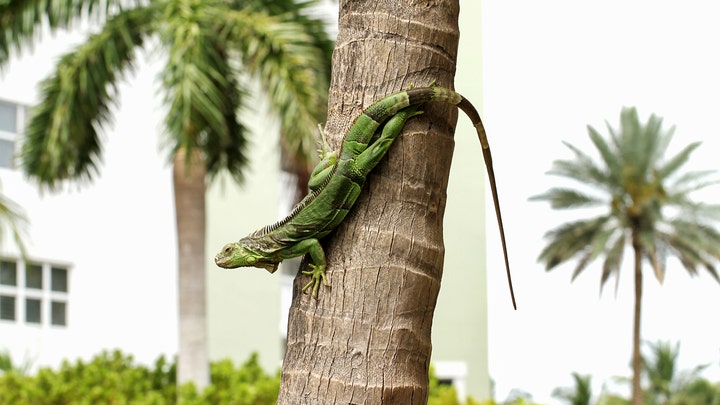
Green iguanas are an invasive species that threaten Florida's native wildlife and plants.(iStock)
"When collecting live, cold-stunned green iguanas for removal, members
of the public should wear protective gloves, pants and long-sleeved
shirts to protect themselves from potential scratches."
"The iguanas must be contained in a secure, escape-proof, cloth sack or
bag. Only cloth sacks or bags may be used for primary containment to
ensure breathability — and they must be securely closed shut."
"Once transport has begun, collection bags or sacks must remain closed or sealed until they are transferred to FWC staff."
"This is to both keep the iguanas from escaping into a new location and to prevent the iguanas from getting loose in your vehicle if they start to recover from torpor."
"Iguanas can recover from cold-stunning more quickly than you might
expect and, once recovered, can act defensively, with long tails that
whip and sharp teeth and claws."
"This is storm debris on a scale Florida hasn't seen in a long time."
"With hundreds of people moving to Florida every day and coastal development off the charts, the combination of that and more intense hurricanes results in this massive problem."
Jon Paul Brooker, director of Florida conservation, Ocean Conservancy
"We have a landfill we're trying to maximize the life of."
"And we don't have that much space in our county to create a new one."
John Elias, director, public works, Charlotte County, Florida
"There's a lot of debris we know is in the water that we can't see."
"Anything that was on the land, you should expect to be pushed, pulled, dragged into the water."
Jason Rolfe, coordinator, National Oceanic and Atmospheric Administration, Marine Debris Program
A view of the overflow debris management site at Maximo Park where
debris from Hurricane Ian collected in St. Petersburg has been taken
over the past month. The city is on schedule to finish debris collection
next week, an administrator said.[ DIRK SHADD | Times ]
Clean-up crews are continuing to work in the removal of "ghost" lobster traps in the Florida Keys that were abandoned over five years ago when Hurricane Irma struck; traps that continue to ensnare and kill marine animals, a special concern of Jason Rolfe. It is imperative that the waste be removed, but of first concern to authorities is digging out homes and businesses, leaving environmentalists to fear that storm waste remaining in the water could damage sea grasses and fragile habitats in the shallow coastal waters of the state.
Hurricane Michael inflicted heavy damage four years ago, leaving Florida's Bay County in the position of still pulling debris and broken-down boats out of their waters today. An estimated 2.4 million pounds has been removed from their bays. "We are still cleaning up". Country Manager Bob Majka confirmed.
When Hurricane Ian slammed into the southwest Florida coast almost two months ago it destroyed thousands of homes, taking over 100 lives and leaving state and local governments to wrestle with the conundrum of how to manage a staggering amount of storm debris. Mountains of refuse sit at dozens of temporary sites throughout the state. The debris is comprised of fallen trees, mildewing carpet, sodden drywall and allied household items the storm destroyed.
State officials estimated that in the past seven weeks crews removed about 20.4 million cubic yards of debris. That's a huge amount of waste, but millions more litter the state. Hurricane Ian is estimated to have left close to 31 million cubic yards of debris. according to the Army Corps of Engineers. Representing about five times the amount of storm debris left by Hurricane Sandy in New York.
Efforts at cleanup in Florida's coastal cities and counties hit hardest by the Category 4 storm is expected to take months of hard work, at a cost of billions. Following Hurricane Nicole's east coast hit as a Category 1 hurricane on November 10th the enormous clean-up became even more challenging. Beachside homes were toppled into the sea, leaving others uninhabitable when the November storm lashed Daytona Beach; for which no estimate of damage has yet been determined.
In 2017, after Hurricane Irma swept Florida, major damage was left in the Florida Keys, causing about two-thirds of the residents to lose power across the state and leaving close to 29 million cubic yards of debris. Hurricane Michael the next year created close to 33 million cubic yards. Science indicates that these costly disasters will continue to grow in number as sea levels rise and waming waters cause hurricanes to gain rapid strength prior to roaring ashore.
Because of its shallow water table and potential for makeshift landfills leaching contaminants into groundwater, there are particular challenges Florida faces. "Where are we possibly going to find room for all this [debris]?", asks University of Florida professor of environmental engineering, Timothy Townsend. When damaged drywall from flooded homes reaches landfills, he points out, the wet gypsum mixes with bacteria that produce hydrogen sulfide gas. Not only does it stink like rotten eggs, the toxic gas can trigger headaches and nausea and cause health problems for people with asthma.
"I've got a serious situation here. My pilot has gone incoherent."
"I have no idea how to fly the airplane. [Position?] I have no idea [but I can see the Florida coastline]."
Unnamed passenger
"I just told him to make shallow turns and slow descents and I brought him into Palm Beach International, because we had the biggest runway around there."
"I just tried to give him a nice stable approach and try to keep him calm. He said: 'I don't know how to stop this thing if I do get it on the runway'. So I said don't worry about it, we'll take it like one step at a time."
"He stayed really calm and I just kind of talked him through everything. I said: 'When you get in closer to the runaway, it's gonna get bigger. And that's when you want to start really reducing your power'."
"And the plane just landed and he said, 'OK, how do I stop this thing'?"
Robert Morgan, air traffic controller, certified flight instructor, Florida
The pilot was taken to hospital, and the passenger safely made it off the plane
He had no previous flying experience, but this passenger of a small plane whose pilot had suddenly collapsed, now can claim he had the kind of flying experience that few other people would ever have. He landed a light aircraft as a passenger, not a certified pilot. A passenger anxious to get home to his pregnant wife in Florida flying in from the Bahamas. Lucky for the man, confronted with quite the existential dilemma, an air traffic controller, whose calm seemed equal to his own guided him in the Cessna 208 into Palm Beach International airport.
The unnamed passenger had the good sense to call the control tower to explain his plight. When the passenger relayed the little identifying and location information he was able to as a neophyte all-of-a-sudden-passenger-to-pilot in distress, the air traffic controller printed out a layout of the cockpit to use as a navigating guide in aid of guiding the passenger in an extemporaneous lesson on how to utilize the plane's levers and switches.
Other pilots in the listening area heard this peculiar exchange. "The level of difficulty that this person had to deal with in terms of having zero flight time to fly and land a single engine turbine aircraft is absolutely incredible", commented Justin Dalmolin, a JetBlue pilot whose takeoff was delayed as the Cessna Caravan landed. "You know it's nothing short of a miracle and I'm really glad for them and their families that they had such a great outcome."
Up o 14 passengers can be carried by the plane. To be able to fly it with a reasonable level of assurance, would normally require intense pilot training of at least several months' duration. When the plane reached the ground, the unconscious pilot was transferred to hospital; the reason behind his medical emergency was not released immediately. For the sudden-plane-flying passenger there was a transition back to being a mere passenger and he had to clear customs.
"He just sent me a big hug. He said: 'Thank you so much' and I said, 'Man, I'm just glad that you're O.K.' It was an emotional moment."
"He said that he just wanted to get home to his pregnant wife, and I felt even better because I knew he's got a family and everybody is counting on him to be there."
Robert Morgan, air traffic controller, Florida
A passenger who successfully landed a plane traveling from the Bahamas
to Florida after the pilot passed out is pictured, right, with Robert
Morgan, an air traffic controller who helped guide him during the flight
"We're just not doing this really well. Why is it that Canadians have to travel, or can travel, to the United States to get vaccinated? There's something fundamentally wrong with this."
"You can jump the queue. That's what this is all about. Instead of waiting here in Canada for God knows how long, I could go down to Florida and get vaccinated."
Jeff Lerner, 65, Toronto resident
"My biggest concern is not the plane or getting COVID on the plane, my
worry is access to the hospital down there once you're there for the
things that always went wrong and that's why you bought travel insurance
-- broken hips, car accidents, stroke, heart attack."
"There has been an uptick no question, and every day is even more. [The slow pace of vaccine rollout in Canada has made a] very interesting alternative [for seniors]."
"I see people now going down because they're being influenced by their
friends who have been down there since November, and this is the final
incentive they needed to go down there and get the vaccine. To them,
that's all that matters at this point."
"Imagine if you were down there and then for whatever reason an allergic
[reaction] or something just didn't jibe, you end up God forbid in a
hospital bed and it's linked to the fact that you had the vaccine, you
could be out a lot of money."
Toronto-based travel insurance broker Martin Firestone
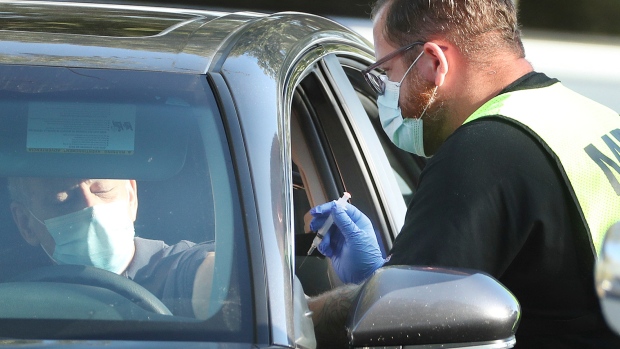
A
healthcare worker with American Medical Response, Inc working with the
Florida Department of Health in Broward administers a Pfizer-BioNtech
COVID-19 vaccine at the John Knox Village Continuing Care Retirement
Community on January 6, 2021 in Pompano Beach, Florida.Photo by Reuters
Florida has a population of 21.4 million people, and presumably that number swells with the influx of foreign visitors, all seeking the sun and sand beaches that Florida is famous for. Visits, particularly from the U.S.'s neighbour to the north are numerous, all the more so during the winter months, when senior citizens from Canada become 'snowbirds', regularly flocking to Florida to escape the cruel, long and cold Canadian winter. Many among them are the proud possessors of property in Florida, many more time-shares, and others are happy to enjoy the climate at rental units.
For many retired Canadians the annual southward journey is vastly preferable to remaining at home; a change of scenery, a change of environment, a life pick-me-up, among the communities of other Canadians. For Florida it's an annual cash infusion, welcoming the yearly migration. Last year, when the SARS-CoV-2 virus struck North America, Canadians abroad were urged by their government to hurry back home. Florida was in the throes of an infectious disease that had made less of a mark in Canada, and no one knew what further to anticipate.
As of January 6 during the second wave, Florida had its act together, was inoculating its population, giving out 323,000 doses, among them 114,000 people age 65 and over. Ontario's population in contrast is 14.5 million and the province has managed to administer 42,000 shots in the like time frame. The Government of Canada, while lauding itself for having placed on order far more vaccine doses than its population could conceivably use, has received thus far a rather inadequate number of doses, which it has doled out to the provinces taking into account their population numbers.
Unaccountably, the provinces appear to have thought better of hoarding the doses rather than immediately using all available to inoculate their most vulnerable demographics. And though fewer than a quarter of the large number of Canadians (900,000) who normally travel to spend the winter in Florida plan to this year, those who do anticipate they will be eligible to receive free vaccinations there, long before inoculations are due to be rolled out in Ontario. No one really knows when the serious rollouts will occur in Canada, transparency has become a little-used virtue of late, replaced by inertia and confusion.
According to recent media reports a number of elderly Canadians have travelled to their secondary residences in Florida, specifically for the purpose of being vaccinated. They are required to show identification but it appears a Canadian driver's license will do, oddly enough. Florida has targeted the elderly for inoculation and began their program a week ago. Many Canadians make in-advance appointments for their vaccinations, then travel to make the line-up, and plan to remain for the second shot, a matter of around three weeks
One man who was interviewed allowed as how he was "appalled and disappointed that I had to jump on an airplane to get vaccinated". According to Stephen Fine, president of online information hub Snowbird Adviser, half of the almost one million Canadians who travel to secondary residences abroad go to Florida, the most popular destination, before Arizona and California. The rules relating to who can be vaccinated in any state or county are largely unknown as yet. There is a certain risk involved in boarding a plane without knowing whether one qualifies for vaccination as a non-resident.
Local policies, he points out, with respect to vaccine distribution has the potential to change with little advance notice. "Frankly", said one Canadian who had been vaccinated in Lee County, "I feel extremely safe here. I feel safer here than I do in Toronto." His Florida residence is located in a gated community about 200 km west of Miami. He flew to Florida on Tuesday, received the vaccine on Thursday and now isolates in his Bonita Springs community.
"I was impressed by how organized they were", he said of his experience when he waited in line for about thirty minutes. His second booster dose is scheduled for early February, and he plans to remain in Florida until April. His wife is soon to join him, and she too plans to be vaccinated as her husband has done.
Health care professionals administer the COVID-19 vaccine at Lake-Sumter
State College in Leesburg, Fla., on Friday, Jan. 1, 2021. Canadian
snowbirds are rushing to get inoculated against COVID-19 down south as
provincial vaccine rollouts lag north of the border. (Stephen M. Dowell
/Orlando Sentinel via AP)
"We've had a huge demand. Over the past three weeks, it’s been a
consistent flow of inquiries that we're trying to pair people up right
now on flights… just to keep it even more safe within their travel
bubble."
"This is not just people that are going to stay down in Florida, this is
even people that were willing to go down with a couple of days to get
the vaccine and then fly home again."
"With all the urgent crises facing our nation and the State of Florida -- the COVID-19 pandemic, racial injustice, climate change -- the administration has used tax dollars and government resources for a Jurassic Park experiment."Jaydee Hanson, policy director, International Center for Technology Assessment and Center for Food Safety
"It’s gone extremely well. We have released over a
billion of our mosquitoes over the years. There is no potential for risk
to the environment or humans."Kevin Gorman, Oxitec scientist
"The mosquitoes created in a lab have not gone through a natural
selection process, in which only the fittest survive and mate. Once they
are released in the natural environment, will they be as fit as the
naturally occurring males and able to outcompete them for mates?" "An ecosystem is so complicated and involves so many species, it would
be almost impossible to test them all in advance in a lab." Max Moreno, expert in mosquito-borne diseases, Indiana University
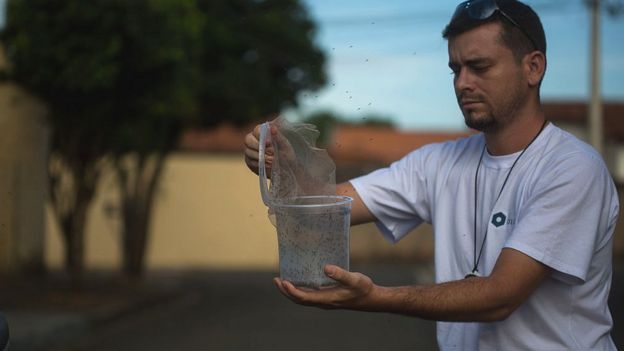
A biologist in Brazil releases mosquitoes to combat a Zika outbreak Getty Images
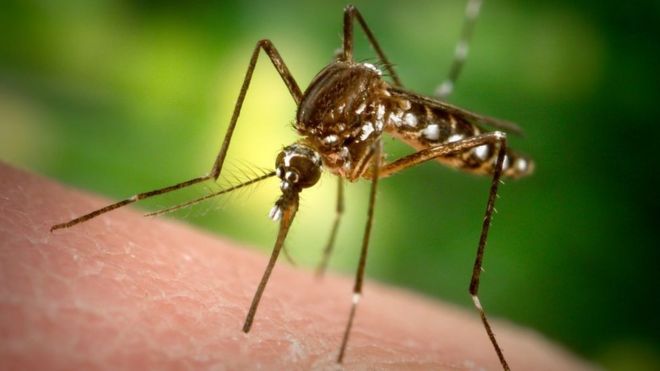
A project is underway in Florida, approved by authorities, to test if a genetically modified mosquito acts as an improved alternative to insecticides to control the spread of Aedes aegypti, the yellow fever mosquito. Known to bite to obtain blood to mature her eggs, the female mosquito spreads a number of exotic diseases like dengue fever, zika and chikungunya.
A British-based lab, Oxitec, which created the mosquito named OX5034, succeeded in altering female mosquitoes to produce female offspring destined to die in their larval stage, thus preventing them from hatching and maturing to the point of biting for blood and successfully reproducing. Male mosquitoes, which are not disease carriers, have been programmed as well, to kill female mosquitoes.
The aim is to reduce the population of Aedes aegypti mosquitoes Getty
The company's promotions have emphasized that the genetically altered mosquitoes will not bite, despite which a public backlash against the experiment has arisen fiercely opposed to the experiment, with some residents stating they will not be treated as "guinea pigs" with the "Robo-Frankenstein" mosquito.
The concern among environmental activists is that a massive population of mosquitoes released for any purpose could result in a detrimental effect on wildlife, endangering bird species, insects and mammals that feed on mosquitoes.
This is not the first occasion when Oxitec's altered mosquitoes have been put into action for the purpose of battling mosquito-borne disease.
The first such tests with the altered mosquitoes took place in May of 2018 when the mosquitoes were released within four communities in the city of Indalatuba, Brazil.There, success was realized when the outcome resulted in a reduction in the numbers of Aedes aegypti of 95% in a trial conducted in an urban area of Brazil.
"This is an exciting development because it represents the
ground-breaking work of hundreds of passionate people over more than a
decade in multiple countries, all of whom want to protect communities
from dengue, Zika, yellow fever, and other vector-borne diseases."Oxitec CEO Grey Frandsen
The Search for More Disease Resistance Citrus Species
"Much of the Florida citrus groves are already pretty inundated."{ "It's going to be hard because we didn't catch it [lethal pestilence] early enough." Leah R. Johnson, assistant professor of statistics, Virginia Tech "[Citrus growers] are resilient and optimistic about the future." "Florida will continue to be a major producer of citrus for years to come." Shelley Rossetter, spokeswoman, Florida Department of Citrus
"Some people believe that citrus in the Central Valley [California] might be spared
because of the climate — that the winters are too cold and summers too
hot for the insects that transmit the disease." "But it looks like the Central
Valley temperatures are right at the threshold, so a few degrees warmer
in the winter and cooler in the summer could change that" "I think we’re
at the tipping point. If people work together and nature helps us out,
fresh citrus might be able to hold on." UC Davis professor
Neil McRoberts, plant disease epidemiologist, scientific advisor, Citrus Research Board of California
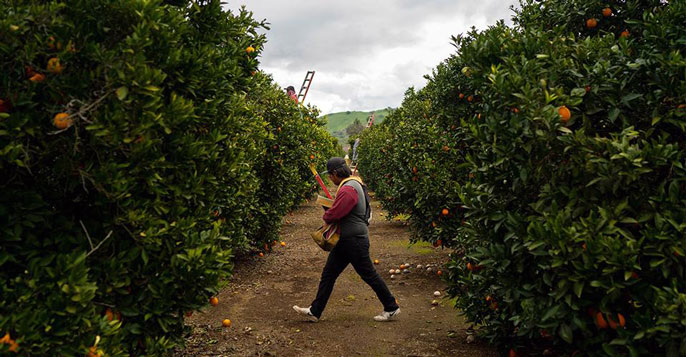
Credit: Joe Proudman/UC Davis
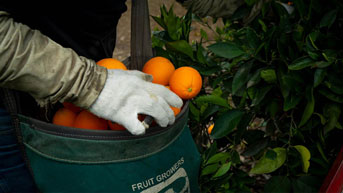
Workers rush to harvest oranges after a light
rain in Exeter, California, just west of the Sierra Nevada mountains in
California’s Central Valley.
A bacterium named huanglongbing which originated in China, has infected ninety percent of Florida's orange groves.A sage who enjoys tragedy might chuckle at the fact that oranges too originated in China, so it could be seen as poetic justice that China, currently embroiled in a heated trade war with the U.S. that has upset trade between the two countries and impacted economic trade globally as well, has its revenge. Not that the bacterium, (yellow dragon sickness) is sparing oranges in China.
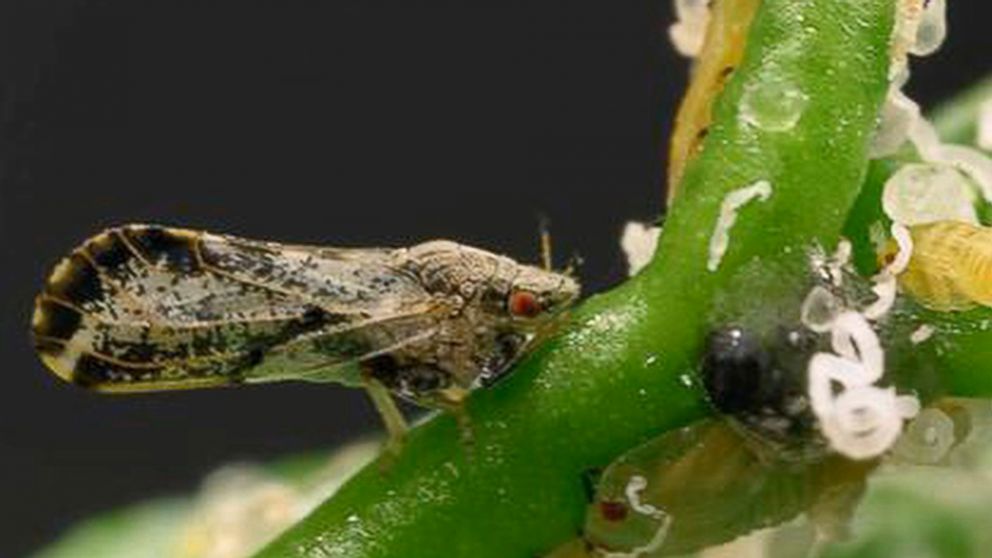
The Asian citrus psyllid spreads a bacteria that causes citrus greening. U.Florida
HLB (short for huanglongbing) is "one of the most destructive foreign plant diseases imaginable [and] has decimated the state's iconic industry", according to the state's Department of Citrus, irrespective of what its spokeswoman optimistically stated. Researchers at rural Lake Alfred not far from Disney World, are frantic in their efforts to develop new root stocks hoping to create orange trees better able to tolerate disease, looking to engineer new orange types to replace varieties that are more vulnerable.
The HLB pathogen frequently has the effect of stopping green fruit from its ripening stage; the symptom named citrus greening, but even when the fruit does manage to ripen it will drop to the ground before it can be plucked off the tree, and under Florida law citrus untouched yet falls from a tree cannot be sold. Harvest time is November to May, but thousands of growers have abandoned their groves. In 2004, there were over 7,000 citrus farmers in Florida; close to 5,000 of those farmers have been forced to drop out of growing citrus.
California’s citrus industry has a total economic impact of $7.1-B.Credit: Joe Proudman/UC Davis
Factories processing fruit to juice have seen two-thirds closing down operations, while packing operations has gone from close to 80 operations to 26. In the ten years up to 2016, according to a University of Florida study, 34,000 orange-industry jobs have been eliminated. This loss in the citrus cultivation industry has the potential to destroy the second-largest industry in the state after tourism, which produces over 80 percent of the American orange juice supply.
"We're in a race right now to save the Florida citrus industry", noted director of the University of Florida's Citrus Research and Education Center, Michael Rogers, of the devastating effect of HLB, spread by yet another invasive species, a citrus psyllid, a tiny insect which sucks the bacteria into its gut while feeding on citrus leaves, then infects the next healthy leaf it feeds upon. The insect reproduces rapidly, developing a resistance to insecticides within a year.
A study by University of Florida and Virginia Tech researchers indicates climate change will permit the psyllid to spread to states north of Florida as temperatures continue to rise, creating further opportunities for the pest which thrives in temperatures between about 15 and 30 degrees Celsius; bad news for growers in Florida where that temperature range typifies a normal year-round climate.
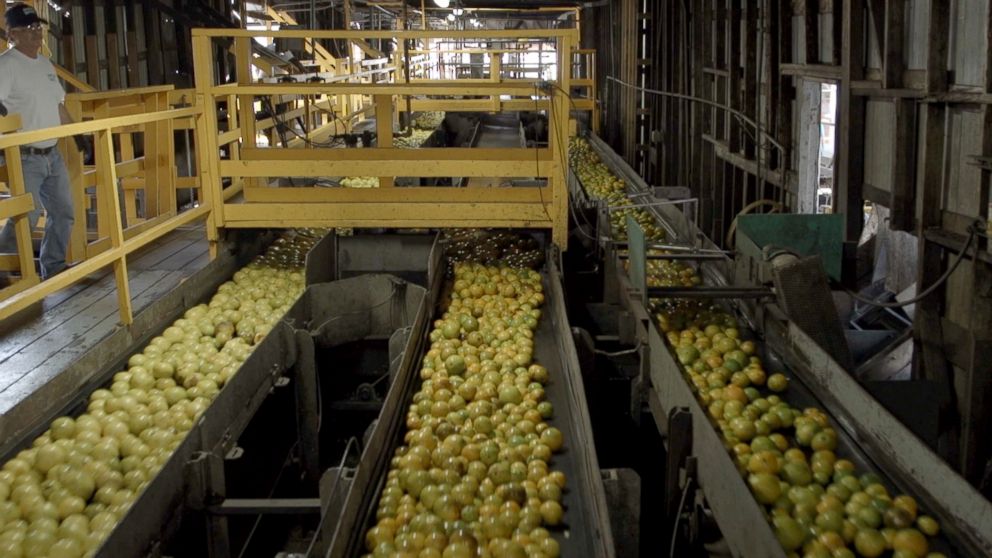
Oranges being sorted before juicing at Florida Natural’s headquarters in Lake Wales, Florida. ABC News
The disease was discovered in 1919, in China. Citrus psyllids were quick to spread when smuggled tree clippings from Asia brought the insects along to Delray Beach in 2005. The National Academies of Sciences, Engineering and Medicine feels that a breakthrough discovery for managing HLB is unlikely to surface in the near future, according to a study it produced last year.