Cruise Ship Journeys: Expect the Unexpected
"Although uncommon, limited human‑to‑human transmission of HPS due to Andes virus has been reported in community settings involving close and prolonged contact.""Secondary infections among healthcare workers have been previously documented in healthcare facilities, though remain rare."WHO situation report"[Everyone on board is] in the same boat, literally.""You don’t embark on a trip with the idea that one of your fellow passengers won’t make it.""We receive information at regular intervals. It is accurate. For the rest, it is a waiting game.""Today we received fresh fruit and fresh vegetables. That was very important to us."Helene Goessaert, ship passenger"We do know that some of the cases had very close contact with each other and certainly human-to-human transmission can’t be ruled out so as a precaution this is what we are assuming.""The risk to the general public is low, [any suspected human-to-human transmission would have occurred between very close contacts like married couples].""This is not a virus that spreads like flu or like COVID. It’s quite different."Dr. Maria Van Kerkhove, WHO director for epidemic and pandemic preparedness and prevention
 |
| WHO: Human-to-human transmission may have occurred aboard the Hondius expedition ship. Still from video, CBCNews |
According to the Wold Health Organization, commenting on a viral outbreak aboard a cruise ship in the Atlantic Ocean, thus far one case of hantavirus has been confirmed, with five suspected cases. Two of those cases were fatal; within a three-week cruising period, three of the ship's passengers have died. Many such cruise ships carry far more passengers than the Hondius expedition ship; thousands in comparison to hundreds. So with that relatively small number of passengers, that three have mysteriously died represents quite a shock.
According to the operator of the Hondius -- Oceanwide Expeditions -- one ship's passenger is in intensive care in Johannesburg and two crew members remaining aboard the vessel exhibit respiratory symptoms. The ship is now carrying 87 passengers and 61 crew. Typically, following exposure to the virus, symptoms begin to erupt between one and eight weeks. The remaining passengers may or may not begin to exhibit further signs of the viral infection.
Hantavirus is an extremely serious condition normally linked to exposure to the urine or feces of infected rodents. It is able, in rare instances, to spread in people-to-people contact. Hantaviruses are capable of causing serious illness and death, spread for the most part by rodents. That infection can be the cause of hantavirus pulmonary syndrome and hemorrhagic fever with renal syndrome, common respectively in the United States and Europe and Asia. What they have in common, whatever the symptoms in the family of the virus, is their severity and potential lethality.
 |
| The cruise ship MV Hondius is seen stationary off the port of Praia, the capital of Cape Verde, on Monday. (AFP/Getty Images) |
The condition in which the remaining passengers and crew on board the ship is one of uncertainty. They await permission to leave the ship at some port whose national health authority may permit them to disembark and regain their position on land. And from there, they can arrange to be repatriated to their countries of origin. But this cannot be done without thorough medical examinations and testing for the presence of the virus, since they may be regarded as ticking health time-bombs. Any who do begin to exhibit symptoms may speedily deteriorate into life-threatening condition.
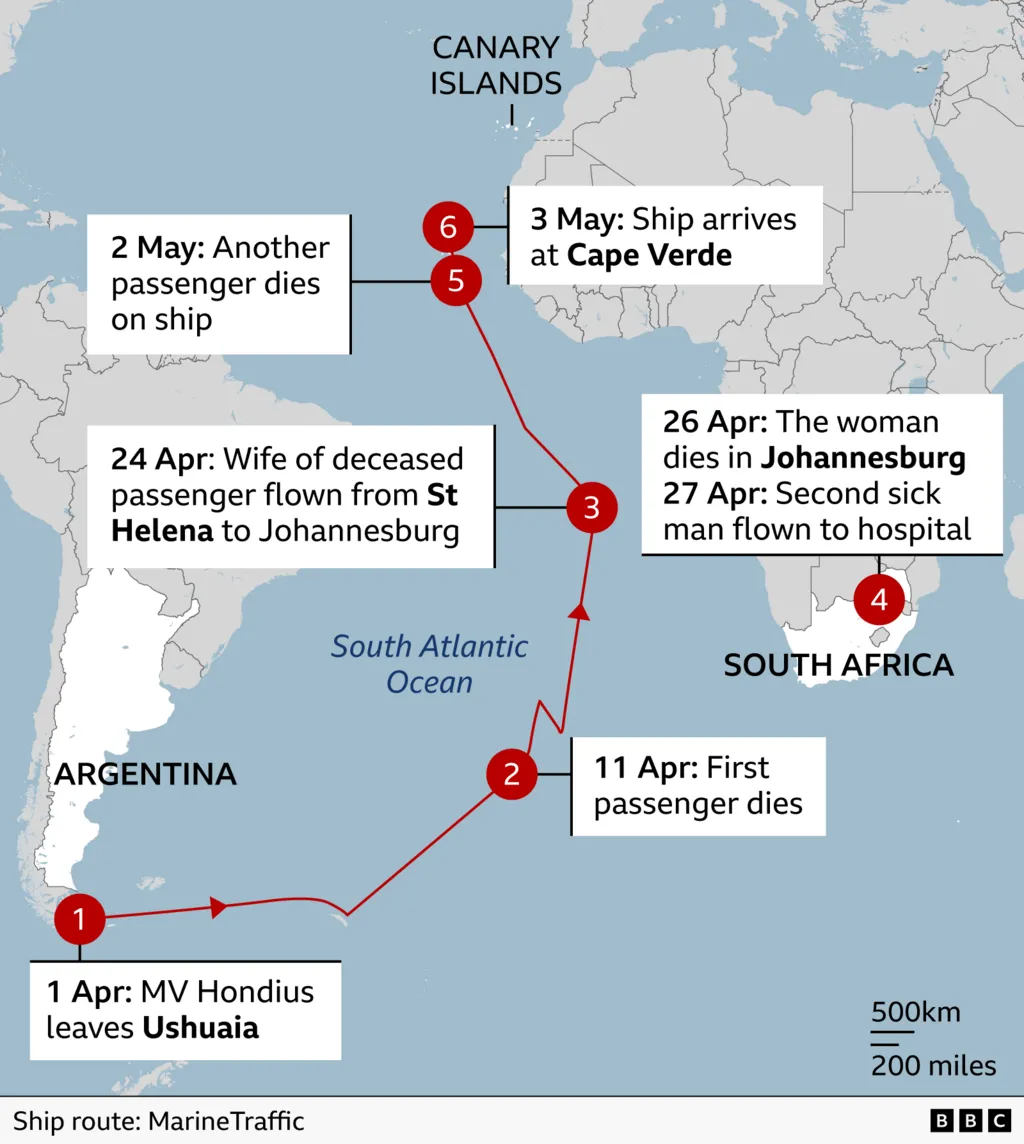
On Monday, Oceanwide Expeditions released a timeline of the "serious medical situation" aboard the Hondius off the coast of Cape Verde, along the western coast of Africa. A Dutch passenger died on board on April 11, cause of death unknown at the time. When the dead man was brought off the ship, his wife accompanied him. Once she too had left the ship, she too became ill and subsequently died, just as her husband had.
Two weeks later, a British passenger became seriously ill and was medically evacuated to South Africa and there, hantavirus was identified. He remains in the intensive-care unit of the hospital he was placed in, in stable but still critical condition. And then a third passenger died on Saturday, a German national. It remains unconfirmed at this point whether all three deaths were caused by hantavirus.
"Hantaviruses are a group of rodent-borne viruses typically transmitted through contact with contaminated environments, including inhalation of small dust particles contaminated with rodent urine, droppings, or saliva.""Although human infections are uncommon, they can lead to severe illness, including hantavirus pulmonary syndrome (HPS), which may progress rapidly to respiratory failure.""In the Americas, HPS has a reported case fatality rate of approximately 30 to 40 percent, underscoring the seriousness of infection once symptomatic, according to the Centers for Disease Control and Prevention.""Unlike respiratory viruses such as influenza or COVID-19, hantaviruses are not typically spread from person-to-person, however direct human transmission has been documented for one hantavirus, the Andes virus, under conditions of prolonged, close contact. The Andes virus is endemic to Argentina, where the cruise ship departed three weeks ago."News Medical Life Sciences
Labels: Cruise Ship, Hantavirus Infection, Passenger Isolation, Three Deaths, World Health Organization
posted by Pieface @ 8:02 PM


0 Comments:
Post a Comment
<< Home