Mexico City Settling Back Into the Cradle of an Ancient Lake Bed
"It [encroaching sea water] damages part of the critical infrastructure of Mexico City, such as the subway, the drainage system, the water, the potable water system, housing and streets.""It' a very big problem.""We have one of the fastest velocities of land subsidence in the whole world.""To do long-term mitigation of the situation, the first step is to just understand [the subsidence issue to respond to its worst effects]."Enrique Cabral, researcher, National Autonomous University of Mexico"[By capturing details of the Earth from space, the project is also] telling us something about what's actually happening below the surface.""It's basically documentation of all of these changes within a city.""You can see the full magnitude of the problem."NISAR scientist Paul Rosen
| Mexico City has been sinking for a century. A NASA satellite is watching it happen ABC News |
New satellite imagery confirms that Mexico City has been sinking by close to ten inches (nearly 25 centimetres) annually, ranking it as one of the fastest-subsiding metropolises on the globe. At about 7,800 square kilometres hosting 22 million people, the capital of Mexico and surrounding cities were built over an ancient lake bed. At one time in the distant past there were canals which are now downtown streets.
Groundwater pumping and urban development have served to shrink the aquifer on which the city sits, which has led to over a century of Mexico City sinking, resulting in monuments and older buildings such as the Metropolitan Cathedral (built in 1573) visibly tilting. A chronic water crisis is also attributed to the contracting aquifer, a situation that will continue to become ever more serious.
| David Bekaert/JPL-Caltech//NASA - PHOTO: New data from NISAR shows where Mexico City and its environs subsided by up to a few centimeters per month (shown in blue) between Oct. 25, 2025, and Jan. 17, 2026. |
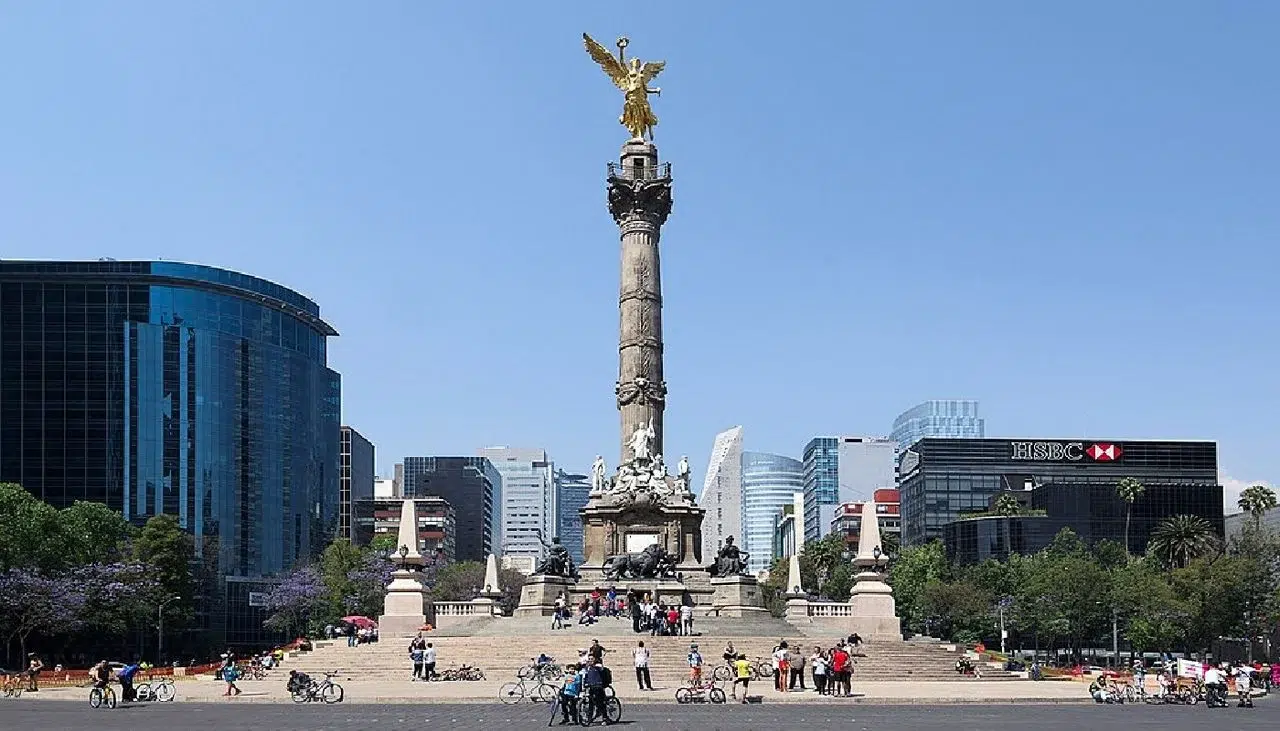
According to NASA, some parts of Mexico City are sinking at a rate of 2 cm monthly. The main airport and the monument commonly recognized as the Angel of Independence, among them. Over less than a century, a yearly subsidence rate of around 24 cm has been identified, amounting in total to over 12 metres.
A powerful satellite known as NISAR which can track real-time changes on the Earth's surface -- a joint initiative between NASA and the Indian Space Research Organization -- has rendered estimates based on measurements taken between October 2025 and January of 2026. NISAR captures details of the Earth from space.
The NISAR research team anticipates an opportunity over time to be able to zoom in on specific areas and eventually obtain measurements on a building-by-building basis. Researchers hope to apply the technology to track events such a natural disasters, fault line alterations, and climate change in regions such as Antarctica and other areas of the world.
"This all allows us to build time series or snapshots on how the ground is moving over time.""That compaction causes the ground surface to sink, and because it doesn't happen evenly, different parts of the city move at different rates.""More broadly, my interest lies in mapping ground motion across coastal zones, where a large proportion of the world's population lives -- and understanding surface change is particularly important."David Bekaert, scientist, NISAR mission"The houses that are founded in [volcanic] rock are stable, but the houses in the middle between the rock and the lacustrine plain are already broken, most of them.""In 2017, a taxi fell inside a fracture.""And what I saw in the Philippines is really terrible because they have two phenomena working together that is very bad for the population: subsidence and sea level rise. They are sinking 30 centimeters per year.""To have these tools and to realize the distribution of these differential rates –it's amazing. Things that we only learned by walking everywhere when we were young, it's different now. Technology is here to help us."Dora Carreón-Freyre, Mexico City-sinking researcher
 |
| The NISAR satellite reveals the progressive subsidence in Mexico City, with areas sinking more than 2 centimeters per month. Noticias Ambientales |
Labels: Ancient Lake Bed, Mexico City, NASA/NISAR, Shrinking Aquifer, Subsidence
posted by Pieface @ 8:28 PM


0 Comments:
Post a Comment
<< Home