Exhausting Canada's Appeal Resources
"I am not persuaded that the process followed by the decision making breached the requirements of procedural fairness.""On the other hand, I have concluded that the delegate's determination that the applicant should not be allowed to remain in Canada on the basis of the nature and severity of acts committed is unreasonable because a key finding by the delegate -- that the applicant was complicit in acts of terrorism committed by Chechen extremists -- is not reasonably supported by the delegate's analysis of the record, including Justice [Simon] Noel's findings supporting the reasonableness of the security certificate.""[Ottawa's focus on fact deviating from the record when ordering his removal was a] fundamental flaw."Federal Court Justice John Norris
 |
| A December 2010 file photo of Mohamed Harkat at an Ottawa news conference. THE OTTAWA CITIZEN/POSTMEDIA |
Under the security certificate he was declared inadmissible to Canada, as representing a security threat.
While the certificate was upheld in 2006, after going through a series of court challenges, a constitutional challenge called for the certificate system to be reworked. Following legal amendments in 2008, a second security certificate was issued, this one declaring him inadmissible to Canada for his having engaged in terrorism, thus making him a danger to Canadian security, as a member of an organization committed to terrorism.
In yet another appeal, this one at the Federal court, Justice John Norris characterized the government's latest striving to remove Mr. Harkat as unreasonable, concluding that the decision should be reassessed and redetermined, given to a decision-maker other than the one that had declared him inadmissible. Back in 2010, Justice Simon Noel, addressing the second certificate, concluded that Mr. Harkat had been involved in the extremist movement in Islam both prior to and following his arrival in Canada. No evidence surfaced, however that he had personally taken part in violent acts anywhere.
According to Justice Noel, the man's involvement "would have been largely one of logistics and facilitation", where prior to arriving in Canada, Mr. Harkat operated a guest house in Peshawar, Pakistan where he assisted in the movement of mujahedeen arriving and departing training camps. The groups with which he was aligned were recognized as having ideological and material links to the bin Laden network, incriminating Mr. Harkat. That connection in and of itself would have made the man inadmissible to Canada.
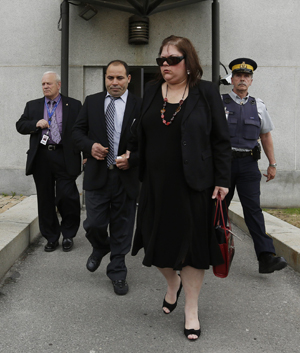 |
| Harkat & wife Sophie leave Court |
Justice Noel generously recognized that Harkat's actions represented a security threat to Canada, but that given the time that had since passed, that danger was vastly diminished and therefore the security investigation publicly exposing him as a target for removal. Justice Noel saw fit to order his release on stringent conditions along with the severing of his past alliances. A decision the government appealed to the Federal Court of Appeal and then on to the Supreme Court of Canada which in 2014 upheld the decision.
The result of which represented "conclusive proof that the person named in it is inadmissible"; that a deportation ('removal order') could theoretically be advanced without resorting to a further admissibility hearing. Then came the tripwire of immigration law preventing the deportation of anyone to another country where they are likely to become a victim of persecution, face risk of torture, or cruel and unusual treatment, technically known as 'non-refoulement'.
Canadian Border Services Agency officials and Mr. Harkat's legal team legally jousted for years arguing and making submissions in relation to the exceptions to refoulement; that should government believe it is justified on security grounds based on severity of the individual's behaviour, the process could be terminated. By 2018 the government decided that Harkat not be permitted to remain in Canada, non-refoulement risk aside "based on the nature and security of acts committed".
Arguing that the decision was unfair and unreasonable, Mr. Harkat applied for a judicial review. That decision on the application was released and Harkat's request for a judicial review was granted. Justice Norris stated that the federal government's focus on facts that failed to match the record in ordering Harkat's removal represented a "fundamental flaw". Representing yet another instance where elected lawmakers are brought up short by unelected judges who, rather than interpret existing law, manipulate it to suit their own biases.e
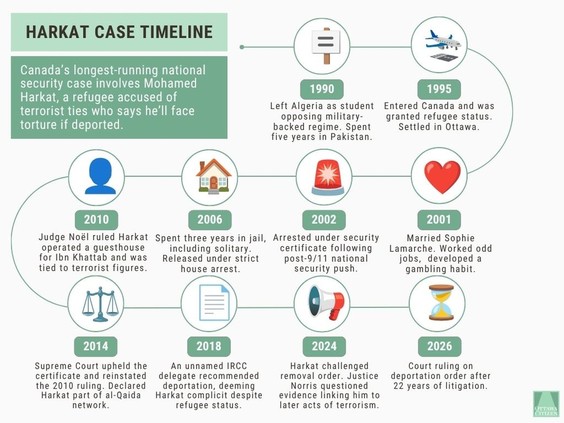 |
| What happened in the Mohamed Harkat case? This chart traces every major development since 1990. (GRAPHIC: SOFIA MISENHEIMER / POSTMEDIA) |
If you’re found inadmissible, you’ll be denied a visa or an
Electronic Travel Authorization (eTA), refused entry to, or removed from
Canada.
You could be found inadmissible for a number of reasons, such as:
- security reasons, including
- espionage
- subversion (attempts to overthrow a government, etc.)
- violence or terrorism
- membership in an organization involved in any of these
- human or international rights violations, including
- war crimes
- crimes against humanity
- being a senior official in a government engaged in gross human rights violations or subject to international sanctions
- committing a crime, including driving while under the influence of drugs or alcoholFootnote 1
- organized crime, including membership in an organization that takes part in organized criminal activity, people smuggling or money laundering
- medical reasons – this includes medical conditions that:
- endanger public health
- endanger public safety or
- causes excessive demand on health or social services (some applicants are exempt)
- financial reasons – if you’re unable or unwilling to support yourself and your family members
- misrepresentation, which includes providing false information or withholding information directly related to decisions made under the Immigration and Refugee Protection Act (IRPA)
- failure to comply with any provision of IRPAFootnote 2 or
- having an inadmissible family member.
Labels: 24 Years of Appeals, Al-Qaeda Links, Deportation, Government of Canada, Inadmissibility, Mohamed Harkat, Revocation of Landed Immigrant Status, Security Certificates, Security Issues
posted by Pieface @ 8:49 PM


0 Comments:
Post a Comment
<< Home