Astronomical Discoveries: Fastest Star in the Milky Way Orbiting Black Hole
"Decades carefully tracking stars orbiting our galaxy's central black hole, Sagittarius A*, have led to this breakthrough discovery.""Because it orbits so close to Sagittarius A*, S301 opens a new window to the fundamental properties of space-time in this extreme black-hole environment."Reinhard Genzal, 2020 Nobel Laureate in physics, Max Planck Institute for Extraterrestrial Physics, Germany"What is special about this star is that it's orbiting Sagittarius A* on a very tight orbit, taking just 8.7 years to complete it.""[The star gets roughly as close to the black hole as Saturn gets to our Sun, which is] unprecedented."Felix Mang, PhD student, co-author of new study/discovery
 |
| Dozens of stars race around the Milky Way’s giant black hole at high speeds. ESO/L. Calçada |
The fastest star in the Milky Way which zooms at 25,000 kilometres per second around the supermassive black hole at the centre of the Milky Way galaxy, has been discovered by astronomers. Named S301, the star orbits precipitously close to the black hole -- so much so that scientists are convinced that its close study may shed light on this cosmic monster that is the black hole at the centre of our galaxy. And in the process, enable them to validate -- or not -- Albert Einstein's theory of relativity.
S301, two billion times fainter than the star Betelgeuse in our night sky, led the team of astronomers to make use of the European Southern Observatory's Very Large Telescope located in the Chilean desert. The presence of the star first came to notice in 2023, and has been tracked ever since, in its orbit. The star travels around 25,000 kilometres per second when it approaches closest to the irresistible gravity pull of the black star.
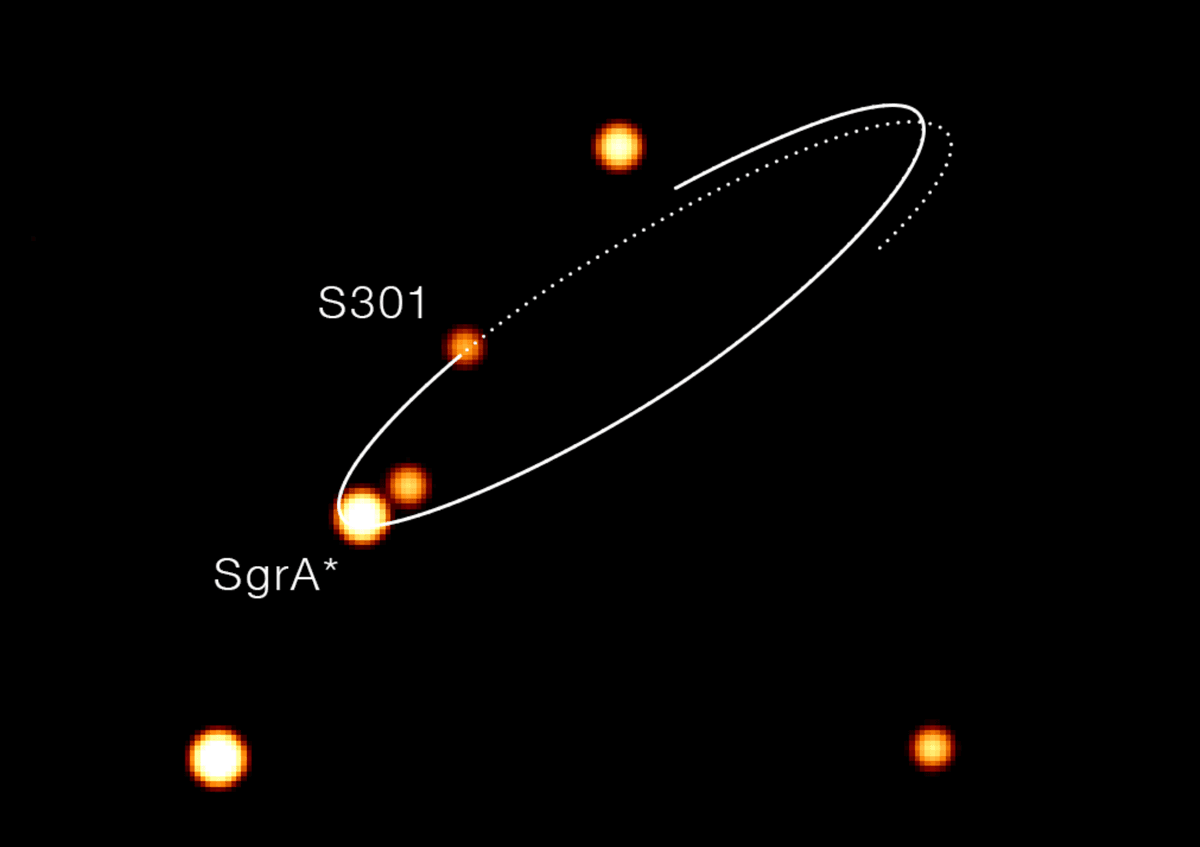 |
| The star S301 orbits the Milky Way’s supermassive black hole, Sagittarius A*, in this annotated image from the European Southern Observatory’s Very Large Telescope. |
Its trajectory is 100,000 times speedier than that of a commercial airplane; over eight percent greater than the speed of light. It is known to be the fastest star that has ever been detected in the Milky Way galaxy. Among scientists, it is believed that S301 once was a partner of a binary star system, torn asunder through the irresistibly strong pull of the black hole. That theory had S301 trapped in the gravity of the black hole while its partner star was blasted outward with sufficient force to entirely take its leave of the galaxy.
In the year 2031, the star will make its next-closest approach to the black hole, at which time astronomers will plan another intense focus of the star's activity in the hope that data they collect from two completed orbits may give them the opportunity to determine the star's trajectory with sufficient precision that the black hole's rotation could be measured -- for as with most space objects, black holes are thought to spin.
According to Einstein's theory of general relativity, a spinning black hole would drag space-time along with it, twisted in a manner that would affect and alter the orbits of surrounding stars. The astronomers anticipate that within the next ten years they will have the opportunity to study S301 for the direct purpose of measuring, for the first time, the spin of the black hole.
"Without this star, we would need to measure the motion of other stars for several more decades to get anywhere close to measuring the spin of the black hole", French astronomer and study co-author Juan Osorno explained, in reference to the study published in Nature.
 |
Labels: Astronomy Study, European Southern Observatory, Massive Black Hole, Milky Way Galaxy, Sagitarius A*, Star S301
posted by Pieface @ 8:07 PM


0 Comments:
Post a Comment
<< Home