Titled Institutional Failures and Child Murder in Canada
"[Alienation claims] are systematically used as a litigation strategy to deflect attention from abuse, undermine the child's disclosure of fear, and portray a protective mother as hostile, irrational or manipulative.""Rather than asking why a child is frightened or resistant to contact, the system can wrongly assume the child has been influenced or brainwashed.""[Even when there is documented family violence or other concerns, in a pro-contact culture] a father-child relationship can be treated as the overriding goal.""The Carney government has committed to keeping Canadians safe as one of its key priorities – this must include children. The federal government and Justice Minister Fraser need to commit to supporting the Bill. Parliament cannot bring these children back, but it can act to help prevent the next death."Suzanne Zaccour, director, legal affairs, National Association of Women and the Law (NAWL)
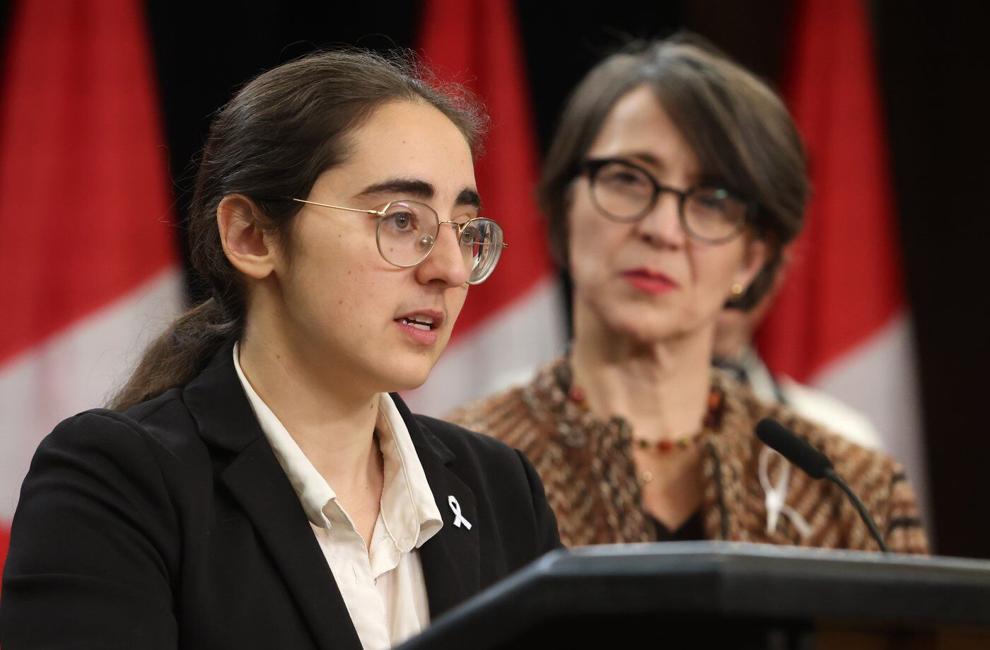 |
| Director of legal affairs at the National Association of Women and the Law Suzanne Zaccour, left, speaks at a press conference in Ottawa on Thursday, Dec. 5, 2024, as gun control advocate Nathalie Provost listens. THE CANADIAN PRESS/ Patrick Doyle |
"[A court] shall not take into consideration [any allegation that one parent has deliberately encouraged a child to become estranged from the other. Judges would not be permitted to order] reunification therapy [or, in extreme cases, reverse custody]."Keeping Children Safe -- proposed bill"The legislation reflects a profound distrust of the Canadian family justice system.""As tragic and concerning as child homicides are, and they have to be dealt with more effectively, the legislation does not address that issue in a meaningful way [risking exploiting child murders that have no relation to alienation].""[The bill] doesn't deal with the child protection system at all.""It's very unfair, and very contra in the interests of the children, to decide cases on an absolute rule that says], 'We can never hear this evidence'.""There are some people, a very small number who, in the midst of a custody battle, are so unbalanced they decide to kill their children. That's a terrible tragedy.""The issue of parents killing their children is a huge concern [but the proposed bill is not the appropriate response]."Law Professor Nicholas Bala, family and children's law expert, Queen's University
 |
| "Keira's Law" is a private members bill tabled in the House of Commons named after 4-year-old Keira Kagan. (Jennifer Kagan-Viater) |
Deadly incidents of 'fillicide' are addressed in a new paper linking a "pro contact culture" and accusations of "parental alienation" to the murders of eight children by their fathers in Ontario and Quebec, representing five disparate families. Authors of a private member's bill before Parliament that has raised some controversy, claim these findings support their bill, introduced by Liberal MP Lisa Hepfner, proposing to amend the Divorce Act to prohibit courts from considering evidence that one parent actively attempts to 'alienate' the other parent through manipulation of a child, coaching that child to resist contact.
Under the proposed bill, judges would be prevented from restricting one parent's time with a child "to whom the child has a close connection" for the purpose of improving the relationship with the other parent. Courts would be prevented from forcing children to attend "reunification therapy". Now before the justice and human rights committee, the proposed legislation has passed second reading.
According to the bill's proponents, in instances involving allegations of domestic violence, alienation claims are weaponized to be used as a legal tactic by parents -- in most instances fathers, accused of abuse -- to discredit the opposite parent. "They run the risk of being perceived as an uncooperative alienating parent" if a parent, must often mothers, insists a child is in danger. Most child homicides involve cases where child protection services failed children.
Queen's University law professor Nicholas Bala supports amendments to require lawyers to screen for risks of family violence and allow courts to interview children. He objects to his interpretation of the bill that would prevent lawyers from presenting evidence that one or both parents are actively engaged in undermining the child's relationship with the other. Dr. Bala points out that in over one-third of cases it is the mother who has been alienated from her children by an abusive husband.
In five cases which NAWL used as examples for their proposed legislation, with the help of the faculty of law at University of Sherbrook, the deaths of children had been foreshadowed by warnings subsequently downplayed or dismissed by family courts or child protection services. Cases were selected on three criteria: murders occurring during custody disputes; institutions such as police, child protection services and family courts intervening prior to the child's death; and sufficient public information available to reconstruct details of the case.
Children, in three of five cases were killed within days of a scheduled court hearing -- two days after a mother asked her lawyer about seeking sole custody in one case, fearing for the safety of her two boys, two and five years of age, their father killed them both. Titled Institutional Failures and Child Murder in Canada, the report describes the case of Keira Kagan whose parents separated when she was still in infancy. The parents' legal disputes had spanned four years, involving ten judges and 53 court orders.
Mother Jennifer Kagan whose husband Robin Brown had subjected her to years of domestic violence that included physical and sexual assault, filed an urgent motion to suspend or restrict him to supervised visits "due to his increasingly erratic behaviour". According to the report "The judge ruled the matter non-urgent and scheduled a hearing for two weeks later". Keira, twelve days later, was found dead at the bottom of a cliff.
 |
| Keira Kagan is shown in this undated family handout photo. The four-year-old girl was found dead next to her father's body at the base of a cliff in Rattlesnake Point Conservation Area in Milton, Ont., in February 2020. Now the girl's name will be enshrined in federal and provincial laws designed to help other children avoid her fatal fate. (The Canadian Press Handout) |
"[No judge took the added step of restricting his parenting rights [despite serious red flags].""[The] mere suggestion [of alienation shifts the focus from allegations of safety concerns] to whether the protective parent is actually doing enough to preserve the relationship.""[A child protection agency two days before the murder, called to warn that behaviour consistent with fathers who harm or kill their children was being displayed].""Yet they did not act. We were forced and directed to permit Keira to be in her biological father's care unsupervised."Philip Viater, family law practitioner, Keira's stepfather
Labels: "Parental Alienation", Divorce Act, Fathers Murdering Their Children, Filicide, Keeping Children Safe, Proposed Bill Before Parliament
posted by Pieface @ 8:14 PM


0 Comments:
Post a Comment
<< Home