Alberta's Compassionate Intervention Act
"Those who suffer from addiction suffer from an illness, and that illness is treatable and recovery is possible.""Not only is it possible, it is probable, if we build those pathways. And this Compassionate Intervention Act is just one of the tools and pathways that we will have in the province to help those individuals.""Is there some constitutional right to 187 overdoses? Causing death on the street and personal carnage within your own life, leading to death and public disorder as well?""I say there's not. But if the opinion of our legislature and the court disagrees, we'll have to address that when it comes there."Dan Williams, Minister of Mental Health an Addiction, Alberta
 |
| Alberta Premier Danielle Smith announces Bill 53, the Compassionate Intervention Act, as Mental Health and Addiction Minister Dan Williams looks on. (Emilio Avalos/RadioCanada) |
The Alberta provincial government is poised to become the first province in Canada to legislate that drug addicts can be forced into treatment, to be held in secure facilities for up to three months at a time; alternately mandating that they complete six months of treatment in the community. Bill 53 was introduced this week by Alberta's Minister of Public Health and Addictions; should it become law, adult family members, guardians, health-care professionals and law enforcement agents could compel addicts into treatment.
Those toward whom this law is aimed would be severe addicts for whom other treatment options have failed. "In our downtown cores, there are visible effects on every street, with individuals who have lost the ability to make healthy decisions, actively putting their lives at risk and causing fear and harm in the broader community", added Alberta Premier Danielle Smith.
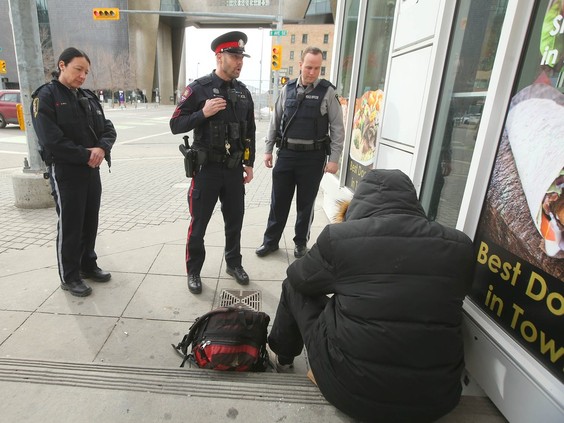 |
| Community Safety Insp Susan Wall, Calgary Police acting Staff Sgt Derek Klassen and Transit public safety Acting Deputy Chief Michael Pratt speak to vulnerable citizen following a press interview in East Village in Calgary. The man was asked to move along because the business was attempting to open. Jim Wells/Postmedia |
Opium overdose killed 2,283 people out of a total of 1,414 who died from drug poisoning last year. Addictions issues come at a cost to the province of $7 billion annually for health care, lost productivity and justice-system costs. Marshall Smith, the premier's former chief of staff, a former addict himself, originated the idea of mandatory treatment. To place an individual into mandatory treatment, an application would have to be made, reviewed, and a lawyer sitting on an independent commission would be tasked with determining whether that individual is eligible for a 72-hour detention for assessment.
The case would be reviewed by a three-member commission team comprised of a lawyer, a physician and a member of the public, once an individual has been apprehended by police. The commission decision would be subject to judicial review of the consensus decision. Legal counsel for the prospective patient would be present at the assessment. To be committed to treatment, a detained adult would be identified as likely to cause harm to themselves or others within a reasonable length of time. Those under age 18 would be exempted from the 'reasonable time' guideline.
Only a small segment of the population would be eligible for compassionate intervention, in recognition that the severity of addiction is a qualifying metric. An example might be individuals who visited hospital emergency departments for substance use on over ten occasions. Individualized treatment plans would be reviewed every six weeks for those remanded to treatment, and patients could be transferred between community care plans and secure facilities as required. They would be unable to refuse medical treatment, during this period.
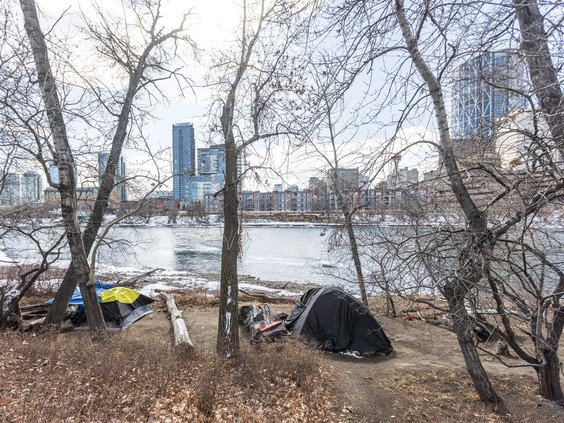 |
| A homeless encampment photographed on the north bank of the Bow River in Calgary. Brent Calver/Postmedia |
Labels: Alberta, Compassionate Intervention, Drug Addiction, Enforced Treatment, Homelessness
posted by Pieface @ 7:46 PM


0 Comments:
Post a Comment
<< Home