Ruminations

Blog dedicated primarily to randomly selected news items; comments reflecting personal perceptions

Saturday, April 19, 2025

Alberta's Compassionate Intervention Act

"Those who suffer from addiction suffer from an illness, and that illness is treatable and recovery is possible."
"Not only is it possible, it is probable, if we build those pathways. And this Compassionate Intervention Act is just one of the tools and pathways that we will have in the province to help those individuals."
"Is there some constitutional right to 187 overdoses? Causing death on the street and personal carnage within your own life, leading to death and public disorder as well?" 
"I say there's not. But if the opinion of our legislature and the court disagrees, we'll have to address that when it comes there."
Dan Williams, Minister of Mental Health an Addiction, Alberta
https://i.cbc.ca/1.7511056.1744754920!/fileImage/httpImage/image.jpeg_gen/derivatives/16x9_1180/danielle-smith-dan-williams-announce-bill-53.jpeg?im=Resize%3D780
Alberta Premier Danielle Smith announces Bill 53, the Compassionate Intervention Act, as Mental Health and Addiction Minister Dan Williams looks on. (Emilio Avalos/RadioCanada)

The Alberta provincial government is poised to become the first province in Canada to legislate that drug addicts can be forced into treatment, to be held in secure facilities for up to three months at a time; alternately mandating that they complete six months of treatment in the community. Bill 53 was introduced this week by Alberta's Minister of Public Health and Addictions; should it become law, adult family members, guardians, health-care professionals and law enforcement agents could compel addicts into treatment. 

Those toward whom this law is aimed would be severe addicts for whom other treatment options have failed. "In our downtown cores, there are visible effects on every street, with individuals who have lost the ability to make healthy decisions, actively putting their lives at risk and causing fear and harm in the broader community", added Alberta Premier Danielle Smith.
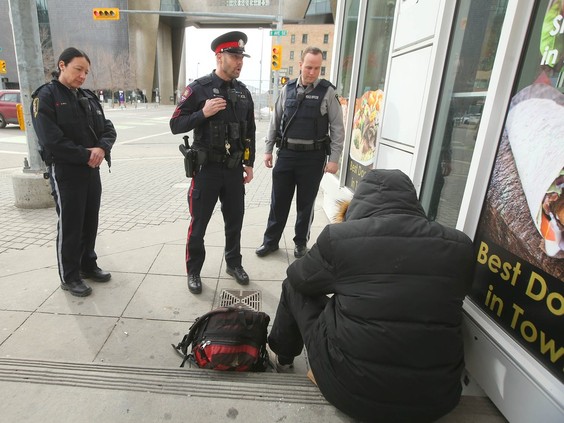
 
https://smartcdn.gprod.postmedia.digital/calgaryherald/wp-content/uploads/2025/03/20250320014_safe-streets_police_transit_bylaw_calgary_jw014_294519134.jpg?quality=90&strip=all&w=564&h=423&type=webp&sig=UQKikF485zpL9I4u_Ihu4A
Community Safety Insp Susan Wall, Calgary Police acting Staff Sgt Derek Klassen and Transit public safety Acting Deputy Chief Michael Pratt speak to vulnerable citizen following a press interview in East Village in Calgary. The man was asked to move along because the business was attempting to open. Jim Wells/Postmedia

Opium overdose killed 2,283 people out of a total of 1,414 who died from drug poisoning last year. Addictions issues come at a cost to the province of $7 billion annually for health care, lost productivity and justice-system costs. Marshall Smith, the premier's former chief of staff, a former addict himself, originated the idea of mandatory treatment. To place an individual into mandatory treatment, an application would have to be made, reviewed, and a lawyer sitting on an independent commission would be tasked with determining whether that individual is eligible for a 72-hour detention for assessment. 

The case would be reviewed by a three-member commission team comprised of a lawyer, a physician and a member of the public, once an individual has been apprehended by police. The commission decision would be subject to judicial review of the consensus decision. Legal counsel for the prospective patient would be present at the assessment. To be committed to treatment, a detained adult would be identified as likely to cause harm to themselves or others within a reasonable length of time. Those under age 18 would be exempted from the 'reasonable time' guideline.
 
Only a small segment of the population would be eligible for compassionate intervention, in recognition that the severity of addiction is a qualifying metric. An example might be individuals who visited hospital emergency departments for substance use on over ten occasions. Individualized treatment plans would be reviewed every six weeks for those remanded to treatment, and patients could be transferred between community care plans and secure facilities as required. They would be unable to refuse medical treatment, during this period.

 
https://smartcdn.gprod.postmedia.digital/calgaryherald/wp-content/uploads/2025/03/homeless-encampments.jpg?quality=90&strip=all&w=564&type=webp&sig=d11Fq5NZkUfSqiSW0KsIXg
A homeless encampment photographed on the north bank of the Bow River in Calgary. Brent Calver/Postmedia


Labels: , , , ,

Sunday, October 01, 2023

And The Solution to the Scourge of Drug Addiction Is .... ?

"We are regularly seeing and hearing in our practices that diverted hydromorphone is causing harm to both adults and children."
"We call on the government to ensure that all hydromorphone prescribed to people with opioid addiction is provided in a supervised fashion or that funding be ceased for the current harmful practice."
"[The] Unsupervised Free Government Funded Hydromorphone [is] causing further harm to our communities by increasing the total amount of opioids on the streets and providing essentially unlimited amounts of opioids to vulnerable people with addiction."
"As a result of this practice, we are witnessing new patients suffering from opioid addiction, and additional unnecessary overdoses and death."
Open letter to government of Canada from 17 addiction specialists
https://www.reuters.com/investigates/special-report/assets/baby-opioids-pennsylvania/overview-video.jpg?v=322416211117
A Reuters investigation found 110 examples of children whose mothers used opioids during pregnancy and who later died preventable deaths after they were sent home from the hospital. A federal law meant to protect those children has largely been ignored by states across America.
 
"What is killing people is an increasingly toxic and unpredictable drug supply... The idea in giving people an alternative to that, that is predictable."
"It's not as if our field is in disarray, in disagreement around sort of the more conventional treatment of addictions."
"This is a very specific item which has a lot of controversy associated with it."
Dr. Paxton Bach, co-medical director, B.C. Centre on Substance Use, addiction medicine physician, St.Paul's Hospital, Vancouver
A person injects an opioid at a Vancouver clinic.
A group of addiction physicians called on the Liberal government to ensure that safe-supply drugs are either not provided entirely, or if they continue to be provided for drug-addicted people, it be in a supervised manner. This, given accounts of people addicted to drugs visiting safe-supply outlets that provide them with free hydromorphone to ensure they have an alternative to the vastly more preferred street-acquired illegal fentanyl which has been implicated in an epidemic of drug overdoses.

The problem has become that those receiving the hydromorphone use it as leverage on street markets by selling it to others and using the profit they gain by so doing, to acquire the more desired fentanyl, thus entirely negating the purpose of the safe supply function, and in the process making more drugs available on the street. Hydromorphone availability has been cited as the cause of inciting more youth to become addicted to drugs, among other untoward consequences.

The pharmaceutical-grade hydromorphone made easily available through the street clinics as a method of reducing drug overdoses from heroin or fentanyl has backfired, the government-funded program of ten pilot projects in British Columbia, Ontario and New Brunswick has simply created a wider and more complicated system of drug use. Despite that a report in the Harm Reduction Journal in June of 2023 concluded enrolment in safer-supply programs leads to "fewer overdoses and overdose-related deaths, reduced drug-related harms, and improved health and social outcomes".

Angelica Richardson McKenney feeds her daughter Lynndaya in December 2012. The snapshot was taken the day before McKenney, high on a trio of drugs, fell asleep on top of Lynndaya and suffocated her. REUTERS/Handout
 
Not, however, in the opinion of critics claiming the programs have led to a number of other problems being created. The letter's authors argue that research of safer supply is "methodologically weak" and the program should be reformed or altogether cancelled. Author of the letter, Dr. Rob Cooper, spoke of a patient receiving safe supply treatment: "She's now dead. She was selling the hydromorphone she was getting and she was buying fentanyl. The problem here is there's no safety measures protecting that person or the public."

Founder of he ACT Addictions Clinic chain in Ontario, Dr. Clement Sun, a signatory to the letter, explains the situation is "almost like we're getting back to the days ... that the source of the drug is not from the illegal dealer [but] is from these safe clinics", resembling how over-prescribed OxyContin fuelled the opioid crisis.

"I'm not against them trying to help addicts, because that's what my job is. But this way, it is reckless", added Dr. Sun. Drug users receive their safer supply drugs, then turn around on the streets and sell them. The "diversion" money is "commonly used to purchase more potent opioids such as fentanyl. There is widespread evidence that this is occurring", the letter adds. In addition to which they argue that the diverted hydromorphine is "creating more children with addiction in our Junior High and High Schools".

Data out of British Columbia indicates hydromorphone to be present in five percent of the opioid deaths that took place in the province. In comparison to fentanyl, which was seen to be present in 88 percent. Dr. Sun believes these deaths might not yet be showing up in statistics. "They're not seeing it, because they're selling it to the kids and they haven't overdosed yet", he stated. "We're not talking about people dying. We're talking about the fact that you're spreading a medication that's addictive and being the supplier to the dealers, to the people who are selling it."

Drs. Cooper and Sun suggest that people who want the pharmaceutical grade opioids could be instructed they must be taken under supervision at a 24-hour pharmacy, while Dr. Bach agreed there are ways that such prescribing could be improved, yet a countrywide reform that addresses all concerns is unlikely to be developed. "I don't think there is going to be any one solution that is universally appropriate. But there is lots of opportunity to be thoughtful about this", he concluded.

https://static01.nyt.com/images/2022/07/26/science/00opioids-vancouver1/00opioids-vancouver1-superJumbo.jpg?quality=75&auto=webp
Credit...Jackie Dives for The New York Times

Labels: , , , , , ,

Monday, March 04, 2019

Opioid Addiction : Probuphine Implant

"We are early in our launch. What we're trying to do is make sure that if a physician has a patient who they feel would benefit from Probuphine what we would do is co-ordinate with that physician so that if they're not trained they have access to someone who is trained and is close enough to them and their patients."
Samira Sakhia, president, Knight Therapeutics
hand-holding-implant

"It's so important to have a number of treatment options because there's no one-size-fits-all for turning the tide on the opioid crisis", explained clinical researcher Dr. Seonaid Nolan, with the B,C. Centre on Substance Use. Dr. Nolan is an addiction medicine physician at St.Paul's Hospital in Vancouver, who happens also to be medical director of the addiction program at Providence Health Care.

She is referring to a slender rod the size of a matchstick containing the medication buprenorphine used as an implant subcutaneously (under the skin) of the upper arm, marketed under the brand name Probuphine, the first of its kind in treatment of opioid addiction. Dr. Nolan considers the implant another option for treating opioid addiction, followed by methadone.

The advantage of the implant is that there are no impediments to its function; no longer must patients remember to take their daily tablets of Suboxone, an especial challenge for people in addiction mode confused with poverty, homelessness, unemployment. Use of the implant would negate the need for patients to be supervised while taking their drug, to ensure compliance and to eliminate the risk of the drug being diverted or misused.
This photo provided by Braeburn Pharmaceuticals shows the Probuphine opioid implant. Federal health officials on Thursday, May 26, 2016, approved the innovative new option for Americans struggling with addiction to heroin and painkillers: a drug-oozing implant that curbs craving and withdrawal symptoms for six months at a time.    Braeburn Pharmaceuticals / ASSOCIATED PRESS

A doctor at St.Paul's Hospital has been trained on the method whereby the implant should be inserted, a procedure considered a preferential option for people leaving correction facilities, residential treatment programs and hospital stays of any duration because of their reduced tolerance to illicit opioids, placing them at higher risk of overdose.

The recommendation has gone forward for provincial drug plans to reimburse the cost of the implant to patients who have been stabilized on no more than eight mg of buprenrphine, linked with counselling. That recommendation from the Canadian Agency for Drugs and Technologies in Health, tasked with reviewing all drugs and devices approved by Health Canada.

Their drug-expert committee feels the cost of the implant should ideally not exceed the cost of a total drug plan of buprenorphine at a cost not to exceed 8 mg daily. In the hardest-hit province in Canada, the Health Minister of British Columbia has stated the independent Drug Benefit Council is undertaking its own review of the implant initial to determining whether the cost will be covered in light of more than 3,000 overdose fatalities in the past two  years.

Knight Therapeutics in Montreal has licensed the implant from an American company, enabling ti to commercialize and distribute the implant in Canada, where its cost is slated to be $1,495 for each implant of four devices, equivalent to six months of treatment with Suboxone -- and to that end, the company has trained doctors in major Canadian cities on the therapeutic implant procedure.
sleeping-patient-implant-img
Four 1” implants are placed discreetly in the underside of the upper arm, just beneath the skin.  
Probuphine Logo

Labels: , , , ,

Thursday, February 28, 2019

Construction Hazard

"Construction and opioids go really well together."
"At the beginning when I was using hydromorphone, I was better at my job. I was more consistent.  enjoyed working more because I felt good. Nothing mattered. Even if I was doing something I didn't want to do, if I was on opioids, it made no difference, you know?"
"I started to attribute me being good at my job with me being on drugs."
"I'd lost all my jobs. I'd lost my girlfriend. I could hardly get out of bed. I was ready to die. I felt like I had lost everything and lost my purpose and nothing mattered anymore. And I was broke, that didn't help. I just said yes. Against my instincts, I said yes, I'd go to treatment even though everything in my body said I couldn't do it."
"Start saying yes to people who can help you. I was, 'I got myself into t his on my own. I can get myself out.' But that's just so wrong and so misguided. I just decided I didn't want to do this alone any more. It's not a weakness to ask for help."
Logan Carroll, construction worker, Ottawa
‘I started to attribute me being good at my job with me being on drugs,” says Logan Carroll.  Jean Levac / Postmedia News

"It's just the nature of the jobs we do. Heavy-duty work that takes its toll on the body -- lifting, climbing -- heavy work that's prone to injury."
"Look at construction sites and see some of this happening. Construction work opportunities are usually short. Typically, our folks go to a job site, try to get as many hours as they can, then go on to the next job."
"Unfortunately, when they do get hurt on the job, they go to their family physician or an emergency clinic, grab something for pain, then go back to work."
"It's staggering when you look at the small provinces and see how quickly the numbers [of opioid deaths] are catching up to the larger provinces."
"What we noticed is we had one particular pharmacy where we had spent $1.8 million in one year just for one construction union in prescription fees. We said, 'This doesn't seem right. Something is wrong.' When we tracked it, we found it that it was for methadone."
"It's deemed a macho industry where guys don't talk about their pain and don't say that they're ailing. That could be seen as a weakness. I think that's really unfortunate."
Arlene Dunn, deputy director, Building Trades Union, Canada

"A lot of people are using opioids for physical pain, but a lot of people are also using them for psychological pain."
"Most Canadian workplaces that have substance abuse policies favour disciplinary measures rather than supportive measures. Instead of paying for treatment, they're actually disciplining them."
"We need to create an environment that fosters them [workers addicted to drugs] to be able to come out and say, 'I need help'."
"[Employers] should be able to say, 'Here is a four-week leave and we'll support you in that.' They shouldn't be forced to come into work. We don't do that with cancer. Why are we stigmatizing people struggling with mental illness?"
"The war on drugs is not working. We see that year after year. Problematic substance use is like any other disease and should be treated as a health concern and not treated as a criminal justice concern."
"We're not saying decriminalization is a silver bullet -- because there's a bunch of other recommendations we made. The other big one is invest in mental health services, increasing access to services so that people can see a psychologist when they need to. We know that untreated mental illness over time gets worse and worse."
Fardous Hosseiny, national director, research and public policy, Canadian Mental Health Association
Opioid overdoses still plaguing the trades
Journal of Commerce, ConstructConnect

The construction and extraction industry had the highest suicide rate of any profession surveyed, according to a 2015 study by the Centers for Disease Control. The study revealed 52.1 deaths per 100,000, a rate seen to be 200 percent steeper than the national average in the United States. Therapies like meditation have evidently proven effective at pain control, but it represents a type of intensive work and scheduling, taking infinitely more time and patience than the expedient of using a pill to dull pain.

Few workplace occupations, it turns out, appear to be as vulnerable to addictions to opioids -- including a prevalence of overdose deaths -- than the construction industry, including general labourers. It was found last fall that 55 percent of the overdose deaths in the province of British Columbia were of workers in the construction and transportation industry, according to a study by the B.C. Coroners Service.

Similarly a study undertaken in 2018 by the Massachusetts Department of Public Health concluded that construction workers there were six times likelier to die of opioid overdose than any other occupation, a trend seen throughout North America. Canada is staggering under a death toll resulting from its opioid epidemic, with Health Canada reporting over 9,000 Canadians dying from overdose between January 2016 and June 2018. British Columbia alone saw 1,489 deaths from illicit opioid overdose last year, the equivalent of four deaths daily.

The problem has become even deadlier with the emergence of fentanyl, the synthetic opioid attributed with a powerful strength one hundred times greater than heroin. Ms. Dunn of the Building Trades Union recognized the emerging problem with construction workers and opioid addiction fifteen years ago when high fees for methadone doled out daily at pharmacies as a prescribed regimen resulted in sky-high dispensing fees for her union.

Opioids like oxycodone proved a quick fix when injured trades workers and labourers visited their family doctors for relief from pain related to industry work. They want to return to work as quickly as possible to meet construction deadlines, working for long hours while in pain.

Labels: , , ,

 
()() Follow @rheytah Tweet