Blog dedicated primarily to randomly selected news items; comments reflecting personal perceptions
Saturday, April 19, 2025
Alberta's Compassionate Intervention Act
"Those who suffer from addiction suffer from an illness, and that illness is treatable and recovery is possible."
"Not only is it possible, it is probable, if we build those pathways. And this Compassionate Intervention Act is just one of the tools and pathways that we will have in the province to help those individuals."
"Is there some constitutional right to 187 overdoses? Causing death on the street and personal carnage within your own life, leading to death and public disorder as well?"
"I say there's not. But if the opinion of our legislature and the court disagrees, we'll have to address that when it comes there."
Dan Williams, Minister of Mental Health an Addiction, Alberta
Alberta Premier Danielle Smith announces Bill 53, the Compassionate Intervention Act,
as Mental Health and Addiction Minister Dan Williams looks on. (Emilio Avalos/RadioCanada)
The Alberta provincial government is poised to become the first province in Canada to legislate that drug addicts can be forced into treatment, to be held in secure facilities for up to three months at a time; alternately mandating that they complete six months of treatment in the community. Bill 53 was introduced this week by Alberta's Minister of Public Health and Addictions; should it become law, adult family members, guardians, health-care professionals and law enforcement agents could compel addicts into treatment.
Those toward whom this law is aimed would be severe addicts for whom other treatment options have failed. "In our downtown cores, there are visible effects on every street, with individuals who have lost the ability to make healthy decisions, actively putting their lives at risk and causing fear and harm in the broader community", added Alberta Premier Danielle Smith.
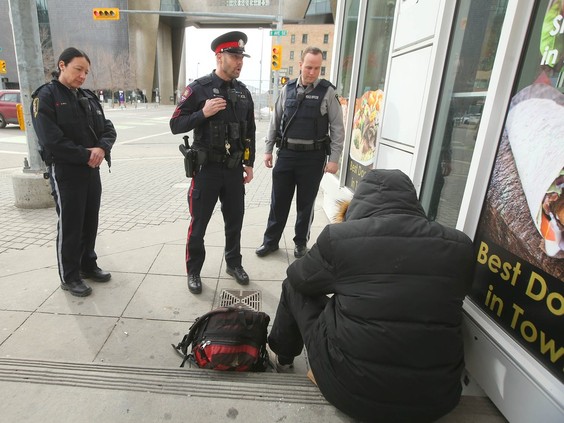
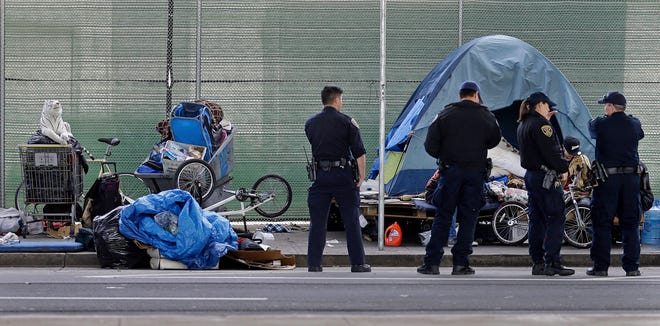
Community Safety Insp Susan Wall, Calgary Police
acting Staff Sgt Derek Klassen and Transit public safety Acting Deputy
Chief Michael Pratt speak to vulnerable citizen following a press
interview in East Village in Calgary. The
man was asked to move along because the business was attempting to open.Jim Wells/Postmedia
Opium overdose killed 2,283 people out of a total of 1,414 who died from drug poisoning last year. Addictions issues come at a cost to the province of $7 billion annually for health care, lost productivity and justice-system costs. Marshall Smith, the premier's former chief of staff, a former addict himself, originated the idea of mandatory treatment. To place an individual into mandatory treatment, an application would have to be made, reviewed, and a lawyer sitting on an independent commission would be tasked with determining whether that individual is eligible for a 72-hour detention for assessment.
The case would be reviewed by a three-member commission team comprised of a lawyer, a physician and a member of the public, once an individual has been apprehended by police. The commission decision would be subject to judicial review of the consensus decision. Legal counsel for the prospective patient would be present at the assessment. To be committed to treatment, a detained adult would be identified as likely to cause harm to themselves or others within a reasonable length of time. Those under age 18 would be exempted from the 'reasonable time' guideline.
Only a small segment of the population would be eligible for compassionate intervention, in recognition that the severity of addiction is a qualifying metric. An example might be individuals who visited hospital emergency departments for substance use on over ten occasions. Individualized treatment plans would be reviewed every six weeks for those remanded to treatment, and patients could be transferred between community care plans and secure facilities as required. They would be unable to refuse medical treatment, during this period.
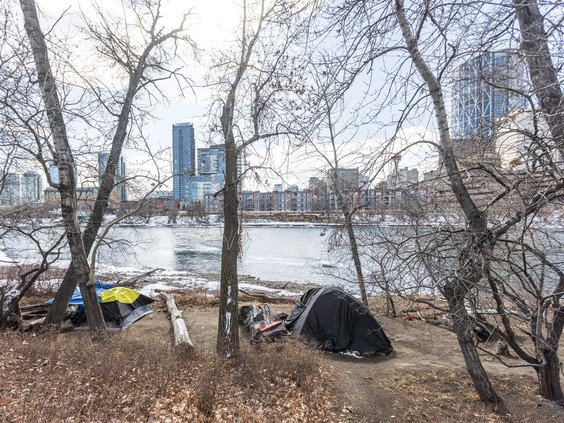
A homeless encampment photographed on the north bank of the Bow River in Calgary.Brent Calver/Postmedia
"I do think this is, in a lot of ways, a test of who are we as a community." "Some people who I'd put in the fed-up category, they're not bad people. They would describe themselves as left of centre, and sometimes very left of centre, but at some point they reach the breaking point." "I think those of us in the service-provider community always knew we weren't going to solve the problem. But I think the expectation was we were going to make a significant dent." "So on the one hand, the message is we have all these resources to quote-unquote solve this problem. And what the general public sees is, it's not getting solved, it's not getting better, it's getting worse." John Maceri, chief executive, People Concern social services agency, Los Angeles
"I think they care more about animals than us." "They're making parks for dogs, but they're not building housing for us." Lucrecia Macias, nurse, cancer patient, homeless
"They'll kick you out of stores." "They won't even let you into laundromats to wash your clothes. The bus driver won't pull over." Lynell Cain, resident of tent encampment, Los Angeles
"Putting mentally ill people and people with drug abuse problems in residential areas is careless." "This is definitely a more complicated definition than just homelessness. Even during the daytime, I fear walking alone." Paneez Kosarian, technology company employee, San Francisco
California has about 140,000 homeless residents -- a quarter of the nation's homeless population. Richard Vogel, AP
Little wonder she does. In September she was attacked by a man outside the front door to her apartment building. A homeless man who warned her the world had been taken over by robots. And then he attacked her. A closed-circuit security camera's footage showed her desperately wrestling with the man. That footage made local news coverage, linking the episode with other attacks carried out by homeless people who appeared to be on the spectrum of mental illness. Peoples' sense of security and personal safety linked to where they live is being eroded.
Lucrecia Macias, the nurse who now lives as a homeless person in Los Angeles had her own house in Palmdale. And then dark fate stepped in when she was diagnosed with cancer and she soon saw herself in deep financial straits when she lost her home. She sees sympathy being evinced for the well-being of peoples' companion pets, but none extended to those like herself living rough as a result of her middle-class life having been disrupted, effectively ruined, lost to the cost of her medical care, leaving her to wander disconsolate on the streets, feeling abandoned by society.
There was a proposed municipal plan for a homeless shelter in a waterfront district of new office buildings and condominiums. Ms.Kosarian who had that frightening encounter with a homeless man and other residents referred to city estimates reflecting half of the homeless people in San Francisco having issues with substance abuse when they opposed the plan. An issue they feel is being overlooked when the finger is pointed at a lack of housing causing homelessness. The city's mayor stated that San Francisco was prepared to enforce a state law to force mentally ill people off the streets. Where to?
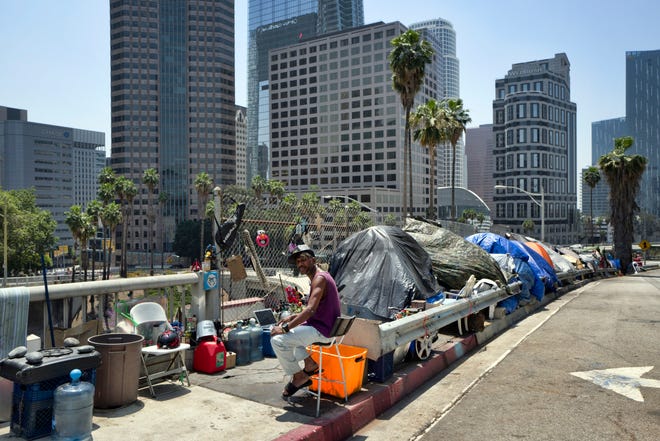
Homeless encampment in Los Angeles, Sept. 23, 2019. (Mario
Tama/Getty Images)
Open-air drug dealing in some areas of Los Angeles and San Francisco is rampant. In those same areas human feces litter the streets along with discarded needles and syringes. California cities have always had a homelessness problem, but in recent years, it has become epidemic. In Los Angeles, the city counted up to 59,000 homeless people, a huge increase over the past few years. According to a poll by the Public Policy Institute of California released a month ago, for the first time in two decades Californians cite homelessness as a major concern.
Bill Bedrossian, chief executive of Covenant House California, a shelter non-profit group with programs for homeless youth, cites frustrations evinced by the public as illustrating an "increase in the lack of empathy. People don't want homeless people near them." When Covenant House wanted to open a centre to house and offer counselling services for up to 30 young people, the community resisted. "It's the worst it's ever been, as far as the backlash", he commented.
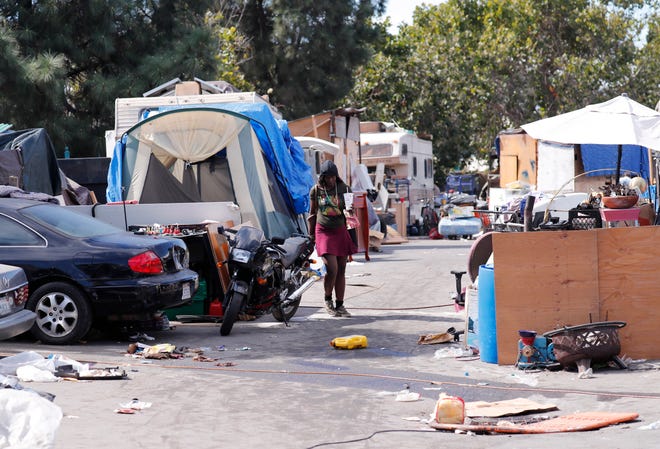
Homeless encampment, Oakland, California. John G.Magabanglo, EPA-EFE
In San Francisco, residents installed boulders on sidewalks as deterrents to people erecting tents and sleeping there. Homeowners in Los Angeles installed prickly plants nearby sidewalks for the same purpose. There are grassy areas that have been fenced off with green plastic in hopes of restraining homeless people from putting up tents and building encampments. In San Fernando Valley, L.A., the experience of homeless people living in Chatsworth was to suffer rocks thrown from cars, insults shouted at them, and pepper-spray targeting them.
"When people think about the homeless crisis, sometimes humanity goes out the window. People say, 'I don't like what's going on. I don't want them near our school, get rid of them'." "When people complain, they are not combining the complaint with a compassionate solution." Candice Elder, founder, executive director, East Oakland Collective
It is not easy, shouldering the burden of being your brother's keeper, not anywhere, not even in one of the wealthiest states in the wealthiest nation on Earth. The problem is endemic and it is everywhere, from nations struggling to join the cadre of developing nations to those countries where economic development has gone hand-in-hand with increased trade, business development and advances in technology, none of which has solved the problem of homelessness.
San Francisco police officers wait as homeless people collect their belongings. Ben Margot, AP
Adding Substance to Homeless Lives by Subtracting Tobacco
"Tobacco affects you head to toe, every single organ in your body." "If you can quite tobacco, you can quit crack, heroin, whatever it happens to be." Dr. Smita Pakhale, respirologist, clinical researcher, The Ottawa Hospital
"It goes hand in hand, [smoking and drug use] it's very much like milk and cookies. If you can reduce or quit smoking, you can quit anything." "I wondered how relevant it would be in the beginning, like how hand-in-hand these things are, but [smoking] kinda opens the door to the other issues [mental health and addiction]." Kelly Florence, peer researcher
"I've had a lot of people who made other changes once they started seeing progress with the reducing of cigarettes." "I've got a lot out of it [the study]. I've learned a lot of new skills. I feel comfortable with myself." "I got my confidence and self-esteem back." Tiffany Rose, peer researcher
Dr. Smita Pakhalé, a staff
respirologist at The Ottawa Hospital and clinical researcher, led
research designed to reduce smoking in a drug-using population. She
stands outside a clinic on Murray Street with two of her peer
researchers, Kelly Florence, left, and Tiffany Rose.Julie Oliver / Ottawa Citizen Among those in the science-health community involved in researching the trials and tribulations of people living on the street, a new consensus has arisen, that smoking-related diseases are on the rise, striking street-livers in huge numbers. An Ottawa conference was addressed by a physician out of Boston in the fall that his multi-year study of 287,000 homeless patients indicated that tobacco and alcohol remained the leading killers, not the abuse of hard drugs.
Now, a study of 858 HIV-positive drug users that began in Ottawa in 2013 has revealed the unexpected statistic that 86 percent were smokers. Which brought Dr. Smita Pakhale, a "lung doctor" into the picture. As a health professional on the front lines she had become frustrated with "band-aids" at the clinical level, deciding to puzzle out the source. Which is to say the results of heavy smoking.
Her interest focused on the vulnerable population of street people, suffering pulmonary disease, strokes, cancers of every conceivable kind, rotten teeth, and additional sicknesses. Her small team has completed a study. For convenience purposes that study took place next to the Shepherds of Good Hope shelter, well used for the non-judgemental assistance it offers to the city's street population.
Traditionally, medical professions regarded smoking in the homeless population as incidental to the greater problems afflicting the unhoused, people who often had a history of mental illness and substance abuse. Smoking was considered to be relatively benign, a source of creature comfort, not the scourge that it is held to be in the general population. Dr. Pakhale thought otherwise.
The PROMPT (Participatory Research in Ottawa: Management and Point-of-care of Tobacco) research resulted in unexpected discoveries, that drug users who reduced or abandoned their smoking habit cut back or quit their abuse of other substances at the same time, thus improving their overall physical well-being. Mr. Florence who was himself a homeless person with addictions spoke of four young drug users and smokers who all entered treatment once they quit smoking.
The 44-year-old Kelly Florence and 33-year-old Tiffany Rose, signed on to the social work aspect of agreeing to help Dr. Pakhale through roles assigned them as a peer research team, monitoring the participants of the study. The study guidelines took shape over a period of a year, and in 2015 it began to seriously track participants' progress. The participants were 80 smokers who also abused drugs.
Initially a survey was completed then a nicotine-replacement program was instituted, and participants checked in to the team at least once monthly A nurse with expertise in smoking cessation was present twice weekly while the peer researchers themselves were approachable on a constant basis. This, along with life-skill workshops were held in a multi-pronged approach to helping the homeless help themselves.
The study participants were given nicotine substitutes; a patch, gum, lozenge or inhaler. They had their lungs tested. They were motivated by being paid $25 for attending monthly check-ins. By the time six months had elapsed 53 percent remained in the study. Of that number, nine percent had stopped smoking while 80 percent reduced tobacco use, and 70 percent reported reducing or stopping other substance abuse.
Dr. Pakhale recently presented her study results at an American medical conference. She envisages the program established on a more permanent basis, and transplanted other cities. She emphasizes that peer engagement along with a suitable, off-hospital location are key to the success of such a program.
"We as a city have got to come together, so that we can build a movement with other cities and force this on the national agenda." Seattle Mayor Edward B. Murray "You step in there [homeless encampment], and it's like you're not even in the United States anymore." "The human waste, the solid waste, the drugs, the tents -- even when you have areas of poverty around the world, you don't see it all in one place." Chief Harold Scoggins, Seattle Fire Department
"Even though we're all beyond frustrated and disappointed with some
of the results, including the increased count on the streets, which is
devastating, we have accomplished a lot of good work that we have been
recognized for." "Thousands of people have gotten a
roof over their head. The problem is there's been a significantly
higher inbound flow of people coming into the homeless cycle than we
anticipated." "We have a very thriving, healthy, growing GDP [Gross Domestic Product]
economy. We're creating poverty at unprecedented levels at the same
time. That's a broken economy fundamentally. There's
something inherently wrong with our economic structure." Dan Brettler, CEO, Seattle-based Car Toys, co-chair Seattle Committee To End Homelessness
Tents are pitched illegally on a sidewalk in Seattle in
January. The number of people sleeping outside in the city shot up by 20
percent in just the past year.David Ryder/Reuters/Landov
Seattle, Washington is doing very well, thank you, its tech-driven economy is on the booming track to continued growth and prosperity. Its West Coast location has made it an extremely attractive venue, however, for homeless people, people who have suffered personal catastrophes that have resulted in lost jobs, lost marriages, lost homes, lost hope. And others who are afflicted with mental illness issues; others yet who are addicted to alcohol and drugs and cannot find their way home.
In November the mayor of the city, Edward Murray, declared a state of emergency over homelessness even though the city is seen as having the problem well in hand. The city is regarded as having solved to some degree the distress of homelessness, recognized elsewhere as a model in housing the homeless. Seattle has devised a city-wide-supported strategy to set aside areas where tent camps are authorized, where social services are available and rules of civil conduct govern.
Sharon Chang, ThinkProgress
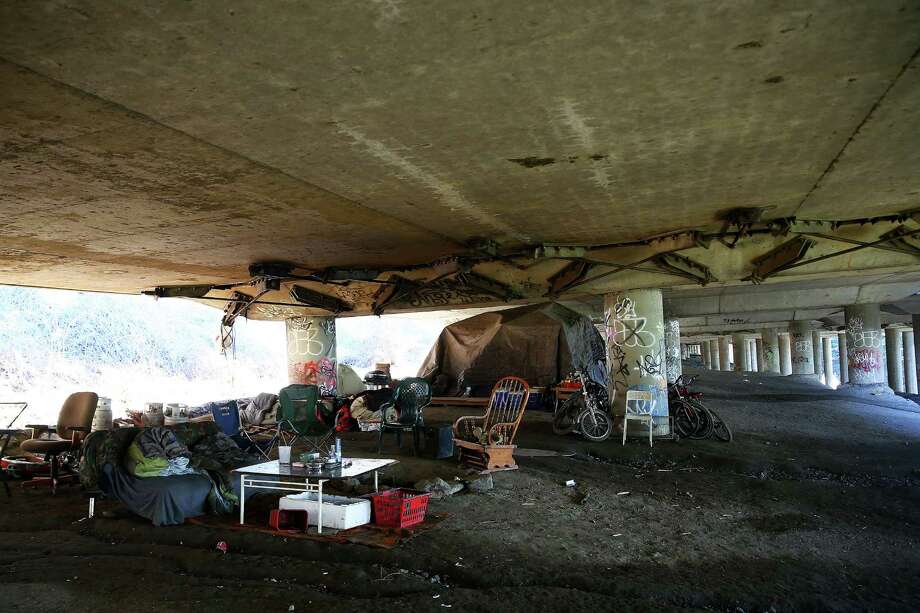
There is a problem, however, in the existence of an outlier encampment whose residents consider their tent city their permanent home. That home is located in downtown Seattle, but residents can be forgiven for not being aware of its hidden existence. It is the city's largest homeless camp, and it exists among the pylons under the city's major highway. All together there is an estimated 10,000 people without permanent shelter in King County, with its population of over two million residents.
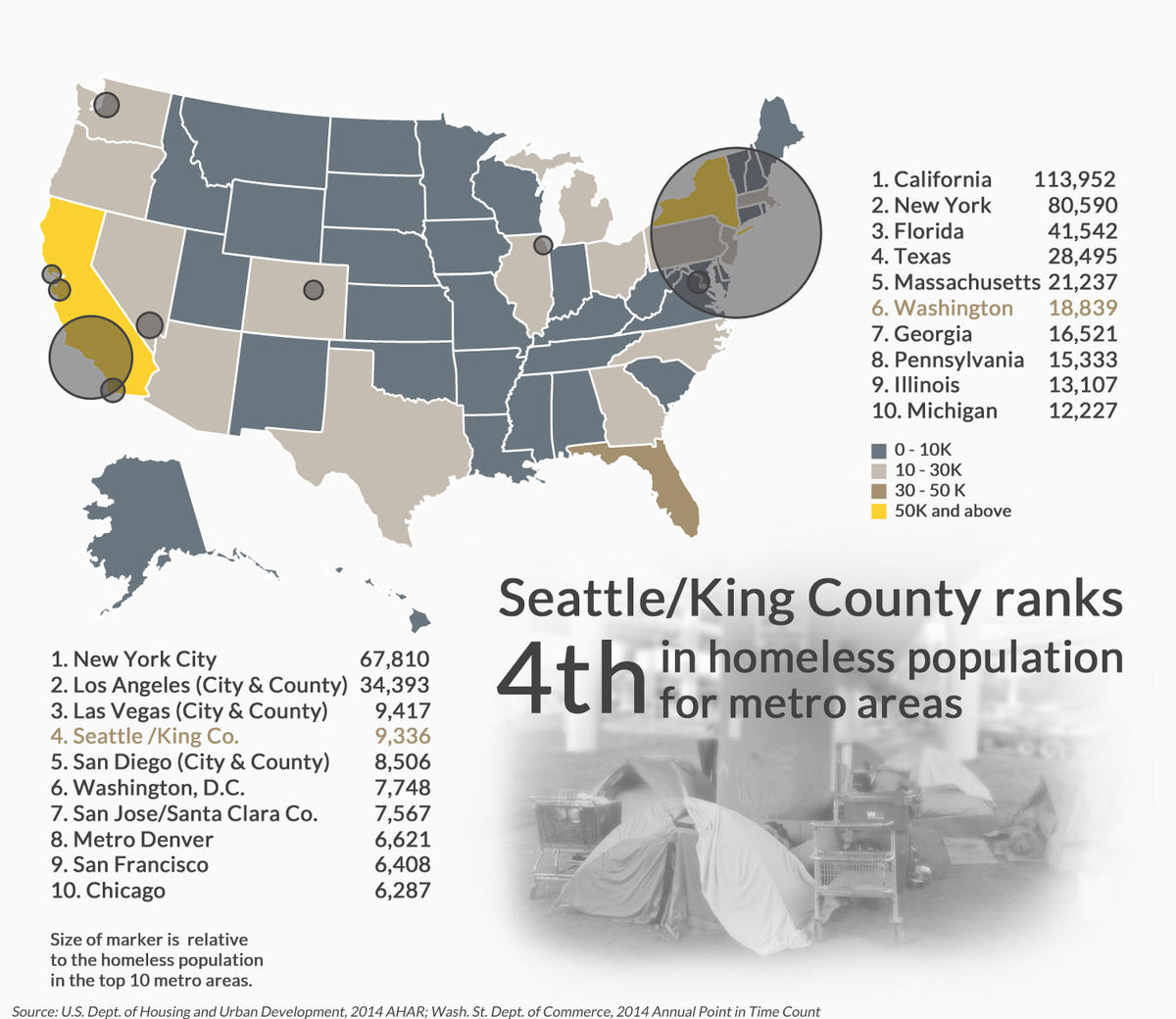
The population of the illegal encampment which is popularly referred to as the "Jungle", a five-kilometre stretch of unseemly territory under Interstate highway 5, which 400 souls call home. For whom there is nowhere else to go that appeals to them. Seattle has the dubious distinction of being recognized as a prosperous city whose homeless population numbers have soared. They are higher than that of any metropolitan area aside from New York and Los Angeles.
The San Francisco template of a healthy economy where the high tech sector is leading a boom, also leads to unaffordable rentals and finds its echo in Seattle. Those who can afford the high rents don't end up homeless. Those that cannot, often do. In the jungle, it could be said that a mixed-economic-social condition exists. Yes, there are the hard-core heroin addicts, but there are also couples and people with jobs, unable to afford to live in high rental properties.
"The Jungle," a unauthorized homeless encampment under Interstate is shown on Feb. 2, 2016. Photo: GENNA MARTIN, SEATTLEPI.COM
It was Mayor Murray's intention to clear out the Jungle, performing that public good in a measured way and offering improved alternatives to the residents. It takes money to do that properly. And there are complications, since the Jungle exists on state property, since the land under the highway is state land. Over the years funding allocated by the federal government for public housing has dwindled, just as mental health and addiction treatment have received less state funds.
Seattle Police and Fire Department crews know the Jungle fairly intimately. They have responded to over 820 emergency incidents over a five-year period. Of those incidents, 70 were violent, 500 were emergency medical calls, and 250 of them were fires.
"I don't think there's much question that in a better climate where you can stay warm and dry at night, that will have an impact [on where the homeless choose to migrate]." "It's not a narrative that gets talked about a lot. The number of people in homeless shelters is just the tip of the iceberg." Nick Falva, director, research and data, Calgary Homeless Foundation
"The word is out that there are certain places in Canada ... where those behaviours [drug and alcohol addiction, mental health issues] will be more likely tolerated." "[It's] not really that remarkable a find [that homeless people are moving to Vancouver." Julian Somers, lead author, report on homelessness in Canada
"All the planning was based on the assumption that if you built enough housing everything would be hunky-dory. As it turns out ... it ain't that easy." "[A] new generation [of homeless people began flooding in to Vancouver from as far as Ontario; younger, drug-addicted, aggressive and averse to help]." "It's not the shuffling guy with his hand out; they're getting angrier. People are scarier. It's taken on a very different public persona." Kerry Jang, psychiatrist, Vancouver city councillor
Vancouver is known as a laid back place with a mild climate where the homeless can look forward to certain advantages not so widely available elsewhere. A 20-hour Greyhound bus trip to the West Coast doesn't cost all that much. There have been other studies identifying patterns of homeless people taking to migrating to cities where a reputation for aid to the homeless beckons. Cities as far-ranging as Osaka, Japan to Sao Paulo, Brazil, to New York City.
The West Coast of North America is disproportionately receiving homeless people. According to a 2013 study, five of the seven largest homeless populations have congregated along the Pacific Ocean, in Los Angeles, San Jose, San Diego, San Francisco and Seattle, south of the Canadian border. In 2008, then-mayoral candidate Gregor Robertson campaigned on a pledge to end homelessness by 2015.
His "housing first" campaign was based on an idea that before drug addiction on the streets can be fought, the need to house the homeless must first be addessed. An aggressive social housing building event took place with the government of British Columbia lending over $143-million to the enterprise that resulted in a network of cheap, "single-room occupancy" hotels in hopes of rehabilitating this segment of the population.
And it succeeded very nicely, reducing the homeless count. And then it shot up again. Where there were 536 people sleeping outside, homeless in 2015, increased from a high of 273 in 2014. Middle-aged alcoholics comprised the majority of the homeless in 2008, and they were mostly housed in 2008. Victoria too, on Vancouver Island has been receiving waves of homeless people. Notoriously a downtown park is now occupied by a tent city.
Steven
L'Heureux, left, and Gord Ross live in a tent city that is growing next
to the Victoria courthouse. It began with one or two tents in August
but has since expanded to 20 to 30.
Photograph By
DARREN STONE, Times Colonist - See more at:
http://www.timescolonist.com/news/local/neighbours-fed-up-with-tent-city-next-to-victoria-courthouse-1.2119100#sthash.wKzsK9vm.dpuf
Steven
L'Heureux, left, and Gord Ross live in a tent city that is growing next
to the Victoria courthouse. It began with one or two tents in August
but has since expanded to 20 to 30.
Photograph By
DARREN STONE, Times Colonist - See more at:
http://www.timescolonist.com/news/local/neighbours-fed-up-with-tent-city-next-to-victoria-courthouse-1.2119100#sthash.wKzsK9vm.dpuf
Photo, Darren Stone, Times Colonist
The Government of British Columbia produced campers to provide alternative housing and food in Victoria. They bought a $3.65-million building to house the homeless, but it was all rejected by the residents of the tent city. Protesters from the population at large supported their ongoing occupation of the park which has turned the nearby area into a crime hub, where discarded needles and public defecation enriches city life.
In Medicine Hat, Alberta, the city chose to become the first city in Canada to end homelessness. Their success was brief, attracting homeless people from afar. Housing has been found in the city of 61,000 for 885 people, an estimated 45 percent of them new to the city. "That was actually quite alarming to us", admitted Jaime Rogers with the Medicine Hat Community Housing Society.
Somers' team followed 400 homeless people over a ten-year period to identify an emerging and clear pattern. Mentally ill people settle into the Downtown Eastside, beginning a steady routine of hospital admissions, clinic visits, arrests and court appearances. Health goes into a downward spiral and after racking up hundreds of thousands in city services, they die at an early age: "This is clearly not a positive story."
"It's criminalizing mental illness. How will we be viewed, 20, 30, 50 years from now? We'll be looked on as the ones who locked up all the mentally ill people." "It really is one of those things so rich with irony: The same society that abhorred the idea that we lock people up in mental hospitals, now we lock people up in jails." "Fiscally, this is the stupidest thing I've seen government do." "We've systematically shut down all the mental health facilities, so the mentally ill have nowhere else to go. We've become the de facto mental health hospital." Thomas Dart, Cook County sheriff, Chicago
Canada’s correctional authority continues to face increasing costs
and challenges in managing a higher proportion of the offender
population with mental health concerns. The most recent data available
indicates that the Correctional Service delivered at least one
institutional mental health service to 48.3% of the total inmate
population, with 47% of Aboriginal offenders and 75% of women offenders
receiving services in FY 2011-12. Just over 90% (or 4,065) of newly
admitted offenders were comprehensively screened for potential mental
health problems last year; nearly two-thirds were flagged for follow-up
mental health interventions. The Service also delivered Fundamentals of Mental Health training to 2,438 staff in fiscal year 2011-12.20
It was no doubt costly to maintain mental hospitals where people whose mental instability represented a danger to themselves and others around them, were locked into these facilities for their own good and that of society. Except that it wasn't a happy solution to the people who were incarcerated in these facilities, regardless of the medical treatment they received, never quite adequate to really help them, just to sustain the status quo.
And so, under the subterfuge of releasing these people who actually did require ongoing medical intervention, although a more useful type of intervention more suited to their individual needs, not necessarily institutional, but institutional if no other solutions could be found, society agreed that it would be more humane to release them, to allow them to care for themselves. Whether they would then take their medications, whether they might be able to function adequately, another story.
In the end, the growing incidence of homelessness, people living on the streets, the societally marginalized, the lost and confused, petty criminals, those incapable of keeping body and soul together grew, and one of the constituents of that growing base of the homeless was in fact individuals with mental illness whom no one was prepared to care for any longer. The institutions that once housed them, after all, were closed 'for their own good', allowing them liberty and freedom.
For many it meant the freedom to cope as best they could, and often enough their best wasn't good enough. But they were free to live on the streets and to persevere. Psychiatric disorders are now recognized as commonplace enough in general society; those who have family support and access to good medical care are able to function. Those without all of those supports turn to other means of survival and at times those means come up hard against the yardsticks of the permissible.
Infractions of the social order means that an arrest and prison are inevitable. Who speaks for the homeless, after all? Over half of the prisoners in the United States are adjudged to possess a mental health problem, according to a 2006 Justice Department study. The figures are even larger when it comes to female inmates; almost three-quarters live with a mental disorder. There is no reason not to believe that the numbers are similarly reflected in Canada.
Sheriff Dart speaks of working days when 60% of the jail's intake report some mental illness diagnoses. It's his opinion that the system is senseless and quite dreadful, on top of which it's an extremely expensive way to treat mental illness. The choice is not his, however. He takes in schizophrenic, bipolar, depressive and psychotic individuals delivered by local police forces to become prison inmates.
Not that facilities do not still exist for the mentally ill; they do. In 1955 there was a single bed in a psychiatric ward for every 300 Americans; there is now one for every 3,000 Americans, according to a 2010 study. More effective pharmacological treatments are available, freeing up the necessity to welcome patients into care, as long as they are adequately monitored and enabled to function. They also must be able to afford medication.
"Some people come here to get medication. They commit a crime to get in", observed a superintendent of a women's unit at the jail. "When I'm not on my medication on a regular basis, I don't make decisions well", explained one female inmate diagnosed with depression and anxiety disorders. Outside of jail her prescribed medication costs $100 monthly which she cannot afford.
Researchers at the University of British Columbia surveyed hundreds of homeless people in three B.C. communities where substance abuse is particularly acute. They found that homeless people who regularly attend church or other religious ceremonies are less likely to consume alcohol, cocaine and opioids. "Religion may have a protective effect on substance-use behaviours. Indeed, several of our participants indicated ... that their faith 'keeps them clean'," the paper by Dr. Iris Torchalla and Prof. Michael Krausz of the UBC School of Population and Public Health declared. The study appears to link an association between less substance use and religious attendance without proving a cause-effect relationship, in the opinion of Dr. Lisa Lefebvre, head of addiction medicine at the Centre for Addiction and Mental Health in Toronto.
Spencer Platt / Getty Images A
homeless man rests in a pew at a Times Square church on December 12,
2013 in New York City. A Canadian study has found homeless people who
attend religious service once a week are less likely to indulge
addictions to alcohol or drugs.
Of 380 homeless adults surveyed in Vancouver, Victoria and Prince George who claim some religious faith, 60 reported they attend services at least once weekly, according to the report published in the Community Mental Health Journal. "When people are homeless or suffering from a mental illness, there is often a stigma, or a feeling of not belonging", said Shawn Lucas, head of the spiritual care department at Toronto's Centre for Addiction and Mental Health.
Spencer Platt / Getty Images Participants in a Canadian survey of the link between addiction and religion told researchers their faith 'keeps them clean.'
"Usually when people attend a religious organization, there is a sense of belonging." It is not only a sense of community that all human beings require to satisfy their emotional needs. It becomes incumbent on their community to pay attention and commit to services and humanitarian aid to help the homeless find a home for themselves, irrespective of their mental condition; at the very least to help them find safe haven.
"Once I started using that church, feeling good about myself, my friends started taking me into their places. Good things started happening for me." "I was inebriated so often that I really didn't give a thought about it until I actually went. I was a wreck." "Slowly, through time, the staff started helping me out, got me a pair of glasses, just helped me get my dental work done, and they supported me when I was sobering up. Now I'm housed. I don't really drink any more." "At the (other) shelters, there's just way too many people. I never felt that any of my stuff was safe. I didn't like that whole scene." Kyle Hiemstra, 26, Ottawa
Kyle
Hiemstra, left and outreach worker Jason Pino and chat in the basement
of First Baptist Church on Laurier Ave West. Pino and the church
received a bylaw exemption allowing them to shelter a small number of
homeless people one night a week on a trial basis. Photograph by: Chris Mikula
, Ottawa Citizen
"We've had absolutely no issues at all - no thievery or stealing. There's never been an issue of having to call the police. There's been no acts of violence." Outreach worker Jason Pino
"We're heating the building. We have the space. It seems foolish just to let the mice run around. I'm not saying we have mice, but it's kind of a waste of space, in my view, if (a shelter) can be done responsibly. So why not?" First Baptist Church Rev. Scott Kindred-Barnes
Sometimes it takes the compassion of strangers to fill in where family and friends have thrown up their hands in exasperated surrender to their inability to aid a young and vulnerable and dreadfully needy family member. Sometimes it's lack of patience, or of adequate dedication to the weary, soul-searching task at hand to apply themselves to the arduous effort required to turn a young person's life back to what is considered socially normal. Sometimes it may be indifference.
So thank nature for all that is good and altruistic that resides in the hearts and conscience of people who have nothing personal to gain in going to great lengths to help those whom fortune has deserted. People like Jason Pino who worked for a year to finally get the City of Ottawa's approval to use his church as a temporary, safe shelter meant specifically to give aid and encouragement to young people living on the street.
"A lot of churches are known as places of sanctuary ... we felt we should be allowed to do this" explained Mr. Pino, who operates the church shelter program through what is called Restoring Hope Ministries charity. It has proven to be such a successful humanitarian enterprise at the local level that the City of Ottawa is now looking around to find other churches willing to similarly commit their premises and supervision to emulating the First Baptist Church.
It wasn't an easy transition from living on the streets to tentatively agreeing to give this new haven a chance. Kyle Hiemstra began staying overnight once a week in the church's basement in the company of five other young people in need of emergency housing. When he finally did arrive for the first time, he liked the shelter. He slept on a pullout cot, chatted with others and played board and video games. "I don't really see it as a church", he said, still returning occasionally.
According to Ottawa's Alliance to End Homelessness 7,308 people used shelters in 2012. The city is looking to broadening interest among places of worship for the accommodation of service of this kind, city planner Alain Miguelez, explained. "What we basically want to do is something that's well suited for Ottawa", he said of the program that first began in Toronto in 1987 following the winter death of a homeless man.