Mercury Contamination in West Africa's Artisanal Gold Mining
"If it hurt right away, like a knife, people would stop. But the issue is that it takes years for the dangers to manifest.""People are dumping it directly into the river. They're burning it in the open, releasing toxic smoke into the air."It's extremely dangerous.""Kedougou has rich land -- very rich land. Now mercury is everywhere. Our animals consume it, and it comes back to us.""Even the soil is no longer fertile."Doudou Drame, president, Observatoire Territoriale du Secteur Extractif, Kedougou, Senegal"Women are much more exposed than men.""People used it [mercury-free gold processing unit] for a while, but then they stopped, because one single unit can't cover an entire community. Naturally, those who were nearby could use it. But for those who are very far away, they can't afford to transport the ore all the way, process it and then go back. It's extra work. That's a problem.""There's a new administration in place, but promises are still just promises. The solution is to install the gold processing units within the communities -- at least one per village."We need to convince communities that even if they make more money using mercury, in the end, they'll spend that profit on treating illness caused by it. The long-term consequences are far worse."Modou Goumbala, manager, La Lumiere, southeastern Senegal NGO
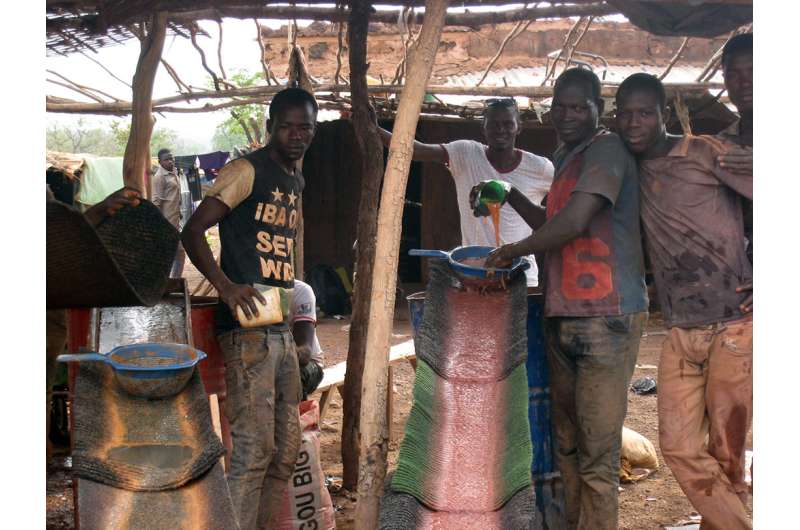 |
| Senegalese gold miners process their ore to produce gold. Duke University |
The dominant technique for the extraction of gold from ore across West Africa -- mercury, a potent neurotoxin -- persists in informal mining, much of which is illegal and unregulated. In gold-rich Kedougou region of Senegal, women use mercury regularly, and most often without using protective gloves and masks. Exposure to mercury can result in irreversible brain damage, developmental delays, tremors and loss of vision, hearing and co-ordination.
Once released into the atmosphere, mercury spreads through air, water and soil. The metal contaminates rivers, poisons fish and accumulates up the food chain, particularly in the wake of heavy rains. Mercury levels in soils, sediments and water near artisanal gold mining villages in southeastern Senegal were found by a 2018 study led by Duke University to exceed safety thresholds set by the World Health Organization and the U.S. Environmental Protection Agency by ten to 100 times.
Mercury is prized for its ability to quickly bind to gold in artisanal mining. The liquid metal is mixed into crushed ore, and then heated -- often over open flames -- to evaporate the mercury, where a lump of gold is then left behind; a cheap, effective -- and dangerous process. Small-scale artisanal gold mining is the primary global source of mercury emissions, exceeding the burning of coal, according to the UN Environment Program. Artisanal mines in Senegal alone are estimated to release between 12 and 16 metric tons of mercury annually.
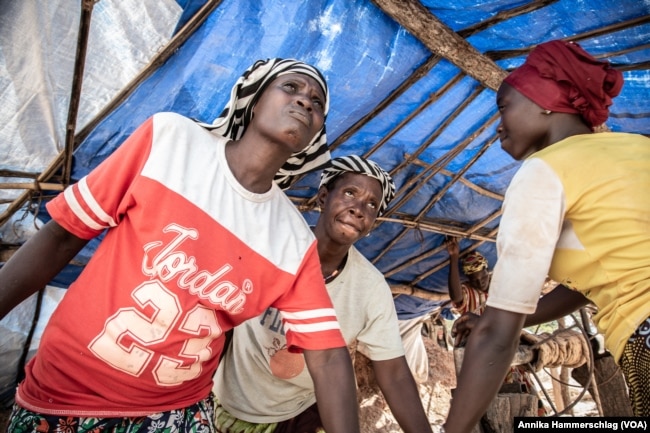 |
| Women make up about half the gold miners in Senegal. Here, women work at a gold mine in the country's Kedougou region |
Pregnant and lactating women exposed to mercury is particularly dangerous, since the metal is able to cross the placenta, placing fetuses at risk of developmental delays and birth defects. Through contaminated breast milk, infants may absorb the toxin. Mercury evaporates over heat, leaving behind a kernel of gold. No protective mask or gloves are used, just the raw materials and bare hands. Typically, children stand close by, watching the process and breathing the fumes.
Gold processors in Senegal tend to process between five and 10 grams of gold monthly, earning themselves between $370 to $745, more than double the national average salary of about $200. The substance is widely accessible, with supplies arriving from Guinea, Mali, Burkina Faso and Ghana, according to a 2022 report by the Institute for Security Studies. The government promised it would build 400 mercury-free gold processing units in 2020. Only one so far has been constructed; a facility that uses gravity to separate gold from ore, eliminating mercury by relying on sluices and shaking tables.
To curb pollution, Senegalese authorities suspended mining temporarily within 500 metres of the Faleme River which cuts through Senegal's gold belt, forming part of the border with Mali. Weak enforcement left officials struggling to stem the influx of informal miners, many arriving from neighbouring countries. A measure that barely scratches the surface of the problem, according to critics. Access to clean water is a problem, leaving women to use local contaminated waterways to bathe their children, wash clothes and clean dishes.
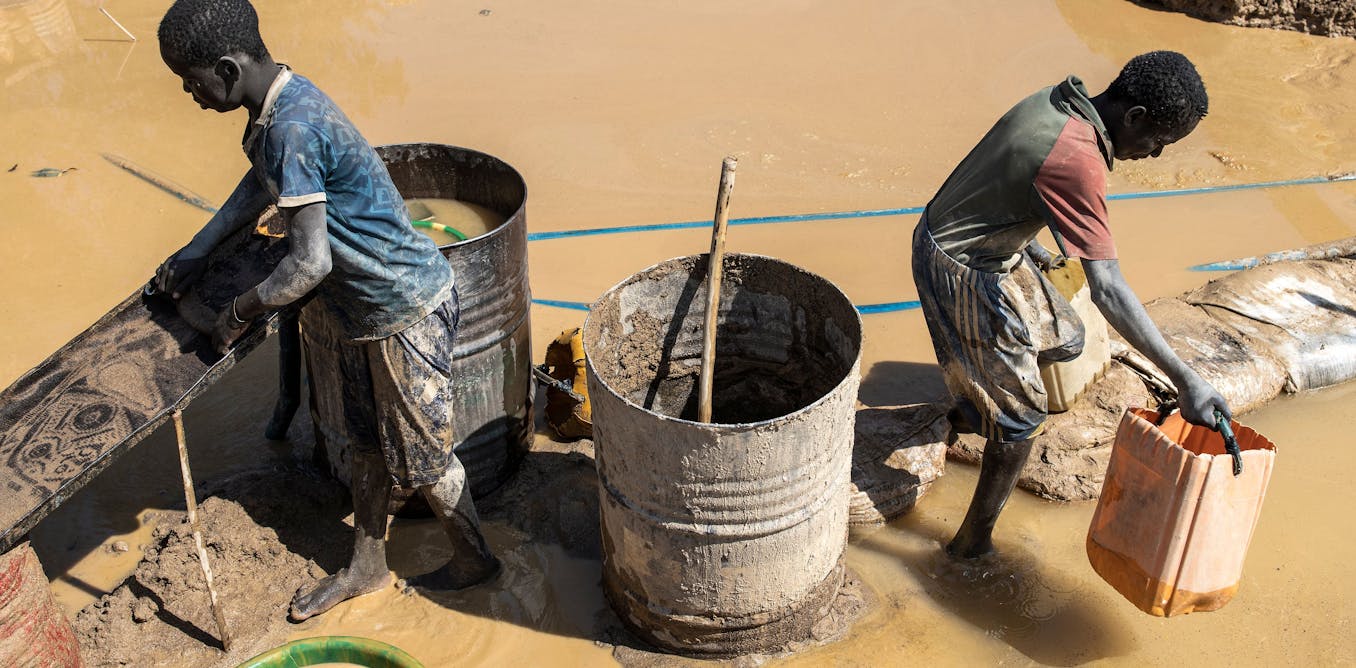 |
| Artisanal gold miners pan for gold at the Bantakokouta gold mine, south-east Senegal. John Wessels/AFP via Getty Images |
Labels: Artisanal Miners at Risk, Environmental Contamination, Mercury, Processing Ore Into Gold, Senegal, West Africa
posted by Pieface @ 9:14 PM


0 Comments:
Post a Comment
<< Home