A Benevolent Uyghur Employment Opportunity in China?
"[Such allegations are] nothing but vicious lies concocted by anti-China forces. [The Uyghur Forced Labor Prevention Act is interference in China's internal affairs].""[All residents in Xinjiang] enjoy happy and fulfilling lives.""Xinjiang-related issues are not human rights issues at all, but in essence about countering violent terrorism and separatism."Washington Chinese Embassy"Uyghur society is going to be changed in the long term through labor transfer. So it's a long-term strategy, and that’s why China is doubling down on it.""China is intensifying it because with labor transfer you can achieve cultural assimilation.""You can achieve linguistic assimilation. You can break apart communities – traditional communities – and break apart families."German Scholar Adrian Zenz, director, China Studies, Victims of Communism Memorial Foundation, Washington"The so-called forced labor is only a groundless accusation.""Isn’t there any right to work for minority ethnic groups such as the Uyghurs in Xinjiang?""If you make them unemployed, unable to work, and unable to sell their products under the pretext of forced labor, is this humane?"Chinese Foreign Minister Wang Yi
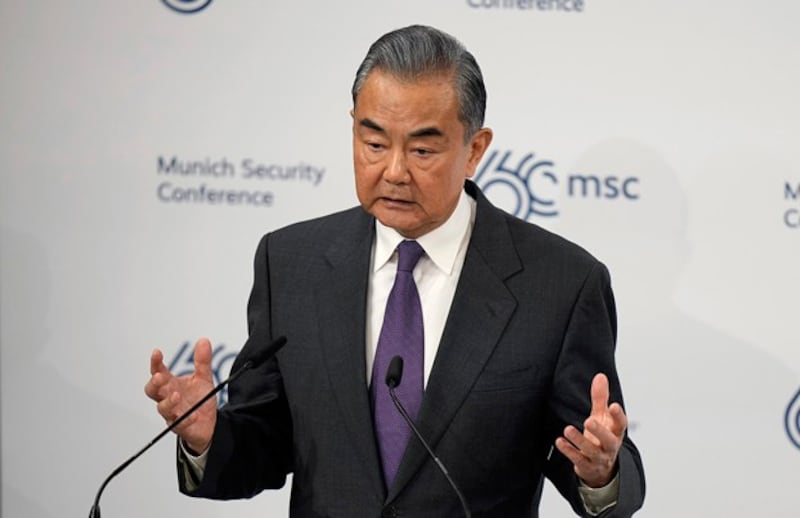 |
| Chinese Foreign Minister Wang Yi delivers a
speech at the Munich Security Conference in Munich, Germany, Feb. 17,
2024. (Matthias Schrader/AP) |
Supply-chain auditors and border and customs officials involved in identifying labour abuses and blocking import of tainted goods, appear to have little knowledge around China's more recent placement of Uyghurs from Xinjiang in factories across China, involved in the production of a wide range of goods that will be identified with brand-name products around the world. The United States and the European Union adopted laws to prevent consumers and businesses from funding the persecution of China's Uyghurs.
Tracking the relocation and treatment of workers from Xinjiang to factories across China is an endeavour vexed with practical difficulties, quite unlike targeting imports known to emanate from Xinjiang province. Tens of thousands of Uyghurs have been dispatched by China's government to work in factories located outside of Xinjiang. Although the workers earn salaries, labour conditions of their workplace are unknown. U.N. labour experts, scholars and activists claim the programs reflect well-documented patterns of forced labour.
According to China, participation by Uyghurs in these out-of-province, across-China programs is strictly voluntary. A great favour is being done the Uyghurs by the Beijing in moving them to workplaces across the country, in the process exposing them to economic opportunities, a situation that ends up addressing chronic poverty in Xinjiang. The rejoinder by experts and activists is that Uyghurs have little choice but to accept job assignments.
The programs, they insist, fold into Beijing's design to exert control over a minority population historically engaged in resisting Chinese rule. Uyghurs, a Central Asian, Muslim people live in Xinjiang, up to 12 million-strong, on the border with Kazakhstan.
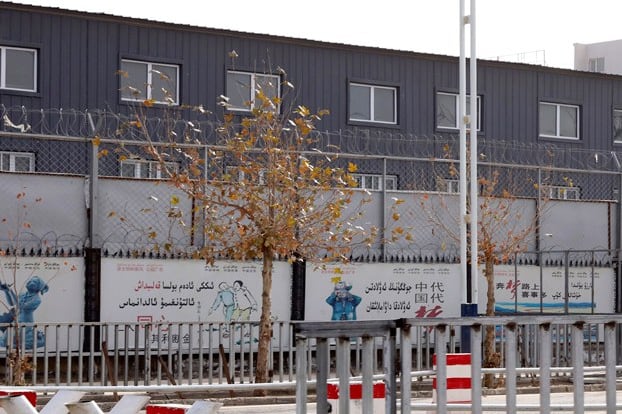 |
| Two layers of barbed wire fencing ring the Hotan City apparel employment training base where Hetian Taida Apparel Co. has a factory, in northwestern China's Xinjiang region, Dec. 5, 2018. The U.S. blocked shipments from Hetian Taida in 2019 over accusations the manufacturer was using forced labor. (Ng Han Guan/AP) |
The Uyghur Forced Labor Prevention Act bars imports into the United States from Xinjiang made with forced labour. Reports place forced labour in various places; prisons, mass internment camps and large-scale relocation programs regionally. The regional production of cotton, textiles, critical minerals and solar panels is involved. Videos demonstrate other Central Asian minorities from Xinjiang -- Kazakhs and Kyrgyz people included -- who also are persecuted, and the U.S. law covers their work production as well.
A number of discreetly interviewed workers hesitatingly suggest they labour under close supervision at arranged jobs, requiring permission to leave factory grounds, new on arrival. At some factories, security guards confirm Uyghur workers had been sent by government agencies. Other workers interviewed claimed to have willingly agreed to take the offered jobs, and remain as workers of their own accord.
A worker in Hubei Province spoke of himself and 300 other Uyghurs living in a dormitory separate from staff comprised of the majority Han Chinese population. The Uyghurs were assigned minders from their home counties in Xinjiang, and were permitted to leave factory premises and should they wish to return to Xinjiang, a month's notice is required. Working up to 14 hours daily, a monthly salary up to 6,000 yuan ($837) is earned; the national average for a factory worker in China.
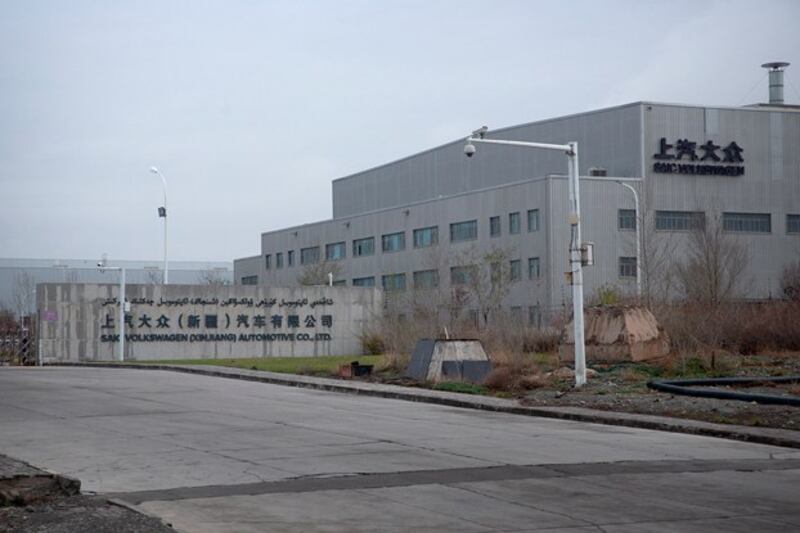 |
| The SAIC-Volkswagen plant is seen on the outskirts of Urumqi, capital of northwestern China's Xinjiang region, April 22, 2021. (Mark Schiefelbein/AP) |
The government identified 3.2 million transfers of Xinjiang's labour in 2023. The U.N. agency, International Labor Organization, reported in February that the labour transfer programs appear to use measures "severely restricting the free choice of employment". A wide range of multinational companies rely on suppliers to which Uyghur workers have been assigned. The programs are part of China's dominant role in the global economy.
The Uyghur workers process chicken for McDonald's and KFC restaurants in China while others make products for export, such as washing machines for LG Electronics and footwear for Crocs. German automakers, including Volkswagen, Mercedes-Benz and BMW attempted to address the sensitive forced labour issues. Over 100 companies were identified as receiving Uyghur workers or parts or goods produced by them, including LG, Tesla, Midea and KFC.
If suppliers are found to have been using forced labour they risk having their imported goods seized by U.S. customs officials. Some companies deny the use of forced labour by their suppliers. "Based on recent audits, we do not have reason to believe that any of our suppliers are in violation of our policies", stated Colorado-based Crocs.
Over a million Uyghurs were held by China in internment camps from 2017 to 2019, ostensibly to fight extremism. Once the camps closed, an estimated half million Uyghurs were sentenced to prison, according to rights groups. Xi Jinping, China's leader, informed officials during a visit to Xinjiang in 2023 that they should be vigilant against threats to stability and "encourage and guide Xinjiang people to go to the Chinese interior to find employment".
"This is not about poverty alleviation. This is about dispersing Uyghurs as a group and breaking their roots", charged Rayhan Asat, a rights lawyer at the Atlantic Council, whose brother has been imprisoned since 2016 in Xinjiang.
 |
| Residents line up inside the Artux City Vocational Skills Education Training Service Center, which was revealed by leaked documents to be a forced indoctrination camp at the Kunshan Industrial Park in Artux in western China's Xinjiang region, Dec. 3, 2018. Voice of America |
Labels: China, Employment, Human Rights, Turkic Uyghur Muslims, Xinjiang Province
posted by Pieface @ 8:13 PM


0 Comments:
Post a Comment
<< Home