Ruminations

Blog dedicated primarily to randomly selected news items; comments reflecting personal perceptions

Monday, September 21, 2026

Tensions Rising in Europe as Russian Threat Increases

"There is a real risk that drones or other types of missiles may fly into the territory of one or more NATO countries on the eastern flank, even cause destruction."
"[Russia's] official narrative will be that this is an accident and that there is no reason for anyone to think about any response from NATO."
"Sustained, very frequent and intense attacks are expected on six major Ukrainian cities, including the destruction of warehouses, all types of products essential for the country's defence, and, as we have witnessed very strongly in recent weeks, the railway infrastructure." 
Polish Prime Minister Donald Tusk
 
"[The security situation has never been] so serious and so tense." 
"Can anyone imagine that we're told to prepare 5,000 soldiers, 10,000 soldiers? And they'll go to fight somewhere we don't even know with whom, why or for what?"
Slovak Prime Minister Robert Fico 
https://media.cnn.com/api/v1/images/stellar/prod/ap26258301841710.jpg?c=original&q=w_1316,c_fill/f_webp
Lithuanian soldiers secure the area where Italian fighter jets shot down a drone during NATO's Baltic Air Policing Mission near Pratkunai village, north of the capital Vilnius, Lithuania, September 15.  AP
 
Addressing parliament, Prime Minister Tusk spoke of the Kremlin's plans to destroy the economy and logistics of Ukraine, a conclusion supported by evidence intelligence services have gathered. Russia's plans extend to NATO's resolve, which it has focused on weakening by attacking the coalition's member states; in effect challenging them to respond. By launching 'hybrid style' drones and missile strikes against countries that are in support of Ukraine, NATO is being tested, even as the conflict launched by Vladimir Putin enters its debilitating fifth year.
 
As a key transit passage for Ukraine aid, Poland has undergone a number of suspicious incidents; multiple cyberattacks on public utilities. Critical domestic water, energy infrastructure and hospitals have been affected in Poland. The railway linking Warsaw to the Ukrainian border sustained damage that had all the hallmarks of Russian sabotage. Late July  saw a Russian missile crash in eastern Poland. Other NATO nations close to Ukraine have experienced similar, albeit fewer such 'warnings' related to Mr. Putin's 'special military operation'.
 
At a time when Moscow has intensified its attacks against Ukraine, inclusive of targets adjacent the Polish border, NATO jets responded by shooting down a drone of Russian origin over Lithuania a week earlier. Slovak Prime Minister Robert Fico made it clear that Slovakia, while taking its commitments to NATO seriously, he is prepared to do whatever he can to ensure that his country not be pulled into a conflict of uncertain value and outcome, in his opinion.
 
The fact is that Mr. Fico speaking for Slovakia does not regard Russia as posing a security threat. Advocating rapprochement with Moscow, he clearly diverges from other NATO members' concerns regarding the threat to their security posed by Russian President Vladimir Putin's territorial ambitions, pining for a return to the Soviet era with eastern Europe appendages of Greater Russia. The consequences of invoking NATO's Article 5, requiring all coalition members to act in defence of one another are unthinkable in Mr. Fico's considered opinion.
 
https://media.cnn.com/api/v1/images/stellar/prod/gettyimages-2281574181.jpg?c=original&q=w_1316,c_fill/f_webp
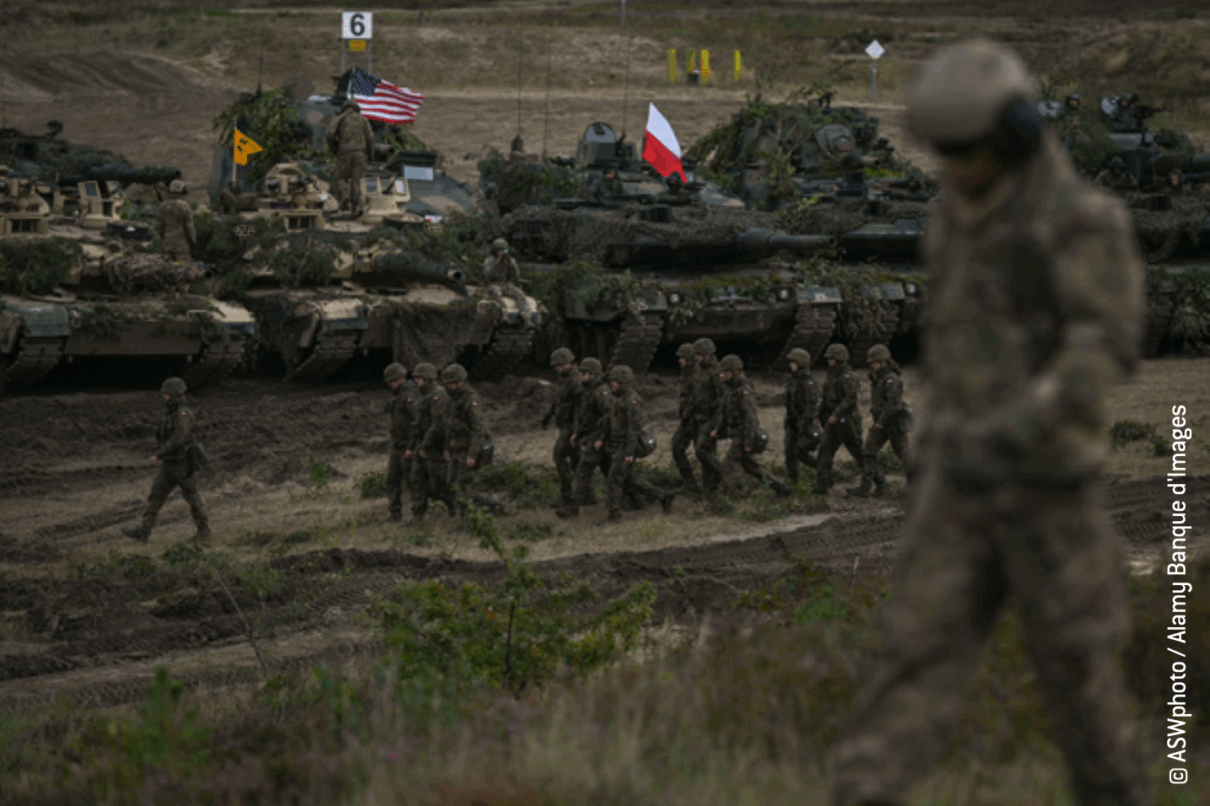
Military personnel from Poland, Lithuania, and France take part in training exercises during Operation Brave Boar 26 at the Orzysz Land Forces Training Center near the Suwalki Gap in Poland, on June 17.
Damian Lemanski/Bloomberg/Getty Images
 
"The path the world is on leads straight to the gates of hell. It is leading  us to World War Three", added Czech Prime Minister Andrej Babis, another critic of the European mainstream, at the IISS Prague Defence Summit. On the opposite side of the equation, the "rapidly worsening" situation concerning security and energy supplies in the face of conflicts afflicting Ukraine and the Middle East, motivates French President Emmanuel Macon to meet with government, party leaders and military and security officials to address the issues.
 
The oncoming, inevitable difficult winter ahead has Kyiv's full focus, along with that of its western allies. In meeting with Ukrainian President Volodymyr Zelenskyy, Mr. Tusk spoke of the potential of co-operation through the "anti-ballistic coalition", and to fully address Ukraine's energy infrastructure, once again in Putin's crosshairs in the coming months. 
 
It is not only Eastern Europe that has become alarmed over gathering dark clouds of war. In the United Kingdom, its government has given notice that people should prepare to stockpile canned food and drinking water in preparation for the possibility of war as Britain faces the 'most dangerous' threat in decades. Hospitals in Germany are preparing for the possibility of an attack by Russia, with Chancellor Friedrich Merz warning of "decisive moments, defending the freedom and peace of our continent". Switzerland too issued calls for resilience and preparations to defend itself against an armed attack. 
  
https://media.cnn.com/api/v1/images/stellar/prod/gettyimages-2274879379.jpg?c=original&q=w_1202,c_fill/f_avif
Russian soldiers who participated in the military invasion of Ukraine march through the Victory Day parade in Moscow, May 9th. Getty Images
"[The Kremlin isn't ready for] any serious talks about a ceasefire, not to mention peace without -- de facto -- Ukraine's capitulation."
"They [the Russians] are convinced the winter will be tragically critical for Ukraine."
Polish Prime Minister Donald Tusk 

Labels: , , , ,

Friday, August 07, 2026

Poland, Building a Resilient Defence System Against Russian Expansion

"This is a watershed moment in the history of both Poland and the European Union [with the signing of the Security Action for Europe defence budget]."
"Poland will be safer in these difficult and highly risky times."
Polish Prime Minister Donald Tusk (May 2026), Warsaw
 
"Poland has long warned the rest of Europe of Russia's expansionist ambitions, even when other EU leaders weren't always willing to listen."
"Poland sees itself as a guarantor of regional security along the EU and NATO's eastern frontier, including the more vulnerable Baltic states. 
"[Poland's history with Nazi and Communist occupations has made its leaders] wary of being caught unprepared for foreign aggression."
"NATO's resolve is the single biggest deterrent to a westward expansion of the current conflict. Poland led the way at the start of the full-scale [Russian]invasion of Ukraine by supplying weaponry to the Ukrainians, that some said would lead to 'escalation'."
"[A key indicator of the program's success] will be a strong and sovereign Ukraine, because stability to Poland's east is inseparable from Poland's own."
Dominic Roszak, president, Canadian Polish Congress
https://d39raawggeifpx.cloudfront.net/styles/16_9_desktop/s3/articleimages/bneGeneric_Poland_soldiers_military_army_Military_uniforms_of_Poland_(5)_WIKI_COMMONS_Cropped_7.jpg
Poland is spending more on defence than any other large EU nation. / WIKI COMMONS
 
With mysterious cyberattacks on Polish railways and hospitals; drones and missiles straying across Polish borders; jets scrambling to intercept Russian aircraft over the Baltic, it is more than obvious to Polish politicians that the imperative for deterrence is here and now, not at some indeterminate time in the future when it might face an existential crisis. Now, a European Union loan has enabled Warsaw to commit close to 44 billion euros toward upgrading its military infrastructure.
 
Poland has become the largest single beneficiary of Security Action for Europe's 150-billion-euro defence budget to modernize its military, expand its domestic arms sector and reward Polish companies collaborating with defence manufacturers. Poland has long plannede to commit 4.8 percent of the Nation's GDP to defence. Poland's link with Canada will see them pursue "joint projects involving emerging technologies", according to the Canadian Department of National Defence.
 
https://smartcdn.gprod.postmedia.digital/nationalpost/wp-content/uploads/2026/08/0801-na-poland_299930040.jpg?quality=90&strip=all&w=564&h=423&type=webp&sig=dFF6cMDVssLG_Izia8_hPg
Poland is investing billions in a major military build-up to deter Russia, strengthen NATO and bolster European security. Photo by WOJTEK RADWANSKI /AFP via Getty Images
 
"For us, safety -- or I would say lack of safety - is a very present topic. It started long before the full state invasion of Russia to Ukraine."
"Russia has been always a threat for centuries. And we know that there is not much needed for Russia to be encouraged to attack again, either us or Baltic states."
Natalia Walsh Iwaszko, former vice consul economic affairs, Consulate General of the Republic of Poland in Toronto  
According to Minister Bartosz Grodecki, head, National Security Bureau of the Republic of Poland, in the almost 30 years in NATO, Poland has "transformed from a recipient of security to a creator of it". Poland, he stated, is aware that in "the event of an attack,the costs of a defensive operation and the consequences of wartime destruction will be far greater than those incurred in building a resilient defence system." 
 
https://www.fondapol.org/app/uploads/2025/09/capture-decran-2025-09-11-a-09.51.43-1210x806.png
As a result of the current paradigm shift and the consequent reconstruction of the international order, Poland is taking massive action to ensure its national and international security.  fondapol.org
 
"[Poles today] are conscious of bad things happening. It's a part of Polish history ... So they are attuned to kind of, better be prepared, and prepare for the worst, hope for the best, and work for the best."
"Reliance on America for moneys [sic] and/or sophisticated systems, which need constant replacement and upgrading [is precarious and unpredictable] with [U.S. President] Donald Trump being Donald Trump." 
David Lesperance, Lesperance & Associates, Gdynia, Baltic port city, northern Poland 

Labels: , ,

Thursday, July 30, 2026

Ukraine, A Nation At War Becoming a Military Power

https://www.regionalstudies.org/wp-content/uploads/2020/01/sm-iStock-498504418-300x200.jpg
"Ukraine is now capable of striking Crimea, threatening Russian supply lines."
"Ukraine is fighting. Ukraine is still suffering. Russian missiles have so long hit civilian targets that it is no longer even remarked that such were once recognized as war crimes."
"More sobering, while Ukraine fights on, it is not evident how the war might end. It is entirely possible that Ukraine may not lose, but still not win definitively."
Fr. Raymond J. De Souza, National Post 
https://assets.cfr.org/images/t_gct_w1200/v1765909329/globalconflicttracker/Ukraine_05/Ukraine_05.jpg?_i=AA
Ukrainian infantry soldier in Donetsk trench. Reuters
 
When Russia first fully invaded Ukraine in February of 2022, Poland received almost two million fleeing Ukrainians. No refugee camps resulted. The Poles welcomed the refugees into their homes. A million such Ukrainian refugees are still left in Poland, sheltering themselves from constant Russian bombardment of missiles and drones over Ukraine's cities in the Kremlin's direct targeting of civilian populations, a noted war crime. 
 
More recently, a revival of Polish right-wing populism has arisen and with it hostility to Ukraine, shifting to viewing Russia's Vladimir Putin with a measure of tolerance. Memories are not dead in Poland to the reality of Ukrainian World War II alliances with Hitler's death squads, helpfully assisting in the murder of Poles and Jews through the auspices of the Waffen SS, where an SS battalion of Ukrainian volunteers was formed, during the Nazi occupation of Ukraine. 
 
https://upload.wikimedia.org/wikipedia/commons/thumb/d/db/Nachtigall_Battalion.jpg/250px-Nachtigall_Battalion.jpg
Nachtigall Battalion in 1941
Ukrainian auxiliaries were involved in the murder of Ukraine's Jews. Some of their leaders are still heralded as war heroes in Ukraine to the present day. Poles were their victims as well, while the Soviet military eventually became their liberators from the Nazi extermination project. Russia's President Putin has used that history to explain his full-scale invasion of Ukraine; 'liberating' it from the neo-Nazis still presumably governing the country from Kyiv.
 
Even the Trump administration's soft spot for Putin expressed by President Donald J. Trump has had its influence, which  tended to view Ukraine with suspicion and Russia with a degree of admiration. There has been a levelling off of President Trump's expressed fondness for President Putin now that Ukraine's resolute self-defence has finally put Russia's plans on the back foot. No one appears to have realized that the Russian territorial grab of 2014 when it annexed Crimea and incited rebellion in the Donbas would lead to a full-scale invasion.
 
https://assets.cfr.org/images/t_gct_w1200/v1772290651/globalconflicttracker/2026-02-28T103013Z_800024804_RC2XUJAU14VO_RTRMADP_3_IRAN-CRISIS-BLAST/2026-02-28T103013Z_800024804_RC2XUJAU14VO_RTRMADP_3_IRAN-CRISIS-BLAST.jpg?_i=AA
February 28, 2026 joint strikes by U.S./Israel on Tehran, Iran.  Reuters
 
Ukraine now is recognized as an Eastern Europe military power, producing its own armaments even while it continues to rely on military aid from Europe and North America. Ukrainian President Volodymyr Zelenskyy has been welcomed as an adviser for the Gulf countries under attack by Iran in response to the U.S.-Israel 2026 aerial attacks. Ukraine's formidable counteroffensive while producing millions of advanced drones, has enabled it to hit Russian targets from Moscow right up to Siberia. 
 
Ukraine's fervent wish to become a member of NATO will be realized, post-war. There have been errors in judgement made by President Zelenskyy and he has been brought up short by public anger over them, as when his appointed defence minister and the chief of the Ukrainian military were at loggerheads, the former opting for a new approach in meeting the enemy, the latter wedded to the tried-and-true conventional responses with conventional weaponry. 
 
When given an ultimatum to make a choice, the president fired his popular defence minister only to face days of demonstrations by furious Ukrainians, forcing him to reverse his decision. And the war goes on.
 
Ukraine's President Zelenskiy meets with major general Drapatyi in Kyiv
Ukraine's President Volodymyr Zelenskiy meets with Major General Mykhailo Drapatyi, amid Russia's attack on Ukraine, in Kyiv, Ukraine. Ukrainian Presidential Press Service/Handout via REUTERS
 

Labels: , , , , ,

Sunday, July 19, 2026

Ukraine's 'Blood Experience' Parlaying Drone Expertise for Military Technology

 
"One night in March, a two-person Ukrainian crew established a record  for the Ukrainian Armed Forces by shooting down, in one engagement, 23 Russian Shahed drones with Sting interceptor drones designed by the Ukrainian military technology company Wild Hornets. The story is noteworthy not only for the number of intercepted drones, but also for the operation’s cost efficiency and Ukraine’s interceptor-production capacity behind it."
"A Sting interceptor costs about $2,500. In comparison, a single U.S.-made Patriot interceptor missile that does the same job costs more than $3 million and requires significantly more time and resources to build and operate than a drone. Lockheed Martin produced approximately 600 of the most advanced PAC-3 type of Patriot missiles last year; meanwhile, the Ukrainian Armed Forces used about 700 of these interceptors in the span of only four winter months in 2025-2026."
"The conflict in the Middle East has further exposed the shortcomings of a high-end, slow-production approach to defense systems. In March 2026, when Iran launched hundreds of Shaheds at Persian Gulf states, countries with the most advanced U.S.-supplied air defense systems outside NATO watched their defense capabilities erode as their interceptor stockpiles drained quickly. The air defense systems worked as intended, yet they were not designed to protect against the intensity and scale of Iran’s attacks."
"Kyiv is building drones in massive quantities out of wartime necessity against Russia’s ongoing full-scale assault, now in its fifth year. A key part of that necessity is Russia’s large-scale use of Iranian-made Shahed drones against Ukrainian cities and infrastructure. That Russian campaign has raised serious questions about Iran’s responsibility under international law. In response, Ukraine is rewriting the global rules of air power and air defense, replacing sheer mass and large stockpiles of weapons as key factors in warfare with the benefits of quantity, speed, and the ability to learn faster than the enemy. It is a novel and adaptive, low-cost military-industrial model that is already catching the interest of other countries."
Lesia Bidochko, Just Security
 
https://breakingdefense.com/wp-content/uploads/sites/13/2023/05/230526_ukraine_quadcopter_GettyImages-1468749342-scaled-e1693994223641-768x432.jpg
Ukrainians train with handheld drones. (Photo by Sean Gallup/Getty Images)
 
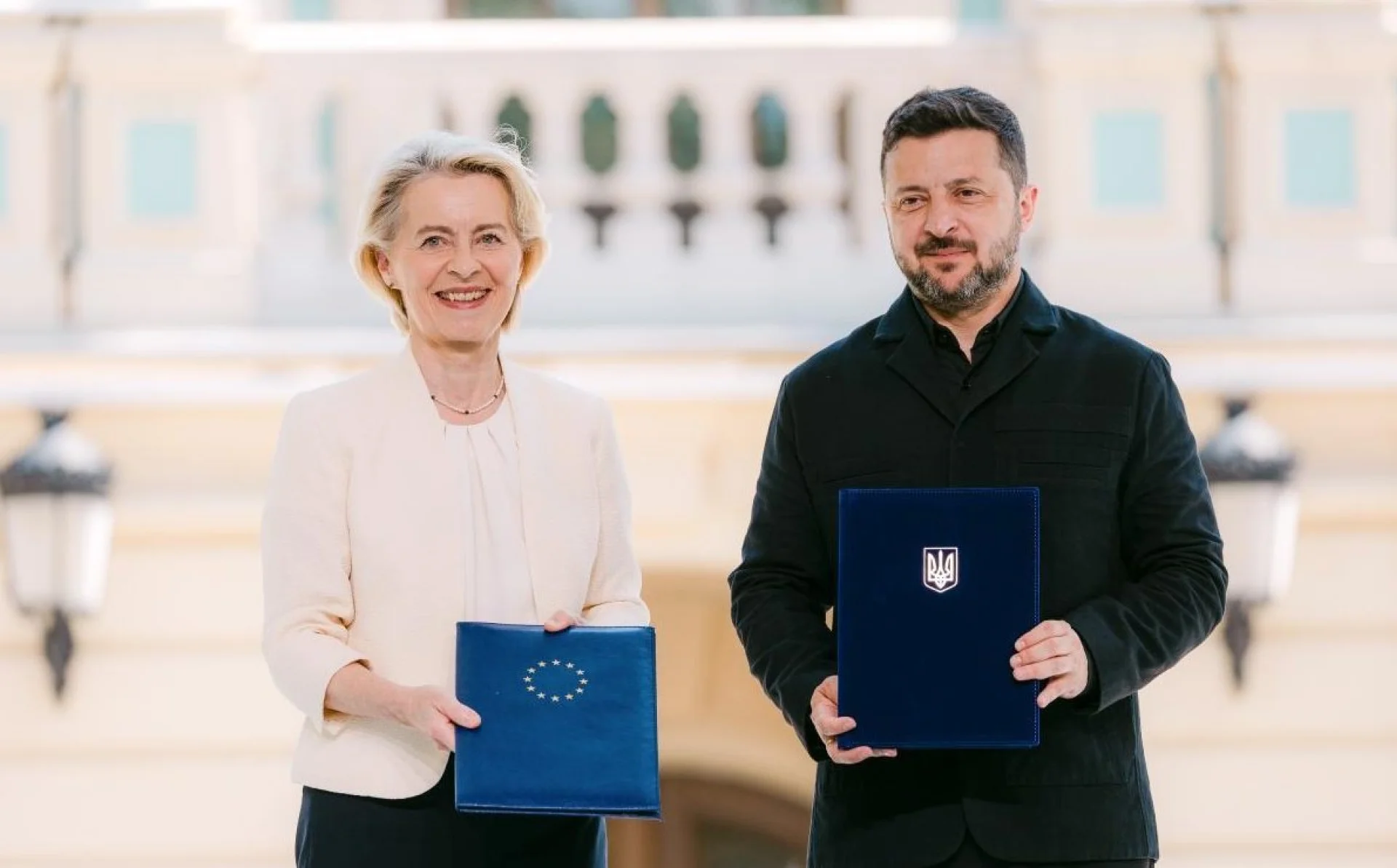
"Together we can work on joint production, on making all of the components of the systems work, and provide both defense industrial bases with the impetus needed to step up investments and production [following The European Union and Ukraine's drone deal to merge Ukrainian expertise in unmanned warfare with the continent’s industrial capacity, with the goal of ramping up production of drone and counter-drone systems]."
"In Europe, we already have huge technological and industrial capacity that can be deployed. And we have safe and secure production sites that can help to scale up. But we do not have that battle-tested knowledge and expertise that Ukraine has forged. So the point I am making is that we need to combine our strengths. Together, we can work on joint production."
European Commission President Ursula von der Leyen 
https://euneighbourseast.eu/wp-content/uploads/yootheme/cache/b8/p-070254_00-43_02-high-18891-e1784191790901-b853af08.webp
EU launches Ukraine defence industrial partnership, Drone Deal and disburses €1 billion for drones  EU Neighbours East
 
Kyiv can be credited with many outstanding features in this uneven war imposed upon Ukraine by Vladimir Putin's ambitions to restore Greater Russia; among them the courage and intestinal fortitude to counter the full-scale invasion in its fifth year and add to that the determination to win this war, whatever it takes to repel the Russian beast. And nor can its ingenuity in designing new technological weapons of its own manufacture to match anything Russia obtains from the Islamic Republic in this new era of drone warfare, much less its entrepreneurial enterprise in marketing its products and its experience be overlooked.
 
So while Russian drones -- the Iranian Shaheds -- have wrought their weight in deadly measure as a means to kill thousands of soldiers and civilians in Ukraine, countermeasures to Russia's innovative first-person-view vehicles, jet power, fibre-optic tethers and similar innovations have led to Ukraine developing its own versions in countering the Russian military's. EU member-states such as Croatia, Spain, Italy, Poland, the Netherlands, France, Denmark and Germany now see their own firms aligning with Ukrainian companies that specialize in first-person-view combat drones.
 
Ukrainian President Volodymyer Zelenskyy, pushing the drone deals whenever and wherever he can now realizes a ready market. Where Hezbollah deploys unmanned aerial vehicles to attack Israel, and Iran uses them against several regional countries, a case in point. Kyiv has signed ten-year security agreements with Gulf allies Qatar, Saudi Arabia and the United Arab Emirates since the joint U.S.-Israel aerial attacks on the Islamic Republic which led to its missiles and drones hitting its neighbours' U.S. military bases. A proposal, Zelenskyy stated is "also on the table for our American partners".
 
https://assets.cfr.org/images/t_cfr_3_2/f_auto/w_1920/v1781208642/UkraineDrones_A/UkraineDrones_A.jpg
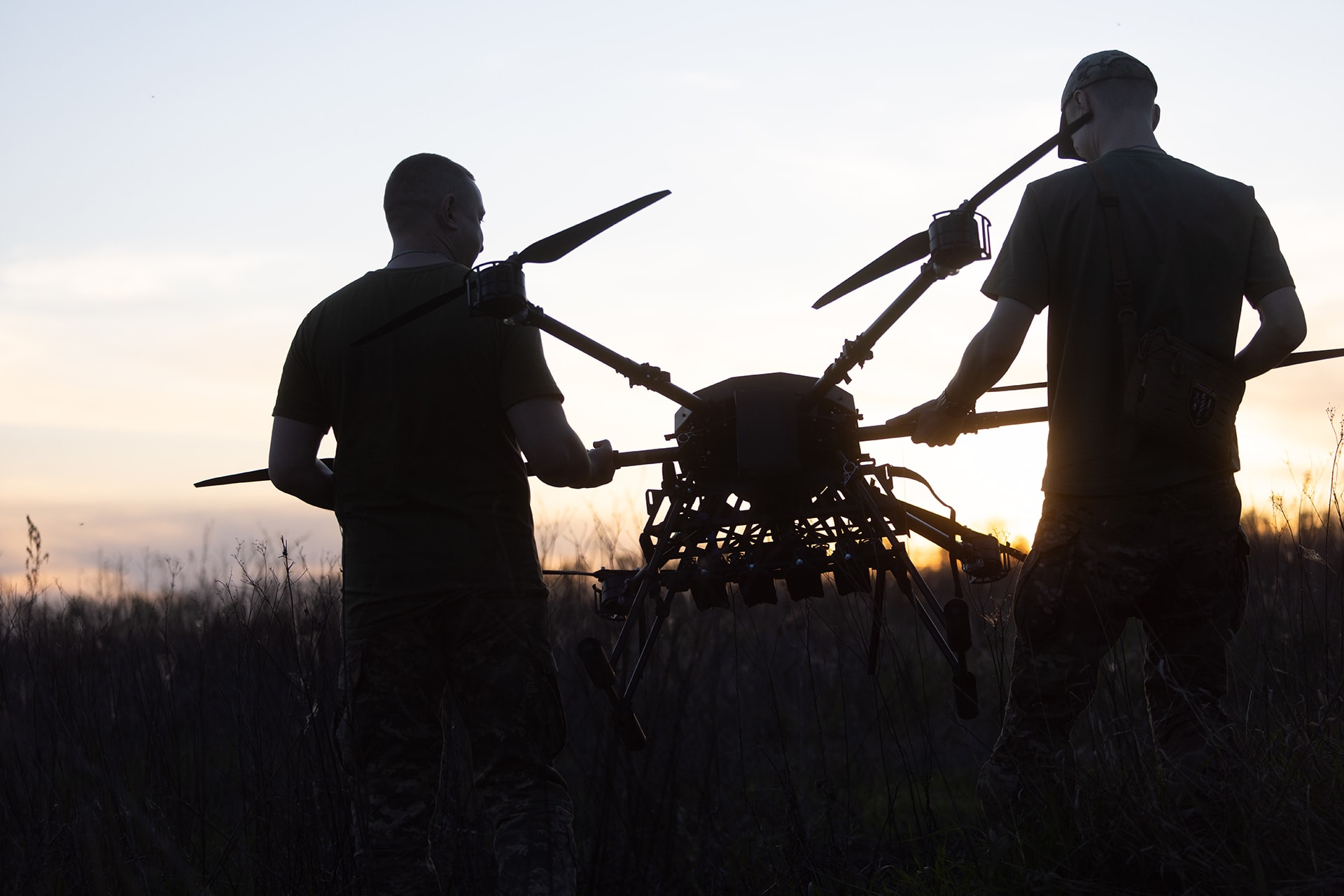
Ukrainian soldiers of the 127th Heavy Mechanized Brigade carry a Heavy Shot UAV across a field on May 8, 2026, in Kharkiv Oblast, Ukraine. Yevhen Titov/Global Images Ukraine via Getty Image
 
"Latvia will adopt Ukraine's unique combat experience in airspace defence against drone attacks." 
"[The deal includes] immediate access to technologies, but most importantly, the immediate arrival of Ukrainian anti-drone combat unit experts in Latvia."
"Our skies can only be protected if we follow Ukraine's example, know-how and experience." 
Latvian Prime Minister Andris Kilbergs  
A joint drone production facility is to be built near Latvia's border with Russia. Russia's Eastern Europe neighbours are fully cognizant of the potential danger they are in, following Ukraine's invasion, led by the Russian President's roving eye and territorial acquisitiveness. Kyiv anticipates more military and economic support, in particular American-produced Patriot missiles in short supply, given U.S. forces fighting Iran. Its breakthrough arrived when President Trump stated Kyiv would be allowed to make Patriot missiles itself in Ukraine.
 
"The terms must be beneficial for Ukraine, and the proceeds from exports must strengthen Ukraine's defence", stated President Zelenskyy of plans to release exports of Ukrainian drones. Reliance on early warning systems, radar, electronic warfare, mobile fire groups, helicopters, jet fighters and interceptors encompass Ukraine's anti-drone defences. Interceptors are increasingly being realized as the main line of defence for intercepting drones.
 
Over 100 Ukrainian companies produce interceptors. "We have approximately 15 to 20 very effective interceptors, which are also extensively used at the front", revealed Andrii Hrytseniuk, chief executive of Ukrainian government organization Bravel, providing a platform for the country's defence tech sphere. 
 
https://npr.brightspotcdn.com/dims3/default/strip/false/crop/6756x4504+0+0/resize/800/quality/85/format/webp/?url=http%3A%2F%2Fnpr-brightspot.s3.amazonaws.com%2F2a%2F3f%2F94838ea34ef89d3ad0aab35b86c8%2F7fe9e0cf-f2f3-4757-b380-2482f5095e99.jpg

A Sting interceptor drone flies during drills at the Yatagan School for Unmanned Aerial Systems in the Kyiv region, Ukraine, Efrem Lukatsky/AP

 
"There is no one single bullet. There is sort of this funny magical thinking that a lot of people are doing in terms of 'hey, just send us all your drones or your interceptors'. "
"And what people are sort of missing is that is, even though there's tech and that's what everybody sees, it's only one piece of everything." 
Deborah Fairlamb, American investor in military technology 

Labels: , , , , ,

Tuesday, July 14, 2026

Ukraine Unsettling Russia in Crimea

"There's no place to hide in Crimea."
"The Ukrainians have the ability to touch every single place where there's an air defense weapon or a logistics hub or an airfield."
Lieutenant General Ben Hodges, retired commanding general of U.S. Army Europe 
 
"To achieve the final objective, this blockade must be intensified."
"This situation must be maintained for a sufficiently long period of time."
Kostiantyn Mashovetz, Ukrainian military analyst
 
"According to announcements by Ukraine’s drone forces, the USF (Unmanned Systems Forces), dozens of electrical substations or other power infrastructure have been hit by Ukrainian robot aircraft across Crimea in recent weeks, with 38+ strikes claimed in the first week of July and 45+ in the second week of July. Besides power transmission and generation infrastructure, attacks have hit gas distribution stations and compressor stations."
"Most of the strikes have been carried out by Ukraine’s workhorse FP-2 push propeller drone, a slow-flying plane roughly the size of a large sofa. USF commanders have said attacks against the Russia-run power grid in Crimea are succeeding because of months of preliminary attacks that hit and destroyed Russian air defenses. The top Ukrainian target in those preparatory drone attacks has been Russia’s Pantsir gun/missile system, an air defense weapon designed to shoot down drones."
Stefan Korshak, Kyiv Post Senior Defense Correspondent 
Temporarily occupied Crimea (Photo: Reuters)
 
Crimea, annexed by Vladimir Putin in 2014 is being given very special attention at this point in time, a dozen  years later by the Ukraine military, where attacks in recent weeks have been increased substantially for the dual purpose of returning the critical geography to its rightful owner, as well as depriving the Russian military of its supply lines. The Kerch Strait Bridge is in Ukraine's crosshairs, the sole direct link to Russia. Ukraine has targeted bridges and roads in its bid to transform the peninsula from its current status as a Russian-occupied fortress into a military nightmare for the Kremlin.
 
This most recent wave of attacks saw Ukraine targeting air defense and radar systems across the peninsula. The energy grid and fuel reserves have also received attention from the Ukrainian military, battered to the extent that blackouts occur, shaking life in Crimea. Causing Russian forces along the southern front to shift into defensive mode. 
 
In the last week alone, Russia bombarded Kyiv, killing 30 people, in its own show of retaliatory force; its usual tactics, targeting civilian enclaves claiming they were aiming at military targets. A stark contrast in military priorities, where Kyiv focuses on military installations or fuel depots to deprive Russia of its critical fuel lines, and Moscow's response is to hit civilian areas.
 
Moscow's special attention toward its prize restoration of Crimea as part of Russia saw to it that years were spent fortifying the geography with advanced air defenses and coastal batteries, fighter jets and bomber-packed airfields -- while on land, missile launch systems abounded. Russia gave itself direct access to Crimea when it built the $3.7 billion Kerch Strait Bridge. 
 
Even in the conflict's first years, Ukraine had targeted Russia's naval headquarters in Sevastopol, driving Russian warships from Crimean ports. They were limited however, by the weapons in Ukraine's possession at that time. According to Ukrainian officials now, their arsenal is capable of inflicting more pain, in essence sufficiently so, to convince Moscow it needed to return to the negotiating table. 

A black and white image shows a tanker at sea at night.
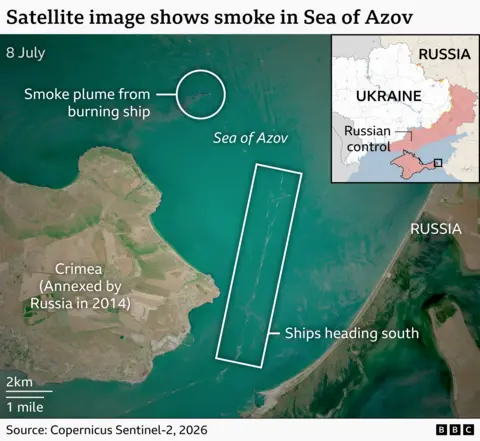
The view from a Ukrainian drone during what the military says was a strike against Russian tankers in the Sea of Azov. (Commander of Unmanned Aerial Systems Force/Reuters)
 
Videos were posted by Ukrainian military units in June of their Crimean strikes. The clips are a vital part of Ukraine's wartime propaganda, illustrating battlefield successes against Russia. Russian forces were increasingly attempting to counteract Ukrainian drone strikes by patrolling critical southern routes with drones and interceptor units, according to Kateryna Stepanenko, analyst at the Institute for the Study of War. "But they need more mobile air defense to blunt the impact of Ukrainian strikes" she noted. 
 
Ukrainian commanders anticipate that Russian troops would adapt, to shift their tactics in turn: "Adaptation can take days, weeks or months, but we consistently find new ways to strike in any direction, at any depth, with whatever assets we have", stated Artem Bielienkov, chief of staff of Ukraine's 412th Unmanned Systems Brigade. 
 
Widespread blackouts in Crimea have resulted from strikes on fuel facilities. Local authorities have declared a state of emergency, gas stations have run out of fuel, and thousands fled the peninsula since the latest strikes began by Ukraine. There were Ukrainian strikes on oil and gas storage facilities, compression stations and power plants.  
Map showing part of Crimea and the Sea of Azov
 
"The occupiers' attempts to fix the  damage to key facilities -- like the Tavria and Balaklava thermal power plants, major substations and fuel terminals -- are running into complex technical and logistical problems."
Hennadii Riabtsev, Ukrainian energy analyst 

Labels: , , ,

Sunday, July 12, 2026

Four Years and Counting...Putin's War

https://images.euronews.com/articles/stories/09/83/41/33/750x500_cmsv2_0d39763c-5a70-5bc7-bc6c-b0256c939ff9-9834133.jpg
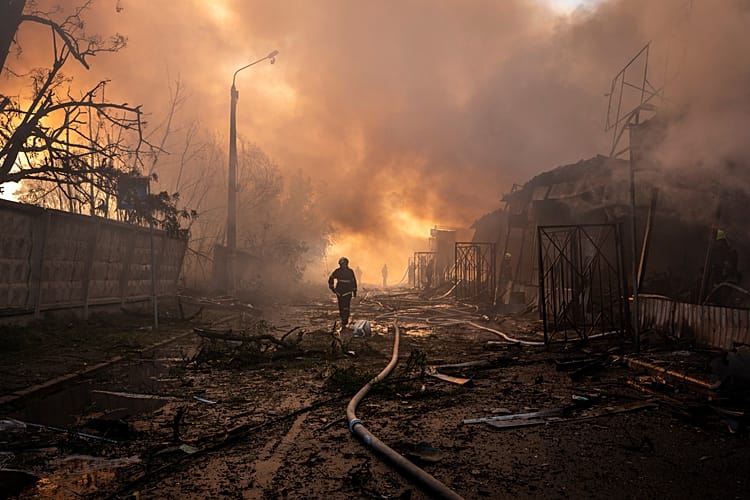
Firefighters try to put out a fire at a city marketplace following a Russian missile and drone attack in Kyiv, 15 June, 2026 AP Photo
"To intercept ballistics, we need the means for interception."
"Russians are certainly using the fact that there is a serious deficit of interceptor missiles now, in Ukraine and the world."
Ukrainian air force spokesman Yurii Ihnat
 
"As long as Patriot missiles remain in our allies' stockpiles, Russia is only encouraged to keep 'vanquishing' residential buildings."
"The United States and Europe have enough strength to stop this terror."
Ukrainian President Volodymyr Zelenskyy 
 
"When we were leaving the building, bodies were lying there."
"When we got downstairs, cars started exploding, and we came out from under the rubble straight into the fire."
Khrystyna Piatetska, 20, Kyiv's Darnytskyi district 
https://i.cbc.ca/ais/47328cf6-e499-4ed6-b752-be72cb649744,1783331242993/full/max/0/default.jpg?im=Crop%2Crect%3D%280%2C0%2C6000%2C4000%29%3BResize%3D796
Rescuers use a crane to remove debris while they work at the site of an apartment building, which was hit during Russian missile and drone strikes in Kyiv. (Oleksandr Ratushniak/Reuters
 
 It goes on and on. So far, Vladimir Putin's 'special military operation' has been the death of 15,000 Ukrainian civilians. The Russian military claims it aims its missiles and drones only at military targets. The reality is Moscow considers civilian infrastructure to be 'military targets' in its campaign to demoralize Ukrainians and place pressure on Ukraine's government to collapse its resistance against Russia's goals of annexing as much Ukrainian territory into Greater Russia as can be accomplished before Mr. Putin is satisfied that what he set out to accomplish has been achieved -- perhaps less than more -- but satisfactorily to the extent that he can rest on his land-grab laurels and agree to a Russo-advantaged 'peace' agreement. 
 
In the latest attacks on Ukraine, civilians have been killed and wounded as is usual for Russian attacks. Ukraine, on the other hand, has tasked its forces to damage over two dozen Russian tankers and other such shipping vessels in the Sea of Azov. Ukraine's achievements have been a world of difference from Russia's. Its intention is to hit Russian oil refineries across Russia in a bid to undercut its war plans. Ukraine's Russia infrastructure hits have succeeded to a considerable degree, triggering a widespread fuel crisis of notable gasoline shortages. 
 
The Kremlin's rather less-than-honourable response has been to intensify Kyiv bombardment along with other cities, knowing full well Ukraine's vulnerable state in fending off ballistic missiles. According to Ukraine's General Staff, 21 tankers meant to transport oil and petroleum products were most recently damaged overnight as well as four tugboats, two cargo ships and a dredging vessel. Russia reported a single individual dead as well as their count of ships having been struck as being no more than four in total.
 
Aftermath of bomb
A local resident inspects a damaged car after a Russian missile attack in Kyiv, Ukraine, Monday, July 6, 2026. (Efrem Lukatsky/The Associated Press)
 
Two Russian aerial glide bombs struck a crowded area in Ukraine's northeast Sumy region killing four, a child included, wounding many others. Another eleven civilians were wounded in missile and drone attacks overnight on Kyiv -- while in Odessa, two people were dead following a building struck by a Russian missile. Across Kyiv's Solomianskyi, Darnytskyi and Dniprovski districts, according to the emergency service, explosions and fires were reported.
 
A dozen missiles, among them six ballistic missiles, as well as 121 drones were launched by Russia overnight, according to Ukrainian President Volodymyr Zelenskyy, who went on to state that most of the drones and some of the missiles had been shot down. The ballistic missiles, however, reached their targets, a reflection of dire air defence gaps in Ukraine's defensive armaments. 
 
Two missiles and 111 drones were shot down or electronically suppressed according to Ukrainian air defences, while according to the air force, direct hits were recorded at 11 locations. Russian forces, according to its Defence Ministry, targeted drone production facilities in Kyiv. The ports of Izmail and Chornomorsk in the Odesa region were also targeted. 
 
Although Oleksseandr Syrsky, Ukraine's commander-in-chief spoke of a turning point in the war with Russia was "still a long way off" in spite of a string of recent successes for his troops, Kyiv's military has stopped the Russian advance in recent months across much of the front line, while delivering a string of major long-range attacks on Russian oil refineries. In Ukraine, many observers, along with some of their European backers feel that the Ukrainian troops are now on the front foot in the four-year war.
 
https://images.euronews.com/articles/stories/09/83/41/33/750x500_cmsv2_109281c0-129f-53f6-b7d5-49daa5e50d21-9834133.jpg
A Ukrainian serviceman of K-2 brigade of the Unmanned Systems Forces operates a midrange drone during a flight towards Russian positions at the frontline, 21 June, 2026 AP Photo


Labels: , , ,

Monday, June 22, 2026

World War I With Drones

"Four years since Russia’s February 2022 full-scale invasion of Ukraine, Russia still occupies roughly 20 percent of the country after gaining almost five thousand square kilometers of territory in 2025." 
"Russia continues to bombard Ukrainian cities, while Ukraine maintains drone attacks on Russian oil infrastructure and military sites."
"Since January 2022, Ukraine has received about $188 billion in aid from the United States and $197 billion from the European Union."
"Fighting and air strikes have inflicted nearly 56,000 civilian casualties, while 3.7 million people are internally displaced, and 5.9 million are registered as refugees. 10.8 million people need humanitarian assistance."
Global Conflict Tracker 
 
"In many respects, this war in Ukraine is the one that most closely resembles World War I."
"[In both wars it was the intensity of firepower that forced armies to turn to trenches]: You bury yourself to protect yourself."
Michel Goya, former French colonel, historian 
People stand amid graves stones and candles
People visit the graves of their relatives, who were killed during Russia's attack on Ukraine, as a large-scale light installation illuminates the Lychakiv cemetery in Lviv, Ukraine, on Feb. 23, 2026, marking the fourth anniversary of the full-scale Russian invasion. (Roman Baluk/Reuters)
 
The heavy casualty counts and brutal infantry assaults of the ongoing war in Ukraine strikes some war historian as comparable to conflict conditions experienced during World War I. By June 11, the war in Ukraine -- Vladimir Putin's 'special military operation' -- saw a point in time where it has been prolonged for four years and three months, its duration outlasting World War I's epic conflict. 
 
Mr. Putin's expectation that his large operational full-on incursion of February 2022 would swiftly see Ukraine surrendering, his goal accomplished in a mere matter of months if not weeks. The Ukrainian counter offensive which saw Russia effectively opposed and the conflict became a war of attrition, it would have seemed inconceivable to any strategists, much less servicemen fighting for their lives on either side of the hostilities that the war would drag on for so many weeks, months and years. 
 
Yet the war has a life of its own, reflecting the level of determination on both sides; Moscow's to achieve its objective; Kyiv to sustain its sovereign rights and push its aggressor entirely out of its geography, including from Crimea and Donetsk, both of which fell to Russia in 2014. 
 
https://i.abcnewsfe.com/a/ce46f594-ba79-4872-ac0c-8bfbf57be6ea/ukraine-main_1771917851608_hpMain_16x9.jpg?w=992
Ukrainian servicemen of the 33rd separate assault regiment participate in a training at an undisclosed location in Zaporizhzhia region on Jan. 30, 2026, amid the Russian invasion of Ukraine.
Tetiana Dzhafarova/AFP via Getty Images
 
Recent polls indicate that almost fifty percent of Ukrainians feel the war will not end before 2027. Among Ukrainians many are prepared to argue that the war's beginning in reality was 2014 when Russian troops with the assistance of Russian-Ukrainian rebels swept Crimea to seize it for Greater Russia, complementing Vladimir Putin's yearning for the days of firm control of eastern Europe during the Soviet Union, and he a modern-day Czar. 
 
According to Ukrainian historian Yaroslav Hrytsak, the conflict that Russia imposed upon Ukraine will rank in historical accounts as among the most consequential in modern European history. Alluding to both wars, having altered geopolitics in Europe through the reshaping of military alliances, driving a feverish defense buildup through NATO, unseen since the end of the Cold War. 
 
https://s.yimg.com/lo/mysterio/api/7ec534c0eadceb44107863e713ad07bcc0414f700dcdbeb5346bf211288e9dbd/lightyear_networkapi/resizefill_w1200;quality_80;format_webp/https:%2F%2Fmedia.zenfs.com%2Fen%2Ftampa_bay_times_articles_917%2F08f2c08a0b05eb62ed96f0e814184db1
The war in Ukraine has now exceeded the first world war in duration. And while the comparison between these two conflicts is imperfect, it is becoming difficult to ignore.
 
 A century earlier, point out military analysts, it was the new technologies of warplanes and tanks that drove the fighting antagonists, while today advances in unmanned aerial war machines have taken centre stage in an increasingly brutal onslaught against humans more attuned to conventional warfare. As in 1914, so too in 2024, where a frozen front line maintains a status quo and where neither attacker nor defender can claim the upper hand. 
 
Historians see World War I trench warfare repeated in the trenches and bunkers that Ukrainian soldiers have been using where assaults with artillery barrages followed by storming enemy trenches by infantry squads were the elemental formulaic schemes brought to play in the early years of the current war, echoing what had been current a hundred years earlier. 
 
Once drones were brought into play, trench-like networks became outdated as unsafe, where drones monitored the battlefield, striking with precision greater than that of artillery shells. Survival now depends on smaller, more discreet and deeper trenches to outfox the drones; shelters now house a handful of soldiers in dugouts. As for the fearsome tanks of WWI, they have become targets for drones, and have been largely retired. 
 
According to Admiral Pierre Vandier, Supreme Allied Commander Transformation in NATO, the Ukrainian front has been lethalized by drones. And the strategy that Ukraine relies upon to use drones to strike deep into Russia to hit its oil assets, strikes at its very economy which funds Putin's special military operation. The battlefield has been flooded with small attack drones of Ukrainian design and forward technology. "This is World War I, but with drones", said historian Yaroslav Hrytsak.  
https://res.cloudinary.com/dmovl8u5q/images/w_680,h_730,c_scale/f_auto,q_auto/v1757948439/globalconflicttracker/image_20100fe68c/image_20100fe68c.png?_i=AA 

Labels: , , , ,

Tuesday, June 09, 2026

Ukraine's Existential War

"Millions have left -- many of them young and able-bodied. You see them here in Calgary [Alberta]."
"They're here on temporary status. They can work, but it's very, very difficult. People are not going to come back if no inch of Ukraine is safe -- and I don't use those words lightly. That's what Ukrainians tell me they feel."
"No one voluntarily leaves their home. So the question is, if we give them citizenship, does that make it easier -- or harder -- for them to return? I'll be honest, that needs to be decided."
"We know Russia is waging hybrid warfare here, including election meddling [in Canada]. Our friends in Ottawa seem to think if we expel theirs, they'll expel ours and we'll lose so much. We can get other countries to represent us."
"Ukraine is still fighting. It will fight to the end. This is an existential war."
"Whether it's the missiles, either defensive or offensive military kit, or really hard-core sanctions, I think many Western leaders are actually still afraid of Putin ... we're afraid that if we push him too hard, he'll do the worst and reach for the nuclear button."
Michael Bociurkiw, Canadian-Ukrainian journalist, Odessa, Ukraine 
https://smartcdn.gprod.postmedia.digital/nationalpost/wp-content/uploads/2026/06/Ukraine-war-1.jpg?quality=90&strip=all&w=564&h=423&type=webp&sig=QDaZVVyDqT9u5luJUbRxnA
A  man carries a dog among rubble outside a residential building which was damaged during Russian missile and drone strike on Kyiv on June 2, 2026. Ukrainian refugees “are not going to come back if no inch of Ukraine is safe,” Canadian journalist Michael Bociurkiw warns. Photo by Roman PILIPEY/AFP via Getty Images
 
"Yes, you [Vladimir Putin] can still force Russians to exist this way. But your resources are shrinking significantly. You will not have enough money or political capital to keep buying the loyalty of Russians the way you have for the past 26 years."
"The front line today is the line from which diplomacy must begin [to negotiate an end to the war]."
President Volodymyr Zelenskyy's meeting proposal with Vladimir Putin
 
"I see no sense [in a meeting after receiving such a 'rude' letter]."
"Is it a way to create conditions for a personal meeting and negotiations, or is it creating an environment in which it's impossible to hold any personal meetings at all?"
"I think it's the latter."
Russian President Vladimir Putin
Volodymyr Zelensky in his office in Kyiv last year
Volodymyr Zelenskyy in his office in Kyiv. The Ukrainian president tells Vladimir Putin in an open letter: ‘If you do not personally come to the conclusion that it is time to end this war, Ukraine will continue fighting for its existence.’ Photograph: Ukrainian presidential press service
 
After over four years of relentless attacks by Moscow's larger military against Ukraine's domestic infrastructure and its civilian population, attacks geared to destroying the country's energy structures to impact as deleteriously as possible winter living conditions year after year, while denials from the Kremlin assure the watching world that its military never sends missiles or drones to target civilians -- only military targets -- the Russian president is incensed over the social niceties spurned by the president whose nation he has mercilessly and without cause shattered.
 
https://ichef.bbci.co.uk/news/1024/cpsprodpb/b417/live/5ce90840-60e1-11f1-82ca-1380a42b6773.jpg.webp
  Putin insists Russia is winning the war and Ukraine must surrender territory   EPA
 
Russian efforts at destabilizing the Ukrainian government and its society and demoralizing its population  have failed. There is unity of purpose in Ukraine, even among the exhausted war-weary population -- and morale continues to be as elevated as can be possible in such conflict circumstances. By seeking to divide the civilian population from its hard-pressed government, Russia has succeeded in pushing them closer together in the common existential purpose of survival.
 
And while Ukrainian President Volodymyr Zelenskyy in a rare open letter to his Russian counterpart proposed a meeting for the purpose of negotiating an end to the war, face-to-face, it is clear that Russian demands and Ukraine's steadfast position can never come to any agreement, despite the urging of U.S. President Donald Trump, pleased at the prospect of the two meeting: "I'm glad that they're maybe talking about meeting, I think we had a lot to do with it. But I think it would be great if they met, they should get it done."
 
https://i.guim.co.uk/img/media/95e3d13114f7f8a4867c40fa3869b46f89650428/0_0_5039_2835/5039.jpg?width=620&dpr=1&s=none&crop=none
Trump says Zelenskyy-Putin meeting would be ‘great’ after Ukraine president’s letter - still from video
 
For starters, President Zelenskyy made it clear that he was prepared for a "full ceasefire" and "all-for-all exchange of prisoners of war", even before such a meeting could take place. He made it abundantly clear that it is imperative for Russia to return the Ukrainian civilians and children who had been forcibly taken to Russia during the war. Alluding to recent successes for Ukraine on the battlefield, Mr. Zelenskyy also reminded Mr. Putin that Ukrainian intelligence-gathering affirmed that over 30,000 Russian soldiers were killed or seriously wounded in May alone.
 
Russia itself has been caught up in a war its population never dreamed would reach them, as long-range Ukrainian drones have brought the civilian population in Russia the undreamed-of nightmare reality that they too, not only Ukrainians can become targets of deadly missiles and drones. The peace proposal reached by Putin and US. President Donald Trump last year in Alaska, requiring Ukraine to surrender land in exchange for an end to the conflict was rejected by Mr. Zelenakyy: "You can see for yourself that Ukrainian and European issues are not decided in Anchorage", he responded. 
 
https://i.cbc.ca/ais/b4ffd4fd-e8b2-4e3c-a740-9b10176cb6c2,1779451299143/full/max/0/default.jpg?im=Crop%2Crect%3D%280%2C151%2C2807%2C1578%29%3BResize%3D860
A Ukrainian serviceman of the 65th Separate Mechanized Brigade walks on a street near the frontline town of Orikhiv in Zaporizhzhia region on Wednesday. (Reuters)
 

Labels: , , , , ,

Tuesday, June 02, 2026

Ukraine, Putting Up a Strong Defence

"[Ukraine has significantly] slowed the enemy's advance and is gradually regaining the initiative."
"[About 35,203 Russian soldiers were killed or severely wounded in April and the goal is] to inflict at least 200 enemy losses for every square kilometre of advance."
"Together with the president and the diplomatic team, we explain to our partners that Ukraine is doing its homework."
"What matters now is for our partners to do their part and help scale up what is already proving effective today."
Ukraine Defence Minister Mykhailo Fedorov
 
"Ukraine is putting up a strong defence."
"If you look at the front line at the moment, it is stabilizing."
"[Ukraine is even regaining territory] on net terms."
NATO Secretary General Mark Rutte
https://www.cbs17.com/wp-content/uploads/sites/29/2026/05/6a17591ec55f49.76867463.jpeg?w=876&h=493&crop=1
Ukrainian servicemen of Khartia brigade launch a drone towards Russian positions at the front line in the Kharkiv region, Ukraine, Wednesday, May 20, 2026. (AP Photo/Andrii Marienko)
 
There is a feeling among Ukraine and its allies that Vladimir Putin's 'special military operation' is on the cusp of failing, with Kyiv's position now of stabilizing the front line, stalling a Russian spring offensive. Ukraine is matching its growing effectiveness at drone deployment, inflicting heavy Russian troop losses, by also striking behind the front lines as well as deep drone and rocket incursions inside Russia, a situation that has succeeded in increased domestic criticism of Russia's president by a war-weary and increasingly vulnerable home population.
 
Many among Russia's elite are becoming edgy about the situation, taking into account the worsening economic situation alongside the demoralizing effects that Ukraine's counteroffensive success has wrought. When some senior Kremlin officials reach the state of considering the conflict has reached a dead end, with no way appearing open to a resolution to the situation, Vladimir Putin must be feeling the heat. He plans to conclude the war by year's end, but as long as he counts on his demands being met, that plan cannot succeed.
 
He needs a face-saving victory; nothing less than full control over the eastern Ukrainian Donbas region, despite that his greater forces have to date in four years of combat, failed to capture. He insists as well on a broader security agreement with Europe that would have the effect of acknowledging Moscow's new gains in territory. Eastern Europe, in fear of Putin's next moves to continue his grasping territorial ambitions with their own sovereignty next in line, is unlikely to give their stamp of approval to his military annexation of eastern Ukraine.
 
https://static.cfr.org/sites/default/files/image/2025/06/Drones_0.jpg
Left: Head of Ukraine’s Security Service Vasyl Maliuk looks at a map of an airfield in a handout picture released June 1. | Right: A drone lifts off from wooden sheds loaded onto a truck at the perimeter of a Russian airbase in a social video on June 1. Left: Security Service of Ukraine/Reuters | Right: Social Media/Reuters
 
A major security advance in the north of the country was announced on Thursday following President Volodymyr Zelenskyy's warning of the risk of a potential Russian offensive from the Bryansk region and from Belarus, in a repeat initiative that failed at the start of Russia's invasion in 2022. Anticipating the Kremlin's resorting to another conscription campaign, however unpopular it is with Russians, to enable greater troop support for another push this summer, Ukrainian forces have succeeded in holding the line after a winter lull.
 
According to data from DeepState, a conflict mapping service in cooperation with Ukraine's Defence Ministry, much of the front was stabilized by mid-May. Ukraine's casualty ratio has significantly improved to approximately one Ukrainian soldier for every five Russian troops. In an assessment by U.S. Secretary of State Marco Rubio, Ukraine possesses now Europe's "most powerful armed forces". The game changer has been Ukraine's deploying in greater numbers, drones which has helped to offset a manpower disadvantage.
 
https://www.thesun.co.uk/wp-content/uploads/2026/06/image_b4b02f.png

UKRAINIAN drones have struck a key Russian oil station 800 miles behind the frontline in the latest blow to Vladimir Putin’s bloody war. Astonishing footage showed towering plumes of smoke billowing in the skies following Kyiv‘s precise attack. Huge plumes of smoke were seen after the blitz Credit: @ZelenskyyUa / X

 
Kyiv launched one of its heaviest attacks on Moscow over the weekend, as well as on the surrounding region, leading many Russians to directly fault their president for bringing the conflict into Russia. In response, Russia has conducted massive drones and missile strikes recently, in an effort to destroy the public morale in Ukraine. The death toll among civilians rose last month, according to the United Nations, to the highest number tallied since July 2025. 
 
All is not quite celebratory in Ukraine which itself has failed to achieve its strategic goals to reclaim most of the territory Russia occupies, nor moving any closer to an acceptable peace agreement in negotiations that lead frustratingly nowhere. Ukraine's population, understandably weary of the war, is increasingly unwilling to join the army, with broader conscription remaining deeply unpopular. Ukraine's Defence Minister Fedorov is preparing reforms to increase pay for service members in hopes of attracting fresh recruits.
 
Adept at intercepting drones, the struggle by Ukraine's air defences continues against ballistic missiles that during the brutally cold winter decimated its energy infrastructure. Growing difficulties in securing ammunition for U.S.-made Patriot missile systems that experience proved to be the only really effective weapon against ballistic missiles, remain a sore point for Kyiv. 
 
https://www.thesun.co.uk/wp-content/uploads/2026/06/photo-handout-state-emergensy-service-1085129486.jpg?resize=960,638&quality=90&strip=all
Russia continues to launch attacks on Ukrainian towns and cities Credit: AFP
 
"Russia is facing setbacks on the battlefield."
"In order to sustain its war efforts in Ukraine, the Kremlin will almost certainly have to impose a second partial mobilization [within the next 12 months]." 
Nigel Gould-Davies, senior fellow for Russia and Eurasia, International Institute for Strategic Studies, London 

Labels: , , , ,

Monday, May 25, 2026

Moscow's War: Terrorizing, Hunting, Killing Civilians -- Human Safari

 drones

"Located in southern Ukraine on the banks of the Dniepr River across from the Russian army, Kherson has become a hunting ground for what locals call a “human safari”." 
"The Russian forces are using drones to target civilians – whether they are on foot, driving, or even on bicycles. The drones they use are known as FPVs, for “first-person view”, meaning the operators see what the drone sees in real time."
"For residents of Kherson, these drones have become a daily threat."
"At least 577 civilians were killed by short-range drones in Ukraine in 2025, and more than 3,000 were injured, according to the UN Human Rights Monitoring Mission in Ukraine (HRMMU). Nearly 95% of civilian casualties were recorded in territory held by the Ukrainian government." 
"In an October 2025 report focusing on the Dnipropetrovsk, Kherson and Mykolaiv regions, the UN Commission of Inquiry of Ukraine found that 'Russian armed forces’ short-range drone attacks ... amount to a crime against humanity ... and war crimes'."
France 24
 
"It starts in the evening. Sometimes, from 8 or 9pm, they start terrorising us. Sirens go off, drones start hitting."
"But in our practice, based on statistics, the peak is around 2, 3 or 4 am. That is when most strikes occur, when people are peacefully sleeping." 
Maryna Averina, spokesperson, State Emergency Service of Ukraine, Odessa region 
Ukrainian FPV drone with a spool of fibre-optic cable.
FPV drone with a spool of fibre-optic cable. Image credit: Armyinform.com.ua
 
The buzz of drones alert Ukrainians of incoming drones equipped with cameras, rigged out with explosives and steered by joysticks in the hands of a Russian military operative a mere dozen kilometres' distance. They know from experience that they will be tracked, chased and attacked by these drones. Familiarity with the phenomenon and the drones' random, unexpected presence, they are familiarly named as Russia's 'human safari' scheme of population demoralization. Translated; a terror campaign begun in Kherson which evolved with new technology, then spread to border areas within Ukraine. 
 
This hunting down of civilians for the quite obvious purpose of a reign of terror, part of the Kremlin's 
'special military operation', in Vladimir Putin's obsession with destroying Ukraine as a sovereign state, while annexing southern Ukraine bit by bit as it did in 2022 when it captured Crimea in 2014. The United Nations has recognized the deadly tactic as a war crime, one that has crossed the border from one army battling another, to an army deliberately targeting civilians, in opposition to international prohibitions on targeting civilian populations. 
 
"It's a really horrible problem the Russians are imposing on Ukrainian civilians in these towns where they're using the human safari tactic", observed Robert Tollast, military sciences researcher at the Royal United Services Institute, London. Russians just across the Dnieper River began two years ago deploying cheap commercial first-person view (FPV) quadcopters to stalk and strike civilians as they went about the course of their days; biking, standing at bus stops, walking their dogs.
 
The spool of fibre-optic cable is usually quite large.
The spool of fibre-optic cable is usually quite large. Image credit: Armyinform.com.ua
 
Begun in Kherson, by April of 2025 the attacks killed 42 civilians each month, injuring close to 300, according to an independent UN human rights commission report. The campaign, determined investigators, was ordered by Moscow for the purpose of systematically terrorizing the population, amounting to "murder as a crime against humanity". At  first Ukraine took to jamming -- flooding the drone frequencies with empty radio noise, which worked for a while.  Until Russia equipped the drones with fibre-optic filament.
 
These hair-thin tethers unspool in flight for 19 kilometres; with small payloads even further, as they carry video to the operator who commands the drone in return. Equipped with these filaments that bypass radio signals, the drones could no longer be jammed. It was  found that if someone knowledgeable, like a soldier, could grasp a filament it could be snapped through a combination of loops and pinches. Someone in the right place at the right time who could muster the speed required to pull off that simple solution could save another person's life, as the drone, the integrity of the fibre-optic threat broken, could no longer relay video and messages back to the operator. 
"The Russian drones are said to “zero in on vulnerable, everyday locations: crowded markets, petrol stations, cafes, post offices, and humanitarian aid centers.” Some days, the drones target ambulances, police officers, nurses, doctors, and garbage collectors. "
"However, most days, the drones “hunt and wound or kill commuters on their way to work, or target pensioners eking out survival in the winter cold.” The drones also scatter butterfly anti-personnel mines “along streets, courtyards, playgrounds and public squares.” These small, camouflaged mines are hard to see, easily blending in with leaves and brush, and have led to a rise in foot amputations."
"The attacks have become so prevalent that civilians are unable to leave their houses during the day unless there is heavy rain or overcast conditions that prevent the drones from flying or decrease their accuracy. When they do venture out, many residents carry radio frequency drone detectors [devices designed to detect the radio frequencies used to control drones] and only travel after dark. "
Articles of War  
Civilians
Articles of War
 

Labels: , , , ,

 
()() Follow @rheytah Tweet