The Financial Dignity of the Canadian Judiciary
"The current salary and benefits paid to judges are inadequate. An increase to the judicial salary is required to ensure outstanding candidates continue to be attracted to the judiciary.""The commission agrees with the Judiciary that the significant gap between judicial salaries and the private sector comparator warrants an increase to the current judicial salary; however, we do not agree with the amount of the increase proposed by the judiciary.""Our recommendation is intended to be fair to the judiciary and to the taxpayer, to strike the right balance between the two, and to be in the public interest."Judicial Compensation and Benefits Commission
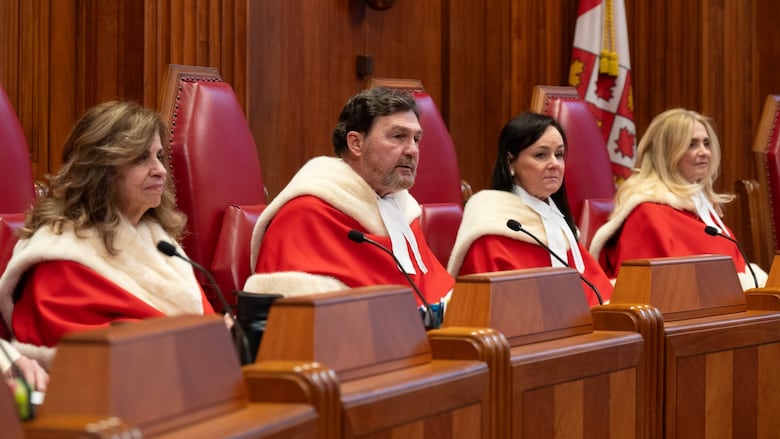 |
| From left to right, Supreme Court of Canada Justice Andromache Karakatsanis, Chief Justice Richard Wagner, Justice Suzanne Cote and Justice Sheilah Martin attend a welcome ceremony at the Supreme Court in Ottawa on Feb. 19, 2024. (Adrian Wylde/The Canadian Press) |
Judges' associations had argued a month earlier that magistrates required a raise of $60,000 to top up their supposedly inadequate salaries, retroactive to April 2024, for the purpose of maintaining a prestigious public position's appeal to prospective candidates for judicial appointment, a vital position in Canada's justice system that, they contend, is increasingly struggling with the need to attract "outstanding candidates".
In response to this contention raised by the associations, a commission was struck for the purpose of evaluating the claims, to reach a consensus that could guide the federal government in its response. That commission was comprised of three members, chaired by lawyer and businesswoman Anne Giardini. The Commission's stated concern, shared by the judges associations: that too few "highly qualified" private-sector lawyers apply to become judges.
Additionally, the Commission revealed that it had been impressed by comments attributed to Ontario Superior Court Chief Justice Geoffrey Morawetz, setting out in detail his efforts to convince private sector lawyers to join the court: "An increasing number of qualified private practitioners no longer view a judicial appointment, considering its attendant responsibilities and benefits, as attractive in light of the resulting significant reduction in income", his affidavit to the commission stated.
 |
| The salary of the Chief Justice Richard Wagner could reach $546,000 according to the panel's recommendations. (Sean Kilpatrick/The Canadian Press) |
It is the Commission's considered opinion that judicial compensation of $414,900 annually is insufficiently attractive to ensure top applicants aspire to the bench, recommending an increase by the government of $28,000 for judges' salaries, at the very least. For starters the commission report recommends increasing salaries for judges by $28,00 for provincial superior and appellate courts, along with federal courts; $30,00 for chief justices, and $36,000 for the chief justice of the Supreme Court, retroactive to April of 2024.
At the present time, most federally appointed judges earn $414,900 (members of the Supreme Court are compensated with $494,100) and chief justices top up by about $40,000 more. These salaries, furthermore are indexed annually in line with the industrial aggregate, generally exceeding the Consumer Price Index. In addition, the Commission recommends an increase of associate judges' salaries from 80 to 95 percent of that of a federally appointed justice.
This, at a time when the federal government, mindful of its overextended financial situation as summarized by the Fraser Institute:
- For many years the federal government’s approach to government finances has relied on spending-driven deficits and a growing debt burden, causing a deterioration in the state of federal finances.
- While deficits can sometimes be justified in certain circumstances, perpetual spending-driven deficits have become the norm rather than a temporary exception for the federal government. The $39.8 billion deficit expected in 2024/25 is the 17th consecutive annual deficit, and deficits are expected to continue into the foreseeable future.
- Deficits have helped drive federal gross debt from 53.0% of the economy ($1.1 trillion) in 2014/15 up to an expected 69.8% ($2.1 trillion) in 2024/25.
- This increase in the level of federal debt comes with costs and will result in higher taxes on Canadians.
- It may be hard to comprehend the scale of the deficits and debt, so to contextualize the current state of federal finances this bulletin provides an example of what a median family’s household budget would look like in 2024 if it managed its finances the way the federal government does.
- The median family earning $101,821 in 2024 would be spending $109,982 if it spent the way the federal government does. To cover the difference, it would put $8,161 on a credit card, despite already being $427,759 in debt.
- Of the total amount spent, $11,066 would go towards interest on the debt this year. Simply put, a Canadian family that chose to spend like the federal government would be in financial trouble.
All government departments have been tasked with cutting their budgets by 15 percent in the next few years, as a reflection of the parlous state of Canada's government spending. Canada is facing a federal deficit of $48.3 billion for 2024-25; $42.2
billion for 2025-26, down from the 2023 deficit of $73.7 billion
accounting for federal, provincial, territorial and local governments.
The country reached an accumulated federal debt of over $1.2 trillion.
The Commission's report was forwarded to Justice Minister Sean Fraser for his review and a decision on the response to the recommendations that will have an impact on over 1,200 judges in Canada for a raise that would cost the government (and taxpayers) over $34-million annually, to start with.
 |
| The independent commission concluded that the current uncompetitive salary rates are detrimental to the recruitment of judges to the federal judiciary. (Chris Ryan/Getty Images) |
"While a shortage [vacant judicial appointments] has been averted for now, the pressures of rising private sector incomes are such that the ability to maintain an adequate level of private sector appointments to fill judicial vacancies is of ongoing concern.""We are persuaded that the effects of past shortages are continuing to rebound within the justice system.""So while the pool of individuals in the last four-year period was more than adequate to fill all the positions, we see clear warning signs that salaries are going to be a factor leading to highly qualified private sector layers electing not to apply to the judiciary."Judicial Compensation and Benefits Commission
 |
| The federal government in Ottawa has opposed a salary adjustment for federal judges. (Benoit Roussel/Radio-Canada) |
Labels: "In The Public Interest", Canadian Judiciary, Federal Government Deficit/Debt, Rise in Judges' Annual Salaries, Supreme Court Chief Justice $Half/Million Yearly
posted by Pieface @ 7:33 PM


0 Comments:
Post a Comment
<< Home