Hezbollah Intransigence
"[The government's decision to remove] the defensive weapons of the resistance, its people and Lebanon during an aggression [facilitates the killing of] resistance fighters and their families and evict them from their land and homes.""[The government should have instead] spread its authority and evicted Israel from Lebanon.""The government is serving the Israeli project.""The resistance will not hand over its weapons as the aggression continues and occupation remains.""The party will fight a [historic)]battle if necessary in the face of this Israeli-US project, whatever the cost.""There will be no life in Lebanon if the government tries to confront the party.""[The government in Beirut] bears full responsibility for any internal explosion and any destruction of Lebanon."Naim Kassem, leader, Hezbollah
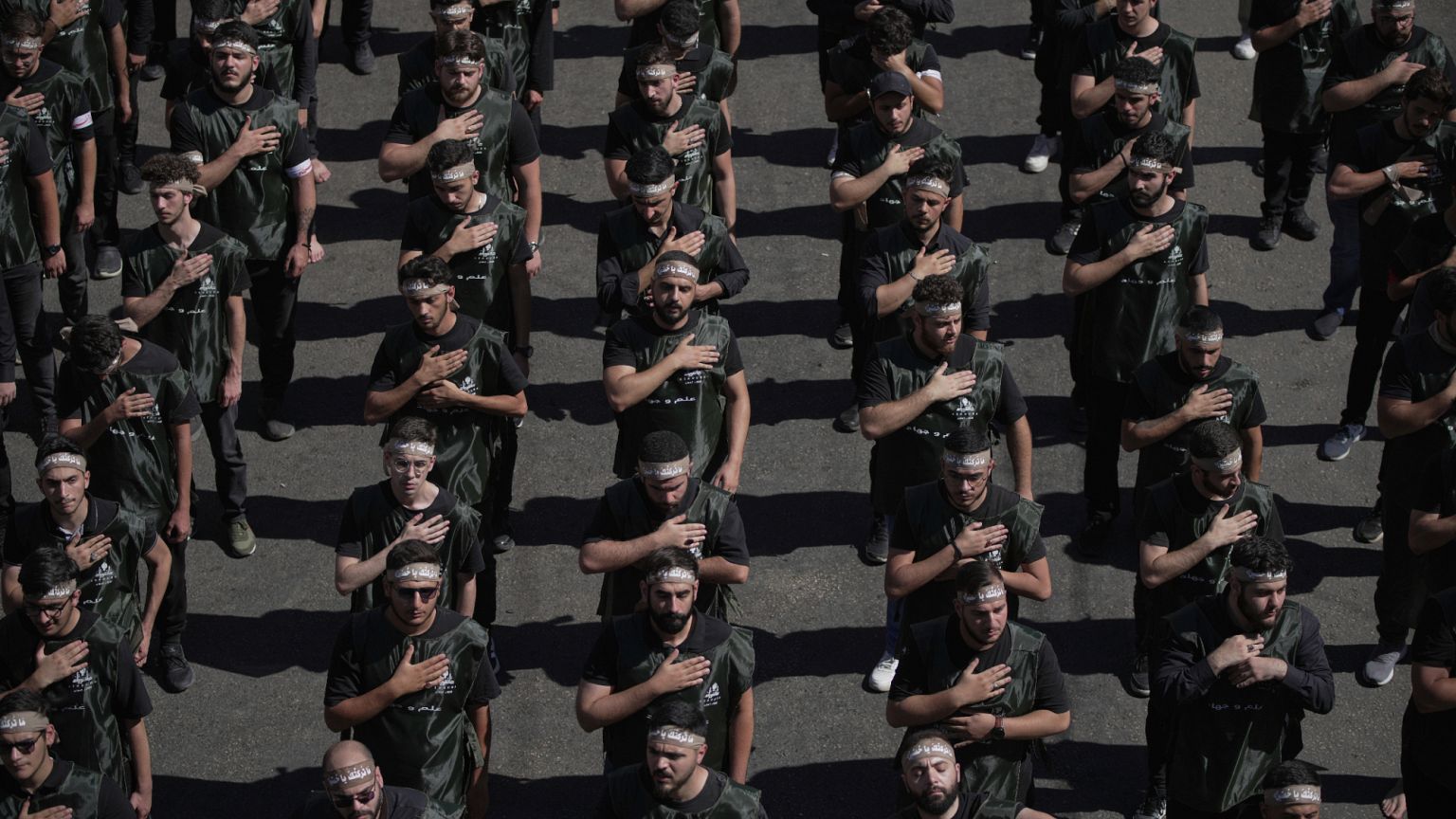 |
| Hezbollah troops pledging fealty Photo: AP |
Lebanon's hostile factions continue to rent the country asunder, a country once peaceful and the centerpiece of the Middle East's manifold tribal, clan and sectarian heritage communities living tolerably amongst one another in their mostly separate geographic internal Lebanon locations, with a degree of respect for one another. That tolerance was not only social and cultural but political as well, with the government comprised at its elite levels of representatives of the majority groups; Christian, Sunni Muslim and Shia Muslim.
Within society itself, the Maronite Christians, Druze and Sunni Muslims dominated, the Shia Muslims relegated to a lower social tier mostly living in poverty and accorded less respect than its sectarian peers. In the 1980s Iran's al Quds division of the Islamic Revolutionary Guard Corps as well as the Syrian Alawite government of Bashar al Assad were tweaking Lebanon's social and political system. The IRGC persuaded Lebanese Shiites that the revolutionary Islam they promoted would help them prosper.
Under the tutelage of the IRGC, Lebanon's Shiites received instructions as a non-state military group with an emphasis on jihad. Trained and supplied with weaponry they became a formidable guerrilla group for whom suicide bombing and threats against the presence of French and U.S. peacekeeping troops in Lebanon became a rehearsal for their budding role in the Middle East as a force to be reckoned with, squaring off against Israel during its invasion of Lebanon to oust the Palestine Liberation Organization from its cross-border raids into Israel.
Lebanon was transformed into a dysfunctional, violence-addicted state, with its multifarious tribal/sectarian groups at threateningly hostile odds against one another. As the civil war disrupted civic life and Lebanese factions bombed and strafed each other and Western attempts at intervention were attempted, kidnapping and hostage-taking for ransom purposes became world news. As Lebanon eventually attempted to restore itself to a vestige of its peaceful past, efforts at disarming Hezbollah failed and it remained an armed adversary even as it became part of the government in taking political office.
Its goal has primarily been the destruction of Israel, as a client of the Islamic Republic. With Hezbollah in Israel's north and Hamas in the south, Iran the ultimate threat to Israel's existence, manipulating its terrorist proxies saw all three engaged in the past several years in an ultimately failed effort to attack and destroy Israel. Hezbollah's decision to support the Hamas 7 October 2023 invasion of southern Israel when thousands of terrorists streamed from Gaza into Israel to slaughter Israeli civilians, and Israel responded by invading Gaza to rout and destroy Hamas, Hezbollah began sending rockets from Lebanon into Israel.
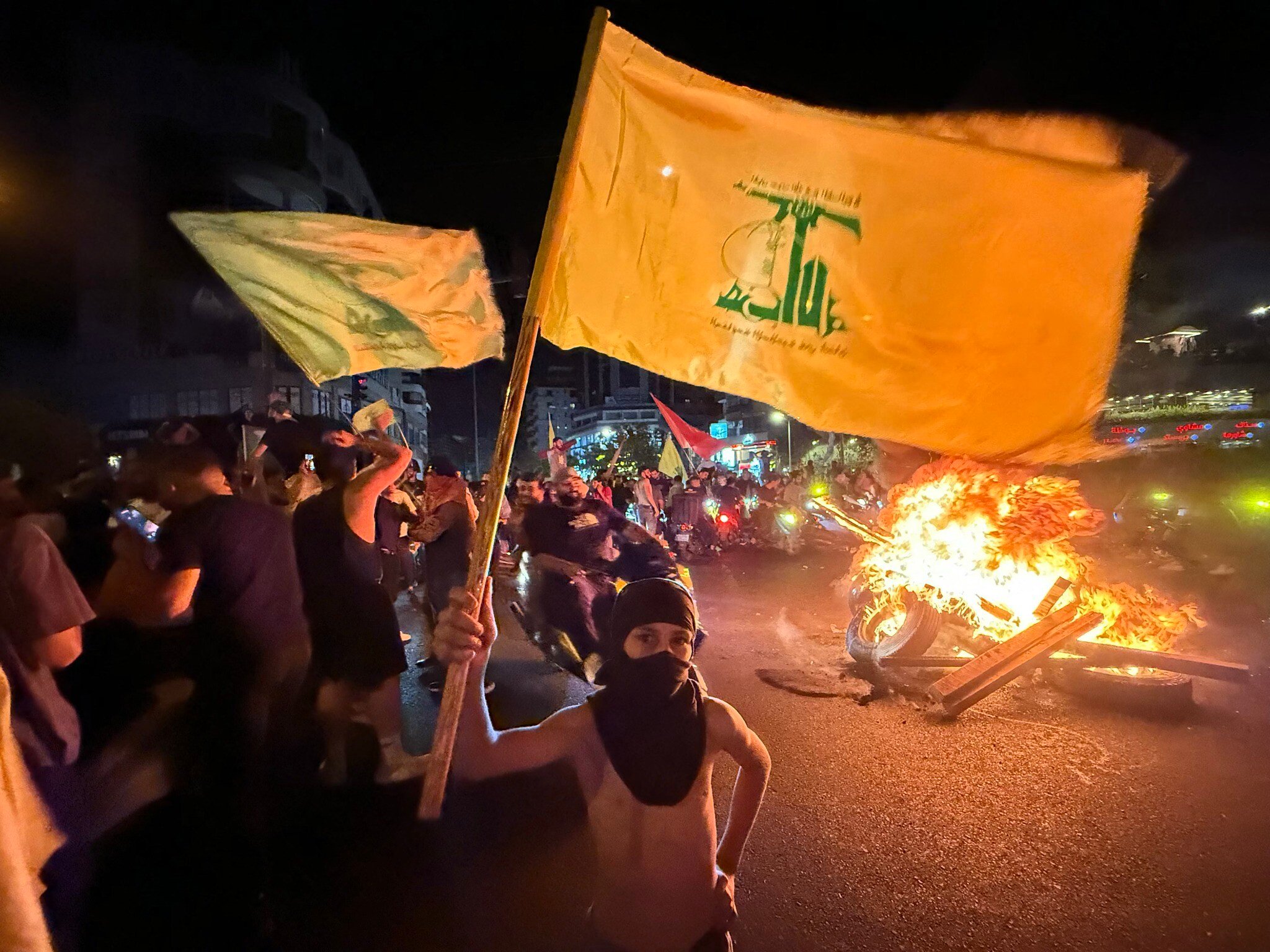 |
| Supporters of Lebanon’s Hezbollah terror group block the streets with burning tires as they rally in cars and motorbikes to protest the government’s endorsement of a plan to disarm it, in Beirut’s southern suburbs, August 8, 2025. (Ibrahim AMRO/AFP) |
Lebanon has been in crisis mode for decades; coping with the sinister manipulation of Syria and Iran, along with Hezbollah. It has been facing, along with social disruptions, a dire economic situation; it has been limping along, a bare skeleton of survival of its former nationhood as a tolerant society. Latterly the national government has made a decision that Hezbollah must agree to their demand to surrender their weapons and rockets stockpiles, in favour of a tentative agreement with Israel, with the potential of a peace agreement brought into effect by the two nations.
The internal crisis is threatening once again to become an internal conflict, another destructive civil war. Hezbollah, aligned with the Shia Amal movement, one of the main armed groups in the 1975-1990 civil war, represented by Parliament Speaker Nabih Berri, threaten together to contest the government's decision. Protesters, warned Kassem, "will be all over Lebanon and head to the U.S. embassy". The groups within Lebanon that want a return to good government and peace between factions, are opposed to Hezbollah retaining its weapons, insisting only the state should carry arms.
Last week the Lebanon government voted for a U.S.-backed plan to disarm Hezbollah by year's end, and a ceasefire with Israel be implemented. International pressure applied on Lebanon to force Hezbollah to surrender its arms following the 14-month conflict with Israel until a U.S.[brokered ceasefire in November is behind the government's move and Hezbollah's resistance.
Hezbollah insists it would only be prepared to discuss a national defence strategy relating to its weapons possession on the condition that Israel withdraw from Lebanon and halts its airstrikes that have killed Hezbollah members since the end of the conflict. Hezbollah's political leadership and much of its military, along with many of its weapons caches were destroyed in its war with Israel. Just as it has been defanged, so too has its sponsor, Tehran, been weakened militarily.
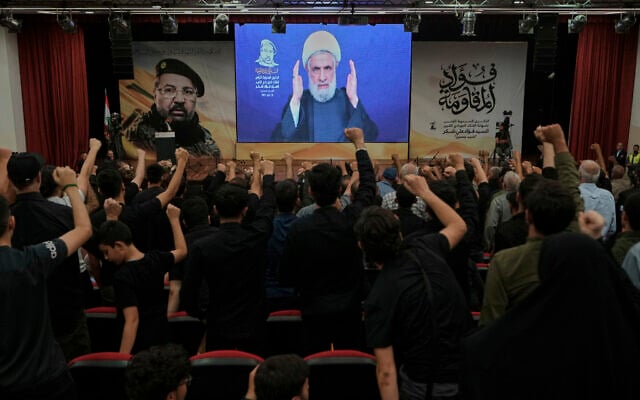 |
| People raise their fists as Hezbollah leader Naim Qassem delivers a televised speech in Dahiyeh, a southern suburb of Beirut, Lebanon, July 30, 2025. (AP Photo/Bilal Hussein) |
Labels: Civil War, Hezbollah, Israel, Lebanon, Terrorism, United States. Peace Agreement
posted by Pieface @ 8:06 PM


0 Comments:
Post a Comment
<< Home