Some Heroes are Search-and-Rescue Quadrapeds
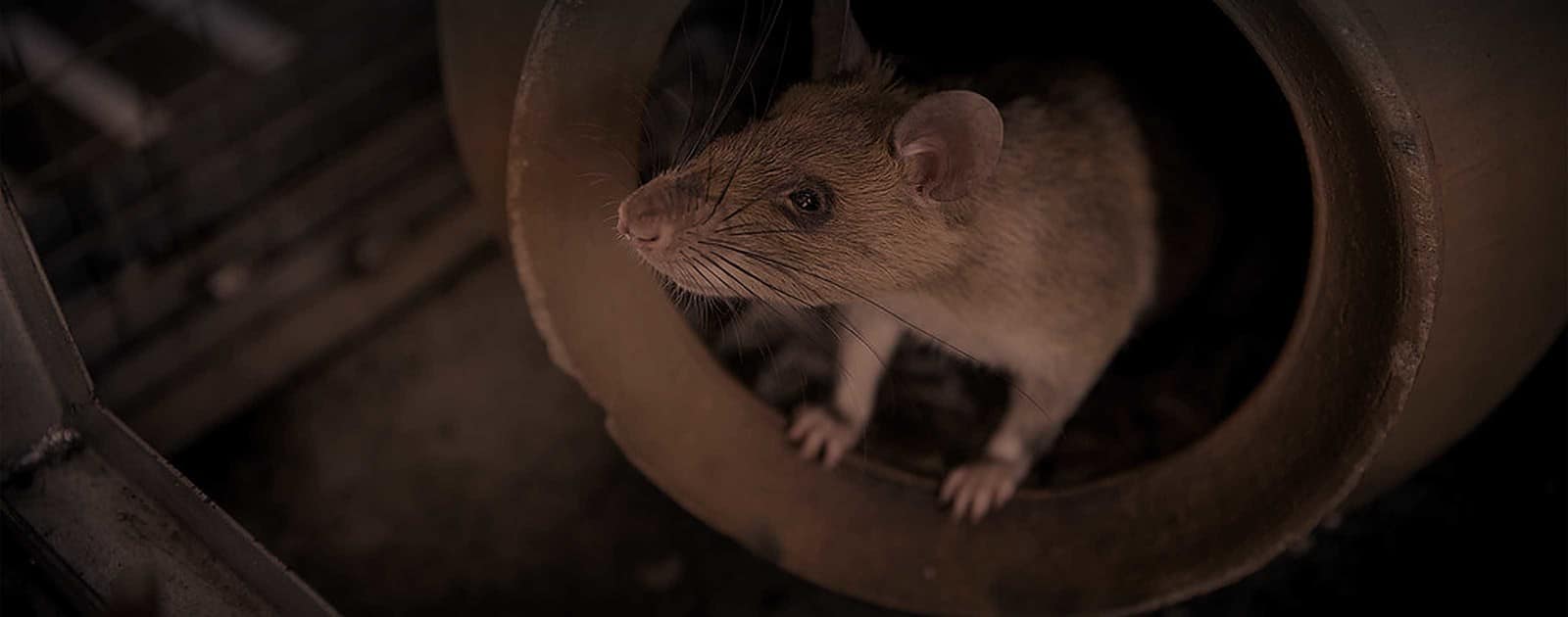
"Their sense of smell is incredible.""These rats are able to detect explosives, tuberculosis -- even tiny amounts of the bacteria -- and in this project, they are able to correctly identify and indicate humans."Fabrizio Dell'Anna, animal behaviorist, APOPO, Tunisia"Every day as many people die from TB as from landmines in a whole year.""It's more spectacular to be on the minefield ... but for TB .. in terms of social impact, it's tremendous.""It's a big challenge. Not being recognized by the WHO [World Health Organization] means that the mainstream funding for TB ... never reaches us."Christophe Cox, CEO, APOPO"The benefits of using rats are significant.""They help us detect cases that might otherwise be missed, which prevents people from unknowingly spreading infections.""Human error may result in a person being told they are disease-free when they are not.""Using rats is a very effective initiative."Felista Stanesloaus, physician, TB clinic, Morongoro, Tanzania
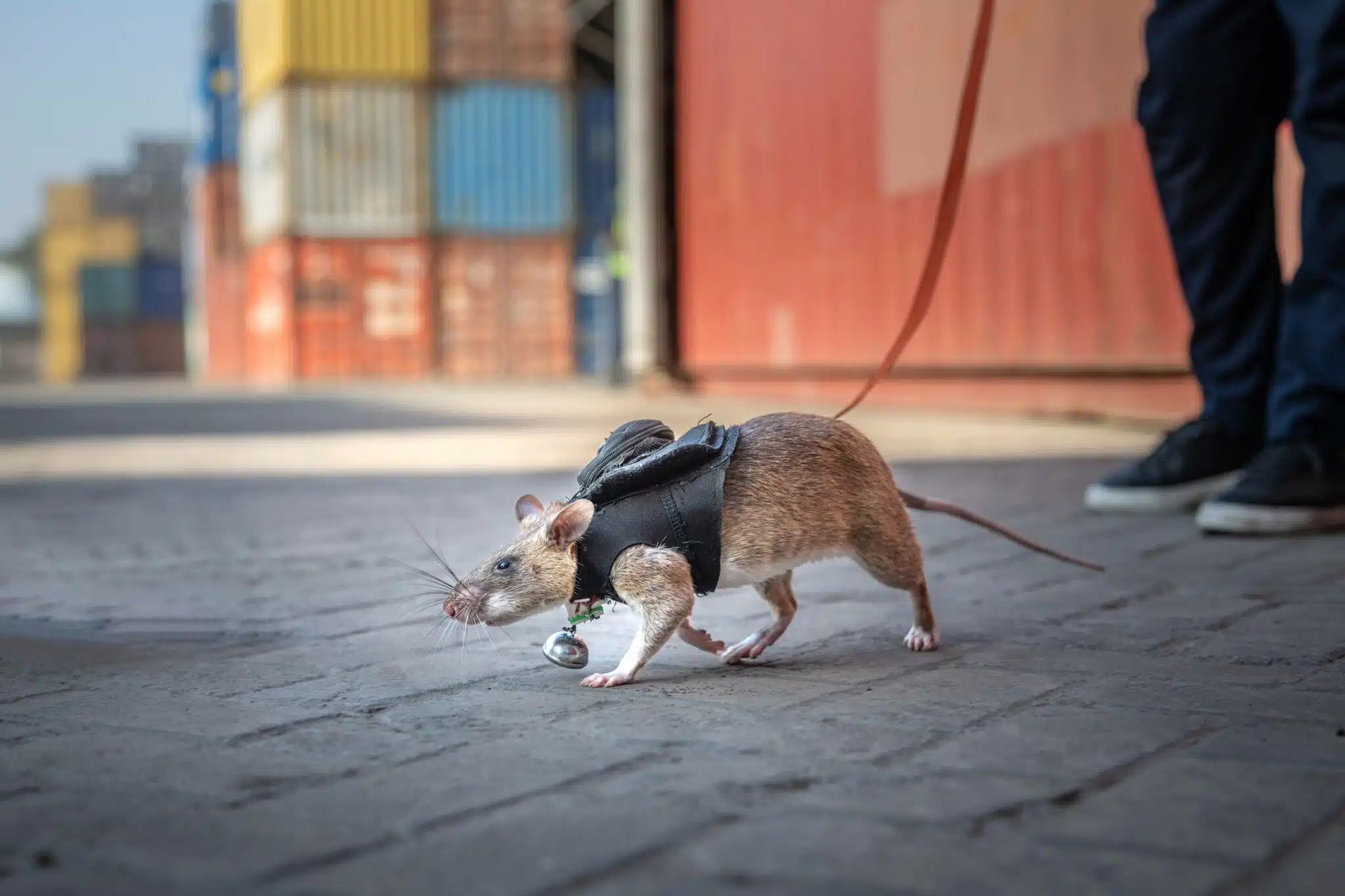 |
| Herorats, APOPO |
In Tanzania during a training and rehearsal session, a rat wearing a backpack enters a earthquake-destroyed building in Morogoro in the Uluguru Mountains of Tanzania. This is a pouched rat, trained and prepared to carry out a mission of locating a human and relaying that success back to its handlers awaiting a response. When the rat discovers a body, it pulls a trigger on its pack, which electronically alerts searchers stationed above the destroyed building. The click that resounds informs human rescuers that a survivor has been discovered.
The pouchrat, known as a 'herorat', knows its task has been fulfilled and scampers off, out of the collapsed building and expectantly over to its handler, who obliges by proffering the reward, a banana, eagerly accepted. This is part of the training for African giant pouched rats in search-and-rescue operations. Not far distant, in a field, other rats are walked on leashes held by their handlers. There a grid filled with landmines which represents part of an APOPO inititiative working with the Sokoine University of Agriculture.
When a rat, at the end of its tether pauses, it is signalling that explosives are present under the surface. The rats, once trained, are destined to be deployed in Angola or Cambodia where the humanitarian group APOPO has lent itself to aiding in the clearance of over 50,000 landmines from 2014 to the present. These unique, highly intelligent little animals have proven their value time and again, whether detecting landmines, the presence of injured humans, or the dread disease of Tuberculosis.
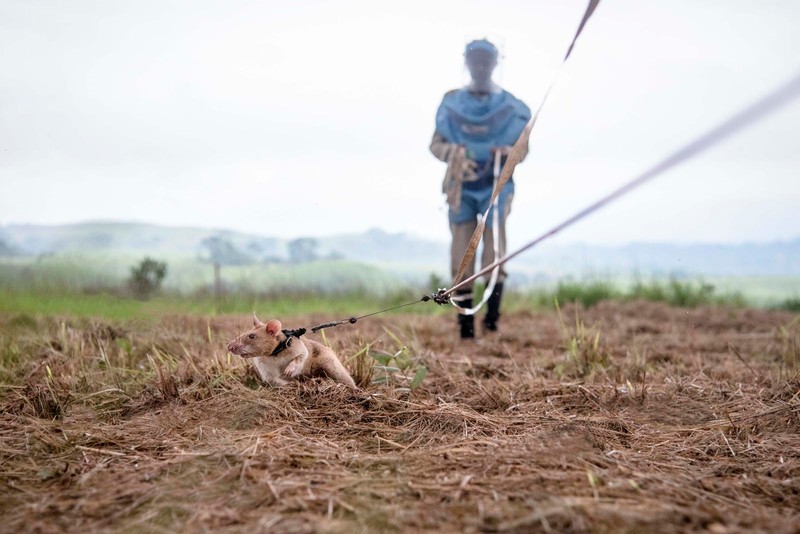 |
| Herorats, APOPO |
Training is initiated soon after birth with a focus on specific missions. The pouched rates have a lifespan of close to a decade, spending the years of their lives involved in their vital work. Training each of the rats costs about $9,700, accomplished with classic patterning techniques and positive reinforcement. A new contingent of the rats trained in earthquake relief are destined for Turkey, partnering with a search-and-rescue operation.
Then there are the rats whose work takes place inside a laboratory where they act as effective detectors of Tuberculosis, an ancient scourge that still runs rampant through populations, centuries of research and treatment aside. According to the World Health Organization's latest report on TB, the disease resurged as the top infectious killer disease, causing 1.25 million deaths and 8.2 million infections in 2023.
Only 50 percent of TB patients in sub-Saharan Africa receive a diagnosis, revealed by a study out of the U.K. and Gambia, where the researchers involved published their findings in the National Library of Medicine. A lack of diagnosis translates to the spread of the disease and Tanzania is trying to cope with one of the highest global TB burdens. APOPO's trained rats have been deployed since 2007 in Tanzania, Ethiopia and Mozambique, working with 80 hospitals in Tanzania, daily collecting samples and conveying the samples to the lab rats.
The rats then sniff sputum samples from patients in a search for positive TB cases, marked as negative. False negatives represent a persistent issue in TB detection and suppression, with each person infected having the potential to spread the disease annually to ten or fifteen more people. In recent years with the use of artificial intelligence tools along with lung scans, TV detection has made great strides. However in rural outback villages and poor urban communities such diagnostic tools are not accessible.
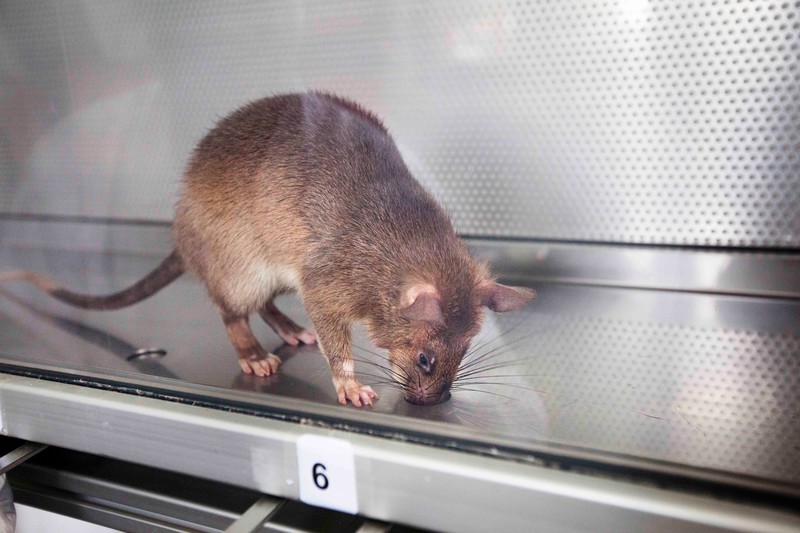 |
| Herorats detecting Tuberculosis APOPO |
It can take two hours to process a sputum sample with the use of molecular detection devices -- where a clinic may have only one of such devices. Overwhelmed clinics may then turn to microscopy or the equally fallible and time-consuming investigation of sputum under a microscope. Whereas 100 samples in 20 minutes can be scanned by APOPO's rats and with greater accuracy. The rats have identified over 30,000 patients, sent home with a clean bill of health, yet actually infected with TB.
APOPO, then, is capable of producing such results with one lab comparative to what 55 hospitals produce in a day. The use of live animals, however, has its own challenges. Samples must be taken directly to a lab with sufficient numbers of trained rats to conduct detection. Some samples are brought by motorbike daily to Morogoro, proving that operations are most effective in dense urban centres such as Dar es Salaam.
And then there is the f act that the World Health Organization does not recognize APOPO's trained rats as primary diagnostic tools; recognizing them rather as a secondary defence. Positive samples detected by the rats are required to be confirmed with human microscopy in APOPO's labs prior to the administration of treatment.
 |
Rodent trainer Neema Justin, 33, shares a moment with an African giant pouched rat after an exercise in detecting illegal wildlife products at the Apopo training facility in Morogoro, Tanzania. Apopo's staff often form close bonds with their rats. Tommy Trenchard/for NPR |
Labels: APOPO, Detecting Tuberculosis Bacteria, Finding Land Mines, Giant Pouched Rats, rained Rescue Rats, Search for Survivors, Tanzania
posted by Pieface @ 8:16 PM


0 Comments:
Post a Comment
<< Home