Fadeout of Nonbinary Fashion Trend
"Trans, queer and bisexual identities are in rapid decline among young educated Americans.""[The number of university students] not identifying as male or female [peaked in 2023 with recent numbers indicating almost by half in two years].""All we have is the question on gender. You have to make assumptions about how a trans person would answer the question.""For young people, gender and sexual identity are now independent fashions that rise and fall separately from other cultural and political currents."Eric Kaufmann, professor of politics, U.K.-based Centre for Heterodox Social Science
"[Through] affirming approach [to transgender care, the Canadian Paediatric Society treats gender dysphoria as that with no social component that can be naturally observed as early as toddler years].""Recent research has suggested that some children may recognize a degree of 'mismatch' between their gender identity and their assigned sex as early as age 2 to three years."Canadian Paediatric Society, 2023 position statement

According to a new analysis published by Canadian academic Eric Kaufmann based on U.S. data -- several surveys of American undergraduates that included questions relating to their self-identified gender -- numbers of young people rejecting heterosexuality have diminished throughout the last several years.
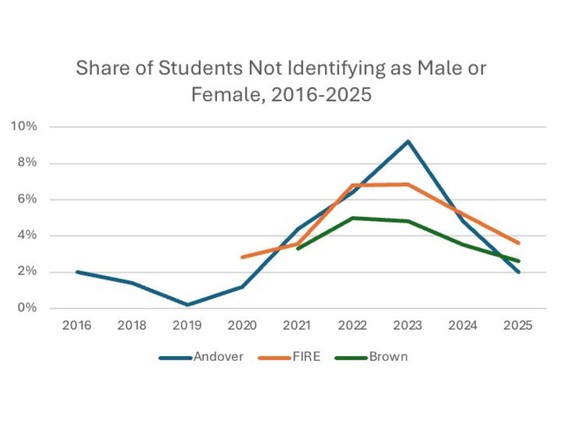
An annual survey of roughly 50,000 students conducted by the Foundation for Individual Rights and Expression (FIRE) comprised the largest of the surveys studied. The FIRE survey found 6.8 percent of respondents identified as a gender other than male or female in 2023. By 2025 that number had been reduced to 3.6 percent.
Elite or exclusive private schools appear to have been the locus of the highest number of students questioning the accuracy of their birth genders. The Boston-area prep school Phillips Academy, for example, saw 9.2 percent of its students identifying as "neither male nor female" in 2023, yet by 2025, the number had dropped to three percent. The follow-up question regarding the possible reasons that nonbinary identification was falling was not immediately clear, however.
Data sets used by Dr. Kaufmann were all comprised of university students. FIRE data indicated the average student in 2025 was as likely as in 2023 to be a liberal atheist in support of banning "anti-trans" speakers from campus. The share of homosexual students was also found to remain relatively stable, with fluctuations of no more than half a percentage point, year-to-year. Categories such as 'queer' and 'questioning' had the most movement, along with the number of students identifying as 'heterosexual'.
 |
| The data in Kaufmann’s report was based on several student surveys. Sharkshock – stock.adobe.com |
FIRE data recorded 68 percent of surveyed students chose 'heterosexual' in self-identity in 2023, in comparison to 15 percent who identified as 'queer'. But by 2025, the number of heterosexual identities rose to 77 percent while eight percent chose queer. Transgender advocates have long rejected the notion of gender identity being a temporary or faddish phenomenon, or one subject to social cohesion/contagion. Even so, a wide swath of medical agencies in Canad not only dismissed the role of social contagion in gender dysphoria, but described it as a 'harmful myth'.
The Journal of Pediatrics published a Canadian study in 2021, that there was no such thing as "rapid onset gender dysphoria", the hypothesis of adolescents driven to adopt trans identities as a result of peer influence. The heading "Study dispels harmful gender dysphoria myth", encapsulated that finding. In the U.K. the Cass Review, a comprehensive government probe found that "peer influence" was driving the rise of youth gender dysphoria at an unacknowledged rate.
That report noted gender-distressed minors speaking "about online information that describes normal adolescent discomfort as a possible sign of being trans and that particular influencers have had a substantial impact on the child's belief and understanding of their gender". Canada was the first country in the world to include self-identified gender as part of its census with the 2021 edition identifying what it called a transgender "generation gap"; a massive disparity between the number of youth identifying as trans as compared to older Canadians.
The gap in the rise of non-binary identity between 2021 and among Canadians born between 1997 and 2006 of whom 0.76 percent identified as either transgender or non-binary was compared to 0.51 percent of Millennials and 0.19 of generation X, which Statistics Canada attributed to the rise of the Internet as an affirmative locus for gender dysphoria, presuming it was present as well among older people.
"The Internet ... may have contributed to the increasing awareness of gender diversity -- especially among younger generations -- by providing transgender and nonbinary individuals with virtual support communities and answers to questions that were less accessible to older generations."Statistics Canada analysis
 |
| Andover Phillips Academy in suburban Boston, which surveys three-quarters of its students each year, for example, reported that in 2023, 9.2 percent identified as neither male nor female. This year, the figure is at just three percent. |
Labels: Adolescent Confusion, Gender Dysphoria, Heterosexual, Internet Influencers, Non-Binary, Queer, Trans, Youth Peer Pressure
posted by Pieface @ 8:38 PM


0 Comments:
Post a Comment
<< Home