Ruminations

Blog dedicated primarily to randomly selected news items; comments reflecting personal perceptions

Friday, October 17, 2025

Fadeout of Nonbinary Fashion Trend

"Trans, queer and bisexual identities are in rapid decline among young educated Americans."
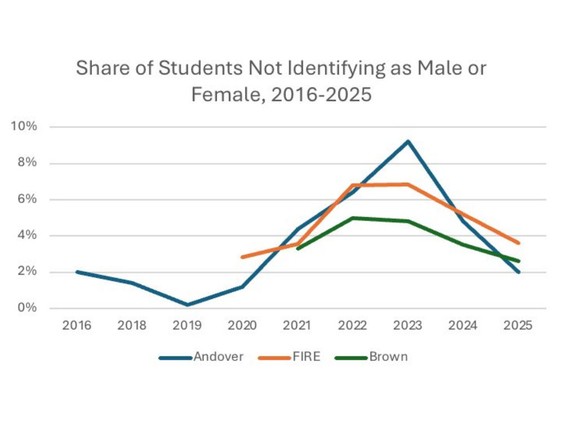
"[The number of university students] not identifying as male or female [peaked in 2023 with recent numbers indicating almost by half in two years]."
"All we have is the question on gender. You have to make assumptions about how a trans person would answer the question."
"For  young people, gender and sexual identity are now independent fashions that rise and fall separately from other cultural and political currents."
Eric Kaufmann, professor of politics, U.K.-based Centre for Heterodox Social Science 
https://smartcdn.gprod.postmedia.digital/nationalpost/wp-content/uploads/2025/10/NONBINARY.jpg?quality=90&strip=all&w=564&h=423&type=webp&sig=uO7moY9ehT2poUzRq2HbqA
"[Through] affirming approach [to transgender care, the Canadian Paediatric Society treats gender dysphoria as that with no social component that can be naturally observed as early as toddler years]."
"Recent research has suggested that some children may recognize a degree of 'mismatch' between their gender identity and their assigned sex as early as age 2 to three years."
Canadian Paediatric Society, 2023 position statement 
 
 
According to a new analysis published by Canadian academic Eric Kaufmann based on U.S. data -- several surveys of American undergraduates that included questions relating to their self-identified gender -- numbers of young people rejecting heterosexuality have diminished throughout the last several years. 
An annual survey of roughly 50,000 students conducted by the Foundation for Individual Rights and Expression (FIRE) comprised the largest of the surveys studied. The FIRE survey found 6.8 percent of respondents identified as a gender other than male or female in 2023. By 2025 that number had been reduced to 3.6 percent.
 
Elite or exclusive private schools appear to have been the locus of the highest number of students questioning the accuracy of their birth genders. The Boston-area prep school Phillips Academy, for example, saw 9.2 percent of its students identifying as "neither male nor female" in 2023, yet by 2025, the number had dropped to three percent. The follow-up question regarding the possible reasons that nonbinary identification was falling was not immediately clear, however. 
 
Data sets used by Dr. Kaufmann were all comprised of university students. FIRE data indicated the average student in 2025 was as likely as in 2023 to be a liberal atheist in support of banning "anti-trans" speakers from campus. The share of homosexual students was also found to remain relatively stable, with fluctuations of no more than half a percentage point, year-to-year. Categories such as 'queer' and 'questioning' had the most movement, along with the number of students identifying as 'heterosexual'. 
 
https://nypost.com/wp-content/uploads/sites/2/2025/10/113472018.jpg?resize=1024,695&quality=75&strip=all
The data in Kaufmann’s report was based on several student surveys. Sharkshock – stock.adobe.com
 
FIRE data recorded 68 percent of surveyed students chose 'heterosexual' in self-identity in 2023, in comparison to 15 percent who identified as 'queer'. But by 2025, the number of heterosexual identities rose to 77 percent while eight percent chose queer. Transgender advocates have long rejected the notion of gender identity being a temporary or faddish phenomenon, or one subject to social cohesion/contagion. Even so, a wide swath of medical agencies in Canad not only dismissed the role of social contagion in gender dysphoria, but described it as a 'harmful myth'.
 
The Journal of Pediatrics published a Canadian study in 2021, that there was no such thing as "rapid onset gender dysphoria", the hypothesis of adolescents driven to adopt trans identities as a result of peer influence.  The heading "Study dispels harmful gender dysphoria myth", encapsulated that finding. In the U.K. the Cass Review, a comprehensive government probe found that "peer influence" was driving the rise of youth gender dysphoria at an unacknowledged rate. 
 
That report noted gender-distressed minors speaking "about online information that describes normal adolescent discomfort as a possible sign of being trans and that particular influencers have had a substantial impact on the child's belief and understanding of their gender".  Canada was the first country in the world to include self-identified gender as part of its census with the 2021 edition identifying what it called a transgender "generation gap"; a massive disparity between the number of youth identifying as trans as compared to older Canadians.
 
The gap in the rise of non-binary identity between 2021 and among Canadians born between 1997 and 2006 of whom 0.76 percent identified as either transgender or non-binary was compared to 0.51 percent of Millennials and 0.19 of generation X, which Statistics Canada attributed to the rise of the Internet as an affirmative locus for gender dysphoria, presuming it was present as well among older people.  
"The Internet ... may have contributed to the increasing awareness of gender diversity -- especially among younger generations -- by providing transgender and nonbinary individuals with virtual support communities and answers to questions that were less accessible to older generations."
Statistics Canada analysis 
https://i.dailymail.co.uk/1s/2025/10/15/07/102990053-15191959-image-a-27_1760508460323.jpg
 Andover Phillips Academy in suburban Boston, which surveys three-quarters of its students each year, for example, reported that in 2023, 9.2 percent identified as neither male nor female. This year, the figure is at just three percent.

Labels: , , , , , , ,

Tuesday, September 30, 2025

Physical/Mental Disabilities/Trans/Visible Minority? Have We Got A Job For You!!!!

"[Positions are] designated to candidates who self-identify as women with a disability or gender equity-seeking persons with a disability."
"The preference given to equity-deserving groups in recruitment processes is based on self-identification." 
"[To qualify as] racialized [applicants must identify as] non-white."
"[Members of a] gender equity-seeking [group must confirm that they] identify as anything not fitting cultural norms around gender identity, expression, and/or sexuality."
"Disabled [applicants include anyone who self-identifies as having] a chronic, long-term or recurring physical, sensory, mental, learning or intellectual impairment." 
Dalhousie University position-seeking criteria
https://aristotlefoundation.org/wp-content/uploads/2025/02/iStock-1395543811.jpg
DEI isn’t just widespread, it’s practically ubiquitous, encompassing 98% of all academic job postings. Aristotle Foundation
 
It starts with Canada's Liberal government's grants into research chairs at Canadian universities. Men who are able-bodied are by virtue of their unqualified descent from 'colonial powers' regardless of the time that has passed from that distant past, are considered themselves to be 'colonialist imperialists', thus ineligible for positions in science at Canadian universities funded by government largess. These $100,000+ plus positions are simply off limits to any candidates who do not fall into the prescribed categories of women with disabilities, or gender equity-seeking individuals with disabilities.
 
In their peerless wisdom, government has decreed -- and universities have agreed -- that positions in leading science chairs within academia cannot be filled any longer with people qualified in their field of science. They must move on elsewhere to make room for replacements who will tackle complex scientific formulae from the perspective of queers, Indigenous and female perspectives. At Dalhousie, one of the most deeply equity-involved universities in Canada, the search is on to find the ideal candidate to apply artificial intelligence to 'healthy aging', within the new focus of using artificial intelligence in research and development.
 
To be fair, candidate screening based on colour or sex has become standard practice at universities right across Canada. Aristotle Foundation for Public Policy's January report reviewed 489 academic job postings in Canada, to find that 98 percent contained a condition that "directly or indirectly discriminated against candidates". Dalhousie was identified as one of the most enthusiastic practitioners of identity quotas in hiring. Multiple positions explicitly turning way candidates based on race, gender or sexual identity have been advertised by Dalhousie in the last year. 
 
Ninety-eight per cent of job postings at Canada’s top universities now require DEI compliance
prioritizing DEI over excellence
From the school's Canada Research Chair in marine carbon transformation,  another in Indigenous prosperity and economic reconciliation, another in observational chemical oceanography, yet another on engineering where applicants are required to generate new technologies to work in deepwater ocean environments, candidates must have an Indigenous, 'racialized women' or 'racialized gender minorities' background to succeed in convincing Dalhousie they would be the ideal candidate for the job. 
 
There is the risk at Dalhousie, as at other universities across Canada, that a share of the federal government's financial support for science funding will be withdrawn unless some  hires remain based on these characteristics. Canada Research Chairs represent funding to the tune of $310 million annually and remain bound to strict quotas on researchers' colour pigment and gender. By the timeline of December 2029, it is expected that 50.9 percent of all Canada Research Chairs be comprised of women and gender minorities; 22 percent visible minorities; 7.5 percent people with disabilities, and 4.9 percent Indigenous.
 
The origins of 'equity quotas' in hiring practises began in the United States where the widespread method of identity-based quotas was eventually hobbled when legal challenges conducted under the terms of the 1964 Civil Rights Act prohibiting discrimination in any program that receives federal funding, led to its cessation. In Canada, Section15 of the Charter of Rights and Freedoms explicitly permits discriminatory hiring as long as the practice ameliorates "conditions of disadvantaged individuals".
 
https://smartcdn.gprod.postmedia.digital/nationalpost/wp-content/uploads/2025/02/GettyImages-1907187799.jpg?quality=90&strip=all&w=564&h=423&type=webp&sig=qU0MIXJAYg_5Aj1jzgzOxA
Photo by iStock/Getty Images Plus
 e
To measure the prevalence and severity of DEI in academic hiring, we reviewed approximately 50 active, academic job postings from the largest public university in each Canadian province. The review was based on eight research questions that each gauge a different DEI strategy—from acknowledging DEI ideologies, to compelling intellectual conformity, to reverse racism (e.g., excluding white males from applying).
All 10 universities sampled—and 477 of the 489 job advertisements reviewed—employed some form of DEI requirement or strategy in filling academic vacancies. In other words, 98 percent of the academic postings directly or indirectly discriminated against candidates and/or threatened academic freedom.
Some noteworthy instances include the following:
  • All University of Toronto job postings and 96 percent of Dalhousie’s mentioned or implied a candidate’s “contribution to DEI” was an asset.
  • McGill and the University of Saskatchewan required all applicants to complete a DEI survey.
  • Nearly two-thirds of the University of British Columbia’s (UBC) and 55 percent of the University of Manitoba’s job postings required candidates to submit a DEI statement or essay.
Interestingly, the institution most likely to exclude candidates outright was also the least likely to employ any DEI strategies. At UBC, nearly one out of every five academic job postings explicitly restricted the job to a particular race, ethnicity, group identity, or other inherent trait. However, it was also the university least likely to call for specific DEI strategies; they were absent from 12 percent of UBC’s postings.
Aristotle Foundation for Public Policy

Labels: , , , , ,

Tuesday, May 21, 2019

Boundaries To Be Transcended

"The gender reassignment is a big chapter in Jan’s life story, but it’s not the whole life story."
"[James Morris was far from being a rebel]; Jan’s upbringing was at the very heart of the British establishment, first at Oxford, then going into the Times, working in the Arab News Agency in Cairo, working as a spy in Palestine and Italy during the second World War."
"And succeeding so tremendously in all of those."
"I mean, you have to be a very good musician to be a choirboy at Oxford, to be in the intelligence service in the British army, to be the one journalist at the Times to go up Mount Everest."
John O’Rourke, Dublin-born film-maker

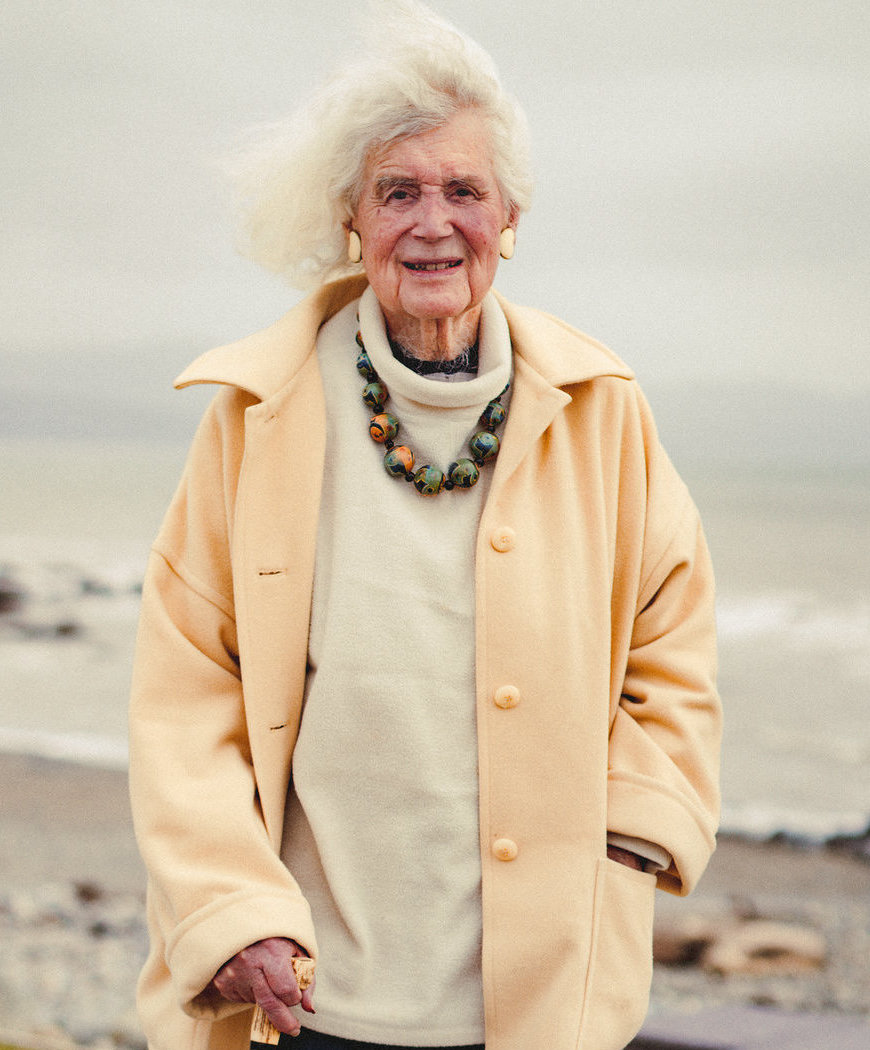
The man who was journalist, soldier, adventurer, author is now semi-infirm at 92 years of age, getting about with the help of a cane. His/her home is in Criccieth, Wales. Known as an essayist, historian, the man who before it became fashionable and acceptable in polite circles to transition from male to female, was a British celebrity, an accomplished man of many parts. One of his legendary
roles was as the chronicler of the world's first ascent of its tallest mountain.

James Humphrey Morris, born in 1926 in Somerset, England had been a choral scholar at Christ Church Oxford, that in itself remarkable. During the closing years of World War II, James Morris served in the 9th Queen's Royal Lancers. When he was 23, he married Elizabeth Tuckniss and together they had five children, four whom they raised to adulthood while Mr. Morris worked for The Times of London as a journalist.

He was given the prestigiously improbable assignment by the Times of acquiring an exclusive story in 1953, focusing on the-then 'impossible' ascent of the Himalayas' Mount Everest, an account that brought his name to world recognition, just as the feat of ascending to the top of Everest made Sir Edmund Hilary's and Tenzing Norgay's were made synonymous with one of the world's greatest adventure in an exploit defying human endurance.
Jan Morris - Surviving Member of the 1953 Everest Expedition
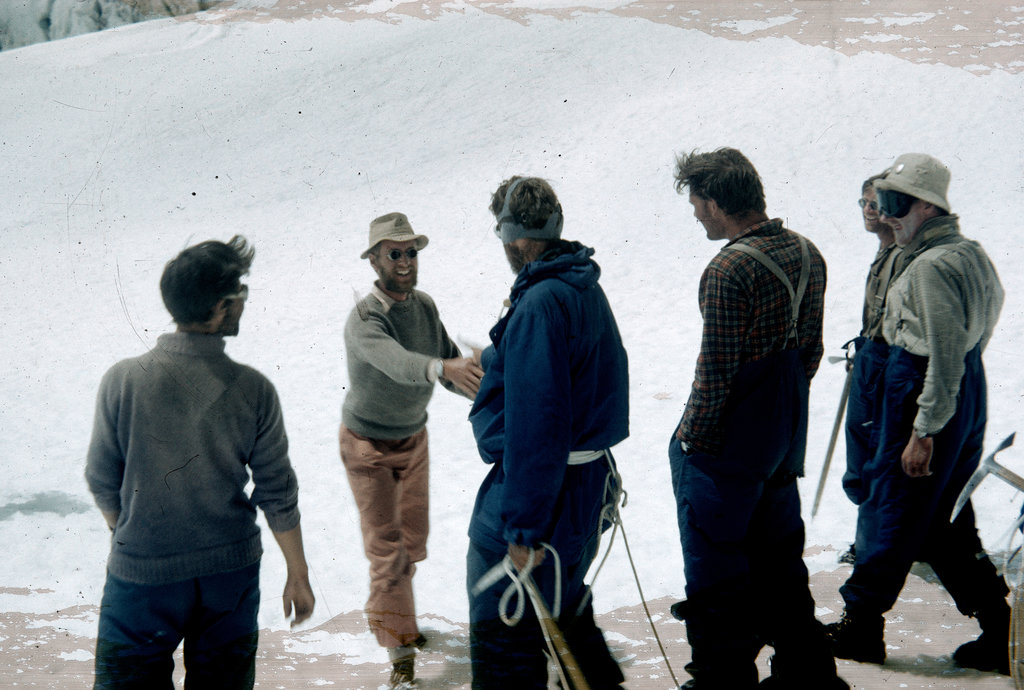
As a journalist, Morris was embedded with Edmund Hillary's Everest team in 1953. "It altered my life so much. Now I'm the only surviving member of the expedition, and I miss them all," said Morris, pictured congratulating Hillary after the ascent. Credit: George Lowe/Royal Geographical Society, via Getty Images
"I was three or perhaps four years old when I realized that I had been born into the wrong body, and should really be a girl" wrote Jan Morris in her memoir titled "Conundrum" which detailed the personal struggle to reconcile mind and body; the mind that persisted in thinking female as opposed to the body so clearly defined by biology as male. When, in 1972, James Morris transitioned through a surgical reassignment to female, he hadn't many fans but did not lack critics.

His steadfast fan, however, appeared to be the person with whom he had lived for so many years as man to her wifely role. From whom it appears, he never kept secret his female side. She must have understood his feelings of dislocation of a soul who felt trapped within a body that failed to match the mind that regarded it as a flagrant error in nature's judgement. Even while he consummated his role as a biological male, he floundered mentally, convinced of his female persona.

Elizabeth, who had been James's close companion never ceased being that; post re-assignment they separated, then later re-married. They lived together in perfect harmony, both post-1972 as females; their 70 years together cementing their lifelong relationship as consanguinity never could. As a young couple they settled for life in Wales where Elizabeth became the consummate housewife and James a journalistic gadabout. Now aged 92, as Jan Morris, age has settled her into a housebound role more than a traveller's.

"To me gender is not physical at all, but is altogether insubstantial. It is soul, perhaps; it is talent, it is taste, it is environment, it is how one feels, it is light and shade, it is inner music, it is a spring in one's step or an exchange of glances."
"It is more truly life and love than any combination of genitals, ovaries and hormones."

Jan Morris - Surviving Member of the 1953 Everest Expedition
Tom Jamieson for The New York Times


Labels: , , ,

 
()() Follow @rheytah Tweet