Ruminations

Blog dedicated primarily to randomly selected news items; comments reflecting personal perceptions

Tuesday, December 02, 2025

"Harm Reduction" In Ontario

"You've basically got a doctor anywhere in the province telling a pharmacy somewhere else in the province to go ahead, give this person [hydromorphone] tablets."
"It's not medicine. It's just wrong."
"[There is] no  way [that patients receive adequate care under this] predatory [form of telemedicine]."
Dr. Lori Regenstreif, addiction physician, Hamilton, Ontario
 
"Many [clinics] operate virtually, with physicians seeing patients every one to two minutes from within a pharmacy setting ... Pharmacies benefit financially through high dispensing and witnessing fees, while physicians incur virtually no overhead costs."
"Urine drug testing is often performed on-site with kits supplied by the pharmacy, further blurring the lines of accountability."
"There appears to be no consistent intake process, documentation standards, or clinical guidelines governing these practices."
Dr. Janel Gracey, addiction physician, Ontario
 
"It's laziness on behalf of the physician, and it's for financial reasons."
"You can see a lot of patients by video link and get a video premium for conducting that service."
"[The practice is] dangerous to society."
Dr. Martyn Judson, addiction doctor, Ontario 
https://i.cbc.ca/ais/1.7071087,1703872541000/full/max/0/default.jpg?im=Crop%2Crect%3D%280%2C0%2C6331%2C4221%29%3BResize%3D805
The term 'safe supply' has been used colloquially by advocates and politicians to refer to the practice of providing people with opioid use disorder alternative drugs that are safer than the street supply. (Ben Nelms/CBC)
 
Dr. Judson, as it happens, pioneered Ontario's use of methadone in the 1990s, reasoning that it would inevitably lead to weaning drug addicts away from their harsh addictions. It is the rationale behind most provinces in Canada establishing 'safe supply' prescribing free recreational drugs to addicts with minimal supervision, assuming that riskier street substances would no longer be attractive to those addicted to hard drugs of the opioid family when less harmful drugs were supplied to them free of charge. 
 
This was a 'do-good', 'feel-good' initiative that gained traction as a result of rising overdose deaths throughout the country, when deadly fentanyl began to make an impact, often used by drug dealers as fillers with other drugs. British Columbia, where overdose deaths skyrocketed made liberal use of safe injection sites, believing that handing out drugs without supervision would lower the risk of street drug use, mostly fentanyl. Until reports began circulating that the free drugs were showing up on the street, where those receiving them sold them to finance the more harmful drugs the initiative meant to keep them from. 
https://i.cbc.ca/ais/1.7018720,1699135390000/full/max/0/default.jpg?im=Crop%2Crect%3D%280%2C0%2C6155%2C4103%29%3BResize%3D805
People take part in a rally in support of the Drug User Liberation Front after the arrest of two workers in Vancouver on Nov. 3, 2023. (Ben Nelms/CBC)
 
The federal government had given its approval to the British Columbia experiment of legalizing all drugs meant for personal use under the safer supply pilot, and then withdrew from and defunded the project when evidence began to accumulate of the pilot's failure. Just as the government of British Columbia itself stepped back from the kind of 'harm reduction' that was fuelling greater drug use, even to impacting a younger demographic for whom the rejected drugs became an introductory course on drug use, at a more affordable street price than harder opioids.
 
Now, in British Columbia, safer supply doses must be consumed under medical supervision, minimizing diversion. In Alberta, safer supply prescribing is functionally banned. Yet in Ontario little attention is given to the money-making 'electronic pill mills' where some medical practitioners set themselves up as one-stop pill-prescribing agents in an easy approach to over-prescribing drugs to the addicted, in concert with certain pharmacies in coordinated protocols financially beneficial to prescriber and supplier, but deadly to their consumers.
 
https://i.cbc.ca/ais/1.7182350,1713905840000/full/max/0/default.jpg?im=Crop%2Crect%3D%280%2C760%2C4032%2C2268%29%3BResize%3D860
Nauman Shaikh, a pharmacist and owner of the downtown Medpoint Care Pharmacy, says he's seen positive changes in patients who are prescribed opioids they would otherwise have to buy on the street. (Kate Dubinski/CBC)
 
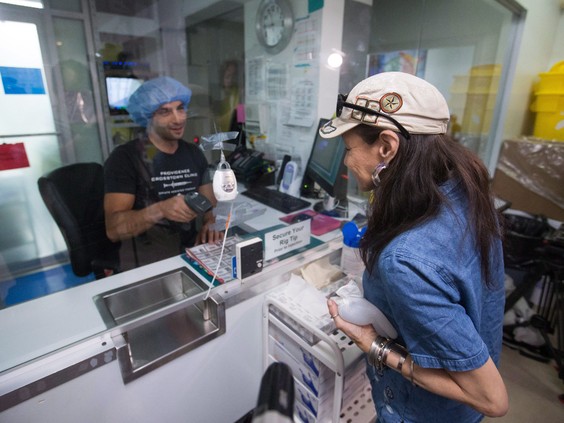
Video booth set-ups at pharmacies operate like confessionals; confess and forgiven. Safer supply in Ontario is being co-opted by tele-prescriptions. Drug users simply enter the premises at will to receive massive opioid prescriptions following several minutes of remote consultation; essentially rubber-stamping requests for drug supply, courtesy of the taxpayer. The user, on having their prescription filled at the pharmacy then is free to sell their drugs on the street for the formulaic transaction of resale funding a more desired drug acquired on the street.
 
These taxpayer-funded billings enrich both physician and pharmacy. And please the drug user no end for the freedom to dispense of the unwanted drug and alternately shop for the drug of choice. Large volumes of drug users simply pick up their prescriptions and they can be multiple times daily, while pharmacies collect extra dispensing fees to fatten their bottom line. Whereas in responsible addiction medicine, regular physical exams of patients and attention to psychosocial stabilization and recovery are bypassed.
 
 Concerned physicians who treat the drug-addicted, aware of what is transpiring have attempted to report the issue to the College of Physicians and Surgeons of Ontario whose purpose is to regulate doctors operating in the province. Yet despite Addiction Medicine Canada, an advocacy group led by physicians having sent the College formal requests for safer supply reform, there has been no response.  
 
https://smartcdn.gprod.postmedia.digital/nationalpost/wp-content/uploads/2023/05/Hydromorphone-1.jpg?quality=90&strip=all&w=564&h=423&type=webp&sig=EU1ByWgvrM18ZiwvZ0CSpg
 

Labels: , , ,

Tuesday, December 29, 2020

Telehealth/Virtual Care : Can We Help You?

"We've seen phenomenal rates of patient satisfaction in virtual-care visits ... and it's a no-brainer as to why. They don't have to travel across town or miss half a day of work, and can comfortably see a doctor from the comfort of home or work with none of the risks of infection you'd have in the waiting room."
"Since then [introduction of the pandemic into the summer], we've returned back to a more sustainable pace of growth, but we're still meeting sales and usage targets in 2020 that we weren't expecting to reach for several years."
"We've seen massive adoption of virtual care and I'd be shocked if things went back [resuming in-office doctor visits by patients]."
"There used to be a technology gap for older people, but that's gone away too. If grandparents can connect with their families via video now, they can do it with a doctor."
"What we're trying to build is an omnichannel health experience that patients can access all in one place. The idea would be that we would eventually figure out a way to get all these providers into one platform, but we haven't made any firm decisions on how or when this will happen."
"Over time, what's happening is that we own a large chunk of the patient's health-care experience. We're the platform that has their hospital records, plus the one they get middle-of-the-night care in and they won't want to switch."
Dr.Brett Belchetz, CE, Maple Corp., telemedicine provider, Toronto
https://www.getmaple.ca/site-content/uploads/2020/08/home1.jpg
Photo: Maple Corp website
 
Every element of human activity has in a brief period of time switched from in-person to on-line connection, so why not doctors' appointments through telemedicine? When the global pandemic struck in North America doctors' offices went on clamp-down, and appointments were largely through telephone contact or Zoom meetings. They will remain that way for the duration of the infectious rate of SARS-CoV-2 until such time as the approved vaccines have seen global distribution and a majority of any population has been inoculated against COVID-19.

Virtual-care service through telehealth at Maple Corp. pre-dated the onset of the coronavirus, but it has realized a huge leap in telemedicine use with the advent of lockdowns due to COVID. Dr.Belchetz worked as a consultant and emergency room physician when with co-founders, the three started the company in 2015. Now, the trio's telehealth/virtual-care service fits right into this era of vigilance against virus contagion, complicated by overtaxed health-care resources.

It is a source of direct medical consultation available on a 24-hour basis, seven days a week, a platform that connects patients with a pre-vetted general practitioner or a medical specialist by video, instant message, or telephone call, which takes two minutes or under, to complete. There are at the present time over two million users and 1,500 physicians involved. Doctors tend to work as much or as little as they wish to commit to, while being paid a set fee for service per consultation.

An average of six doctors across the country make enquiries about joining the network every day, and another 600 GPs are listed as willing to join the roster, as need for their services increases. The company had been developing at ten to 15 percent month-over-month in revenue and usage, but it saw revenues triple between February and April of this year as physical offices and medical centres shut down during the initial lockdown and remained in that position since, offering telephone consultations in lieu of office visits.

A new report was recently issued by the CD.Howe Institute think tank focusing on this situation titled Canada's Virtual Care Revolution: A Framework for Success. A situation the pandemic has brought to bear through general adoption of virtual care. The report's authors anticipate that virtual care will become "a mainstay of clinical care in the future" as long as the financial and regulatory support can be relied upon from providers and governments.

"The pandemic absolutely was a tipping point for telehealth and you can't fit that genie back into the bottle", commented Duncan Stewart, director of technology, media and telecommunications research at Deloitte Canada, pointing to data from Ohio State University's Wexner Medical Center illustrating that 92.5 percent of patient visits conducted during a four-week period ending in April of this year were conducted through video or telephone, in comparison to 0.1 percent pre-pandemic, in March.

There is now an increasing number of publicly funded billing codes for virtual services, despite initial criticism on how the service might fit into the public health-care system in Canada. On the arrival of COVID-19, 60 percent of health-care visits with primary care physicians and specialists were conducted virtually, plateauing at 30 percent, according to a Canada Health Infoway survey of September 2020. Consumer and provider apprehension and lack of support from insurers and governments have been pushed aside in favour of the necessity of providing health care during COVID-19.

Telehealth Company Maple Corporation Raises $75 Million 
Maple, working with governments and insurers to accustom them to the idea and to implement programs has advanced trends to consolidate. In 2018 the company helped a rural hospital in Prince Edward Island through building a platform keeping the facility in operation with the use of virtual staff. Maple collaborates in Ontario with some long-term care homes so residents can be given virtual access to specialists. 
 
Green Shield Canada and Medavie Blue Cross have signed on to enabling wide-spread access to Maple services. And Shoppers Drug Mart Inc. invested $75 million into Maple in exchange for a minority stake in the company's future. Collaboration with the country's largest pharmacy chain helps to expand the service, demonstrating that Maple's platform is capable of handling business on a large scale driven by Shoppers.

Labels: , ,

 
()() Follow @rheytah Tweet