Pew: Breaking the Plastic Wave
"There's a good reason why the plastics recycling rate has never reached double digits.""It's because its chemical and polymer complexity makes large-scale recycling technically and economically infeasible.""We're wasting valuable time by relying on a system that has not worked for decades."Judith Enck, president, Beyond Plastics
"One of the most critical solutions will be to lower production of primary plastic to sustainable levels – those at which the amount of waste generated matches what can be managed.""This balance will also be essential to reducing the global plastic system’s GHG emissions and human health impacts.""Return- and refill-based reuse systems will be a cornerstone of right-sizing primary production and transforming how businesses and consumers think about and use packaging and other plastic products."Breaking the Plastic Wave 2025, Pew Charitable Trusts/ICF International
In the manufacture of plastics, some 16,000 different chemicals are used -- more than one fourth of those chemicals have been identified by scientists as possibly harmful to human health. A research wave has made an effort to fully comprehend how a class of chemicals in particular, known as endocrine disrupters widely used in makeup and cookware, may affect digestive, reproductive and cognitive function.
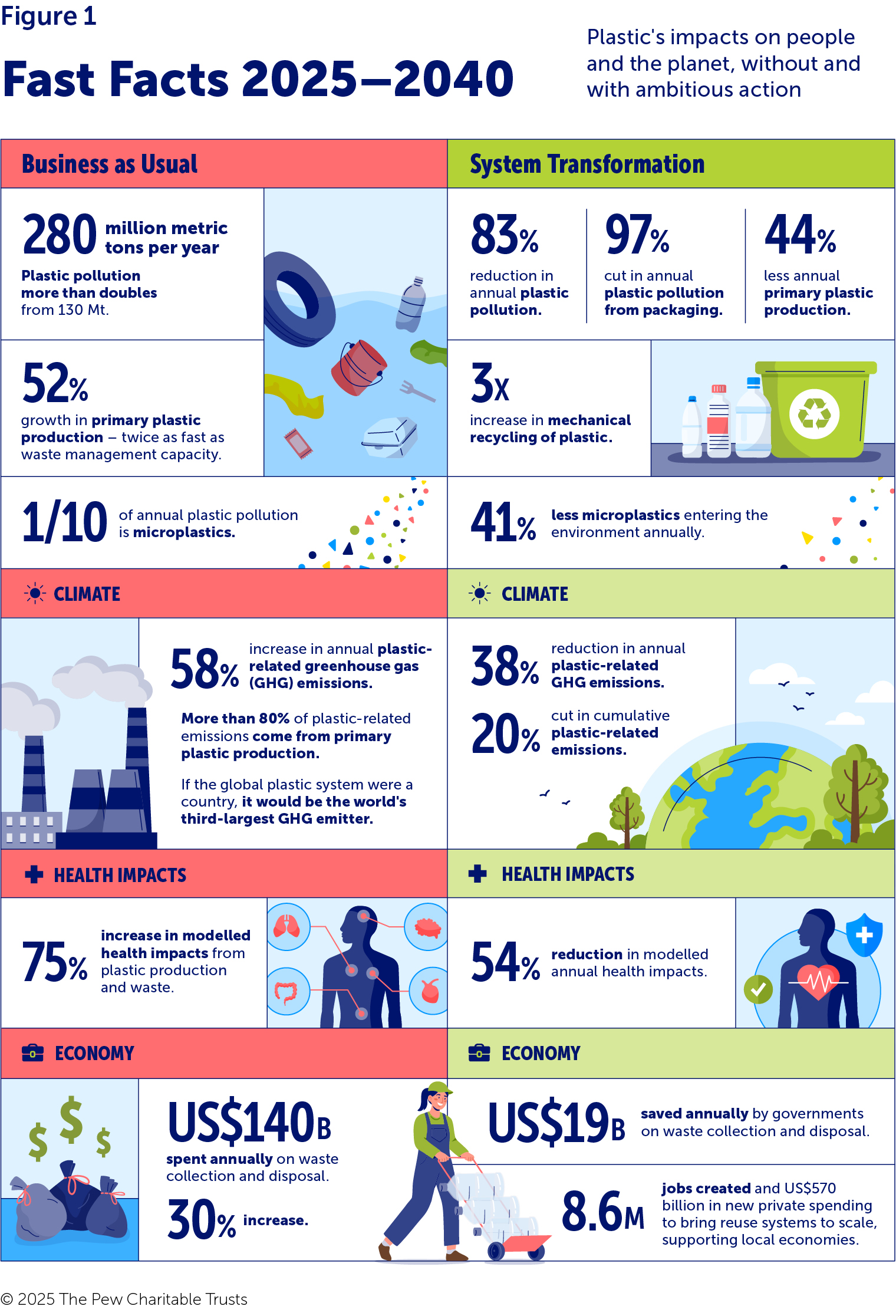
Global plastic pollution is set to reach 280 million metric tons annually by 2040. Yet despite clear evidence that plastic particles clog oceans and beaches eventually breaking down into microplastics, plastics are being continually produced and their production rate is set to rise, to the level of a dump truck load every second
A report by the Pew Charitable Trusts in conjunction with ICF International, Breaking the Plastic Wave 2025, provided those alarming statistics. Countries that produce the major share of plastic blocked proposals to limit the creation of new plastic regulations, despite discussions meant to forge an international treaty for the purpose of controlling plastic pollution.
Data from recent research is compiled to predict outcomes under various policy scenarios in reflection of the fact that recycling rates remain low. This was an initiative by Winnie Lau, director of Pew's Preventing Ocean Plastics project who explained that the research team "wanted to pull it all together in one integrated analysis to look at impacts across the board".
The bleak outlook, warns the report, is that global production of new plastic will increase by 52 percent, to 4.2 gigatons of carbon dioxide equivalent annually. The Pew report authors estimate that the world's population will be absent 5.6 million total years of healthy life in 2025, growing to 9.8 million years by 2040; a grim forecast. As it is, the majority of human health impacts links to cancers and respiratory diseases through primary plastic production.
 |
|
|
If the Pew version of an appropriate response were to materialize, plastic production subsidies should be eliminated and waste collection expanded. In that scenario, close to 100 percent of consumer packaging could be collected, with recycling rates doubling. Which still leaves the dilemma of microplastics which are more difficult to control since their main source is vehicle tire dust, paint, and agriculture-related products.
There are few substitutes for plastic pods in which fertilizer is sold and plastic sheeting used for mulch that dissolve into soil. Beyond Plastics' regional administrator was of the opinion that the Pew report's authors were too optimistic over the growth of plastic recycling, spurred by different regulation policies.
 |
|
|
Labels: Chemical Agents, Global Plastic Pollution, Impacting Human Health, Injurious to Life Forms, Pew Charitable Trusts, Plastic Production, Report
posted by Pieface @ 7:32 PM


0 Comments:
Post a Comment
<< Home