Brain Talk
"So then for example, even if you're sitting in front of a You Tube video that's a 20-minute tutorial, you're going to be uncomfortable.""Because it's just longer, and it needs more of your attention.""What we measured [in our research] is called functional brain connectivity. It doesn't measure laziness or IQ or anything of the sort, but it actually measures, in layperson terms, which regions of the brain talk to each other.""Out brains do love shortcuts, but if you don't use a skill, you will lose it."Natalyia Kos'myna, MIT research scientist"We do know that there are certain parts of the brain, certain connections between regions of the brain, that look like they are differentiated in people who are online more, who spend more time on social media, who are more attached to their phones."Jason Chein, professor of psychology and neuroscience, Temple University"The No.1 reason why kids are not getting the recommended eight hours of sleep a night is that they're using screens too much. They're often using them in bed.""So an interesting study showed that across every single measure of cognitive functioning whether it was impulsivity or reading comprehension or vocabulary, it was all lower among the highest screen users.""Are we choosing how much time we spend on our screens, or are the platforms influencing that choice?""We need a little friction, we need a little struggle, we need a little challenge. That's part of learning."Mitch Prinstein, senior science adviser, American Psychological Association
 |
Dr. Kos'myna was inspired to launch a study on the effects of constant screening of short videos when she began noticing her students' use of chatbots to aid them in completing assignments. Curious whether or how that use affected the learning capabilities of the students, she and her colleagues designed a study geared to measure what effects were being experienced.
The study was initiated by giving essay prompts to students. Among the students, some used their own brainpower to respond to questions; others were allowed the use of a search engine, the AI summaries turned off. And a third group made use of an AI Chatbot without restrictions. The resulting brain activity was recorded for all the students in the experiment. Following the experiment the students were asked questions of what it was that they wrote.
 |
| Potsdam |
Of the 54 students involved, striking results were seen. Those students who made use of the chatbot were unable to retain the sense of what they wrote evidenced in an inability to quote from their own essays, even within a few moments of the essay completion. Their brains were not actively involved during the experiment.
In the journal Translational Psychology researchers studied over 7,000 children across the United States in a 2025 study, finding reduced cortical thickness in certain areas of the brain to be associated with more screen use. The outer layer cortex, sitting above the more primitive brain structures is associated with higher-level thinking, memory and decision-making. "We really need it for things like inhibitory control or not being so impulsive", explained professor of psychology Mitch Prinstein of University of North Carolina at Chapel Hill.
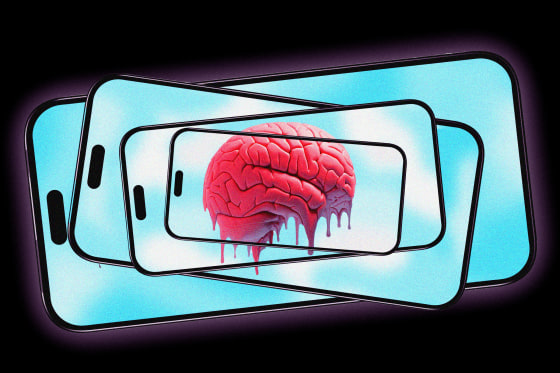
According to research, what which can become habitual for many people; scrolling through short videos on TikTok, Instagram or You-Tube Shorts affects attention, memory and mental health. Increased use of short-form video, according to a recent meta-analysis of the scientific literature, was linked to poorer cognition and increased anxiety. Naturally distractible, our brains are wired to respond to unusual background interruptions.
 |
| image: iStock/tommaso79 |
Frequent switching from topic to topic in scrolling is the fragmentation of attention that makes it difficult to remain focused for longer attention-requiring tasks, just as constant interruptions like continual telephone ringing or children nagging for attention interrupting mind focusing. Whether long-term complications may arise from these interrupted interactions is not known.
The cortex being vital for controlling addictive behaviours, bypassing its normal function through greater screen use for short, distracting videos results in impulsivity prompting users to seek out dopamine hits from social media, leading to greater screen time presenting with incidents of attention-deficit-hyperactivity disorder (ADHD) symptoms. Insufficient sleep particularly in the adolescent years, over time reduces white matter in the brain, a fatty substance that coats neurons and accelerates brain signals.
Labels: Chatbots, Distraction, Excess Screen Time, Interruption, Video Shorts
posted by Pieface @ 8:21 PM


0 Comments:
Post a Comment
<< Home