Increasing Pressure on Iran With Threats of Strikes
"Aircraft carrier USS Gerald R. Ford (CVN-78), its escorts and embarked Carrier Air Wing 8 have been tasked from their current position in the Caribbean to the Middle East to support a U.S. naval buildup in the region, USNI News has learned."
"Ford, currently in the Caribbean Sea, will join the Abraham Lincoln Carrier Strike Group against the backdrop of the Iranian government’s lethal crackdown against protestors and nuclear negotiations between the U.S. and leadership in Tehran, a U.S. official confirmed to USNI News."U.S. Naval Institute"[Failure to reach a deal with my administration would be] very traumatic.""I guess over the next month, something like that [timeline for striking a deal on the nuclear program].""It should happen quickly. They should agree very quickly."U.S. President Donald J. Trump
 |
| Sailors aboard aircraft carrier USS Gerald R. Ford (CVN-78) conduct routine flight operations on the flight deck, Sept. 26, 2025. US Navy photo |
The USS Gerald R. Ford aircraft carrier, scheduled for an overdue maintenance has been ordered by the Trump administration to instead extend its deployment despite having been at sea for close to eight months. Accordingly, the aircraft carrier and its escort ships are currently en route to the Middle East in response to Iran's defiance of the U.S. government's pressure for a new nuclear agreement.
From its deployment in the Caribbean Sea, the USS Gerald R. Ford is now scheduled to sail across the Atlantic Ocean with its crew of 4,200 sailors. Whether the carrier's accompanying warships would be included in the orders to deploy to the Middle East or whether other destroyers and vessels would instead sail with the carrier has not yet been established.
President Trump has threatened openly to attack the Islamic Republic should it not comply with his demands, even as diplomatic overtures are ongoing with an aim to avert kinetic action, adding more violence on top of U.S. strikes hitting Iran's nuclear sites in June of 2025. The tension in the region between Iran, Israel and the United States is palpable and the outcome uncertain.
Admiral Daryl Caudle, head of the US. Navy publicly issued an alert last month that the Ford and other vessels comprising its carrier strike group are needful of maintenance and there would be 'some pushback' from him should an extension of the deployment -- which typically lasts about seven months to meet repair schedules -- be sought. "Let's see if there's something else I can do", he said publicly.
"Extensions for East Coast carrier strike groups beyond the Navy’s planned seven-month deployments have become the norm over the years because of an overworked carrier force resulting from ongoing maintenance delays and combatant commander requirements.""Since December 2021, CSGs have averaged almost nine-month deployments. The carriers often operated in the Mediterranean, but shifted to Middle East-centric deployments after the Oct. 7, 2023, Hamas attacks in Southern Israel and the subsequent Houthi aggression in the Red Sea."U.S. Naval Institute
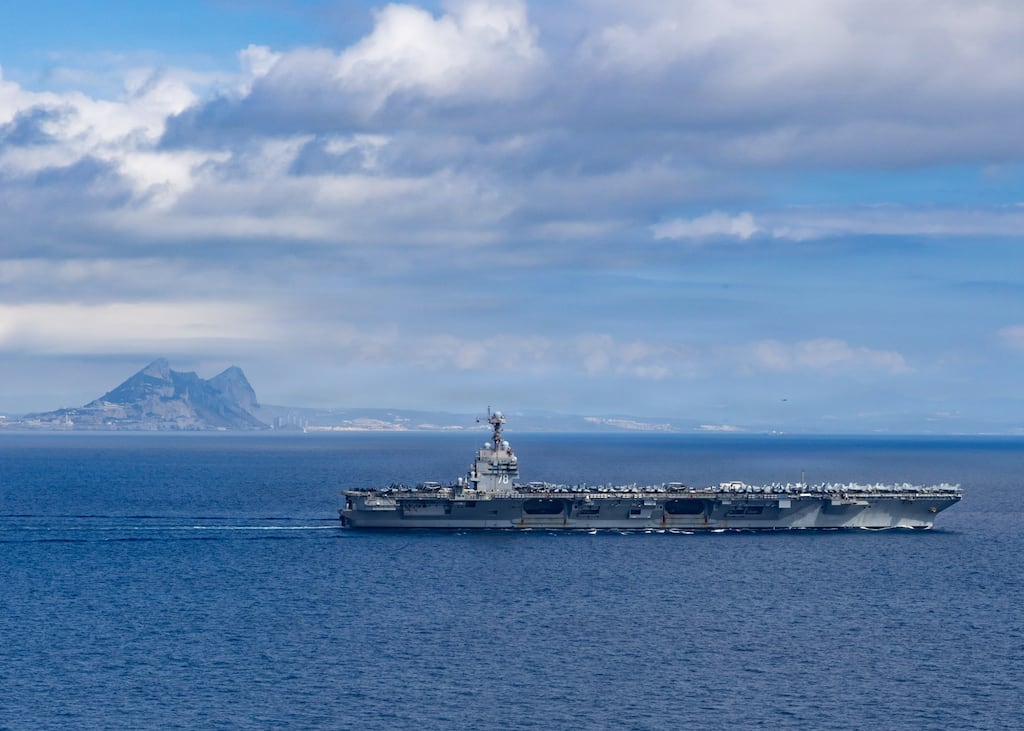 |
| The USS Gerald R. Ford, seen here transiting the Strait of Gibraltar, is currently heading toward the Middle East. (MCS Alyssa Joy/U.S. Navy) |
However, in the event, it appears the Pentagon and the navy reached an agreement that no better alternatives presented, and the carrier would be sent to the Middle East. The USS George H.W. Bush in the midst of an exercise, was not seen to be ready for an assignment, and the USS George Washington was discussed as alternatives, but the latter returned to port in Yokosuka Japan after a Pacific region six-month mission. The Ford had been diverted to the Caribbean in October joining efforts to press Venezuelan president Nicolas Maduro to step down and was directly involved in the Special Operations raid capturing the Venezuelan leader.
The massing of firepower in the Middle East will see the Ford joining the USS Abraham Lincoln. Despite last month seeing President Trump considering striking Iran, course was shifted as defence officials raised their concerns over the potential vulnerability of regional security deteriorating. The Pentagon's response to heightened tension with Iran led to assigning two carrier groups providing not merely dozens of fighter jets aboard, but as well the arsenal of missiles and air defence capabilities supplied by accompanying destroyers.
 |
Labels: Islamic Republic of Iran, Nuclear Agenda, Resistant Iran, U.S. President Donald Trump, United States Navy
posted by Pieface @ 8:16 PM


0 Comments:
Post a Comment
<< Home