New Zealand's Dilemma
"It's difficult to see what more could've been done. [Tarrant] is an unreliable witness and his narrative should be treated with caution.""Pleading guilty to charges where his guilt is certain can't be seen to be irrational."N.Z. Crown lawyer Barnaby Hawes"I very distinctly remember that I left court after the sentencing thinking 'Right, the trauma chapter is now closed, time to heal, time to focus on your own mental well-being', but then it pops up again and again,""It will be just an image [on-screen image of the mass murderer] that I am looking at, because he means absolutely nothing to me at this stage.""I suspect one of his main motivations to do this is to open up traumas again and I won't let him succeed in doing that - he just wants his limelight and to be relevant again."Aya al-Umari, who lost her older brother Hussein in the attack on Al Noor mosque"He took the right of life of my brother and 50 others, and then we're going to sit through now and talk about the legal arguments of his right to appeal.""When you place those two together, they are morally not comparable."
| Extraordinary arrangements are in place in Wellington as a convicted terrorist addresses the country's Court of Appeal. (ABC News: Che Chorley) |
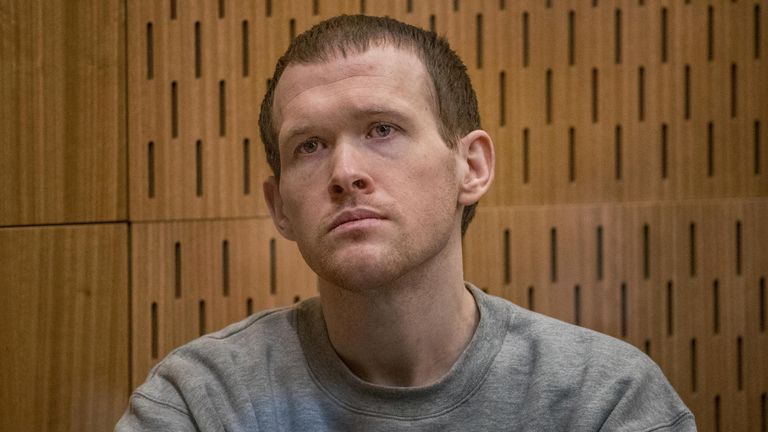 |
| Brenton Tarrant, 35 |
"I did not have the mindframe or mental health required to be making informed decisions at that time.""I think the issue is, did I really know what I wanted to do or what would be a good idea?""No, I didn't actually ... I was making choices, but they were not choices made voluntarily and they were not choices made rationally due to the [prison] conditions."Brenton Tarrant, white supremacist, New Zealand mass murderer
Originally from Australia, the self-professed white nationalist of 35,went to New Zealand for an express purpose in 2019. He planned to acquire weapons and to attack mosques for the purpose of killing as many Muslims as he could manage. And he succeeded to a monstrous degree, taking the lives of 51 people at two mosques, including those of children, women, the elderly and an assortment of other New Zealand Muslims, some there to study or to pursue professions, others having arrived as refugees to settle in a place of haven where they thought they would be safe from violence.
At the time of his attacks of the two mosques in Christchurch, he livestreamed the massacre as it was ongoing, filmed his face as he proceeded to mow down people at prayer, leaving overwhelming evidence of his guilt. "Keeping this case alive is a source of immense distress" to the victims of the atrocity, pointed out Crown lawyer Madeleine Laracy. "It doesn't allow them to heal."
Serving life with no chance of parole, Tarrant is appealing his sentence earned by his cold-blooded, planned and prosecuted murder of 51 people, claiming that it was not his intention to plead guilty, having done so was "irrational", but circumstances induced him to do so by solitary and austere prison conditions. In response to his move to have a retrial, and despite that experts ruled Tarrant was fit to enter pleas, Crown lawyers opposed his appeal, given no evidence existed or claims he was seriously mentally ill.
Lawyers on either side, those who supported and those opposing his sentence appeal, studiously skirted making mention of his white supremacist views, the topic avoided during the week-long hearing where no mention was made of the hate motivating Tarrant's crimes that he cited as reason for committing the massacres.
New Zealand's courts were fully engaged in suppressing the racism that led Brenton Tarrant to commit mass murder. He had made reference to other massacres committed by perpetrators of mass murder that he admired and in fact emulated, before his own horrendous attack. A legal ban was instituted on his racist manifesto as well as the video he livestreamed at the time of the shooting.
In deciding to recant his guilty pleas, a three-judge panel in Wellington at the Court of Appeal hard final arguments by Crown lawyers opposed to the application to have his admissions to charges of terrorism, murder and attempted murder in 2020 discarded. Should he be allowed to revoke his guilty pleas, the case would return for a full trial in court.
The appeal bid was revealed before nine reporters, nine lawyers, a few court staff and an empty public gallery, with the intention of the court seeking to limit public exposure to Tarrant, his views and his motivation; no one permitted to view the evidence as the appeal bid unfolded. The incarcerant's image was not visible in the courtroom other than when he gave evidence while he watched the proceedings by video conference from Auckland Prison.
"What happened in New Zealand, it was unprecedented and at every point we've had to create new methods to deal with the situation.""We're learning as we go.""You do need to have some kind of objective transparency, where the person who is accused can be seen and some of what they are saying can be heard," he said."But at the same time, you've got to make sure that the platform they're given is not hijacked for other purposes."Waikato University professor of law Alexander Gillespie
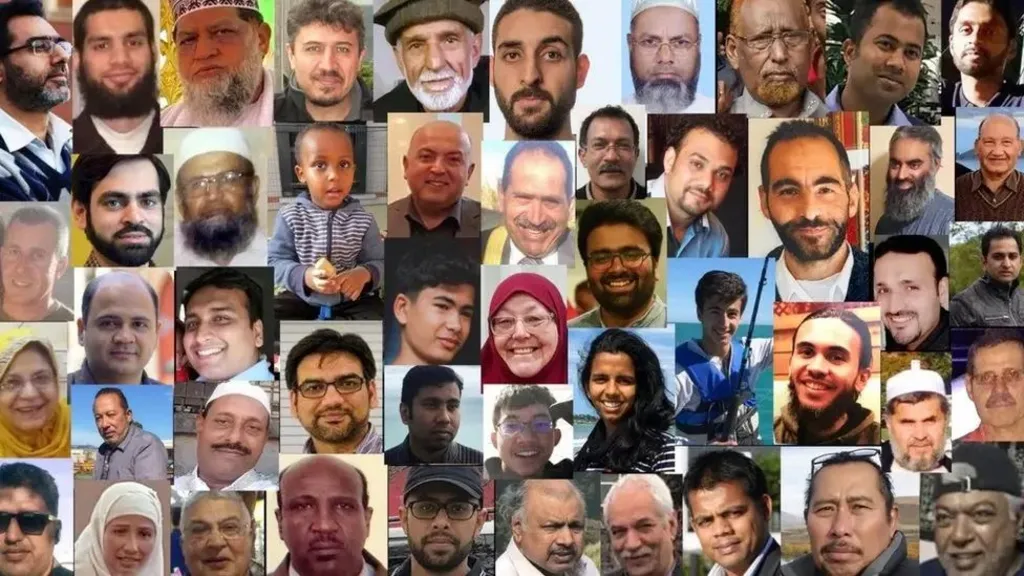 |
| New Zealand mosque assaults victims BCC |
Labels: 51 Dead, Christchuch Mosques, Mass Murder, Mosque Worshipers, New Zealand, Perpetrator Life Sentence
posted by Pieface @ 8:37 PM


0 Comments:
Post a Comment
<< Home