Raising An AI Pet
"When it comes to data-privacy concerns, the core problem is that the public has very little transparency into what companies are actually doing.""If you're having highly personal conversations, [with these sweet and cuddly AI toy-companions] there are companies on the other end that are doing the listening and the talking."R.J. Cross, director, consumer privacy campaign, U.S. Public Interest Research Group"[AI companion toys ranked at No. 9 in official] Top 10 Products of the Year [list in 2025].""After all, they not only look cute but also speak nicely.""They have already outperformed 90 percent of human partners."Taobao online shopping platform, China
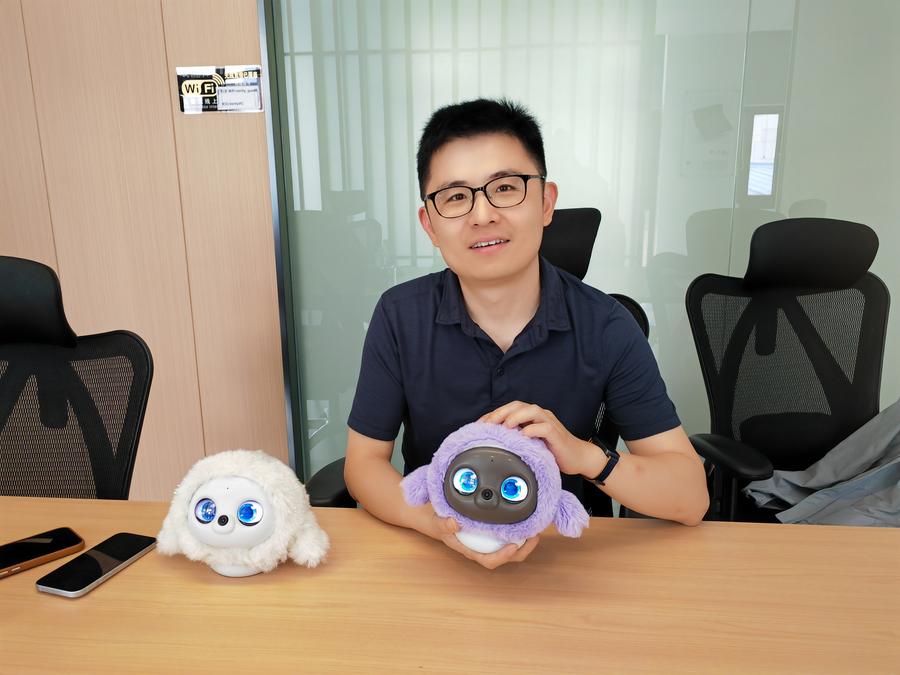 |
Zhou Yushu, co-founder of ROPET and a professor at Renmin University of China, poses for photos with AI pet products he has developed, in Beijing, capital of China, May 23, 2025. (Xinhua/Ma Sijia) |
"As an extension of traditional pets, AI companions offer stickiness and sustainability.""Annual compound growth rate has exceeded 8 percent in recent years, and forecasts indicate it could reach 10 percent over the next five years."Professor Wei Xiang, University of Chinese Academy of Social Sciences
AI companion pets are the latest consumer sensation out of China where young people have taken to talking pets with no need of being taken for walks nor the routine of messy clean-ups afterward, taking the place of marriage. The digital creatures have become comfort companions, replacing human-to-human interaction; an emotional safety net that owners can confide in without fear of their inner thoughts being broadcast about a circle of friends potentially causing embarrassment and requiring explanations.
AI pets have endeared themselves mostly to young, unattached adults as well as to children. Chinese tech-producing companies including Huawei have designed and developed AI pets with young Chinese who live alone specifically in mind as pet-consumers of the AI-variety. Most of the 'pets' have a fluffy body with large, expressive eyes that light up and have the appearance of emotional expression. Their proliferation has state support within a tightly integrated industrial supply mechanism.
The Shenzhen Toy Industry Association projects the AI toy market in China is set to surpass US$1.4 billion by year 2030 at an annual compound growth rate of over 70 percent. This is big business under the umbrella of the state as an experiment in social engineering manipulation that may restore a level of emotional satisfaction and fulfillment absent in a social aura of discontent over economic stability linked to difficulties in securing life partners and establishing families.
 |
| Ropet robotic pets mimic the behaviour of a real animal. They require regular feeding and make grumbling sounds when hungry. If you present it with fruits like apples, oranges, or bananas, its eyes—two LED screens—light up with images of food, making interactions with it more enjoyable. PHOTO: CHINA DAILY |
AI toys with distinct personalities are being offered, such as digital pets by the Shanghai-based tech company Robopoet where, in Las Vegas last month, Fuzozo made its U.S. debut, dubbed the CES event's 'cutest' renditions of 'tech'. Attendees crowded around the show floor to experiment with the palm-size devices to test their responses in various languages, witness how they wobble and briefly appear 'dizzy' when shaken. Two units placed in proximity can communicate with one another for the amused appreciation of onlookers.
Most AI toy owners are women in their 20s and 30s who share their experiences on Chinese social media platforms. Female users on Rednote speak of their pets filling an emotional void: "Other people are getting married and giving birth; I'm already raising an AI pet". Moreover, one that can express joy with widened eyes. While real living pets come with real-life problems, AI pets present none of those tedious responsibility burdens.
AI pets are considered part of the 'emotional economy', steadily rising in popularity. "This is exactly the need AI pets currently meet: providing emotional companionship along with minimal caregiving costs", pointed out Qi Ye, associate professor of psychology, Renmin University, Beijing. Urban younger generations weighted by the struggle for good grades, find good jobs settle down and have multiple children, find the AI-toy companion trend particularly resonating to their emotional needs.
 |
| Zhang Yachun talking to her AI-powered robot named Aluo, AFP |
Labels: AI Pets, China, Chinese Consumer Sensation, Digital Animals, Emotional Void
posted by Pieface @ 8:27 PM


0 Comments:
Post a Comment
<< Home