Terrorism Abounds in Pakistan
 |
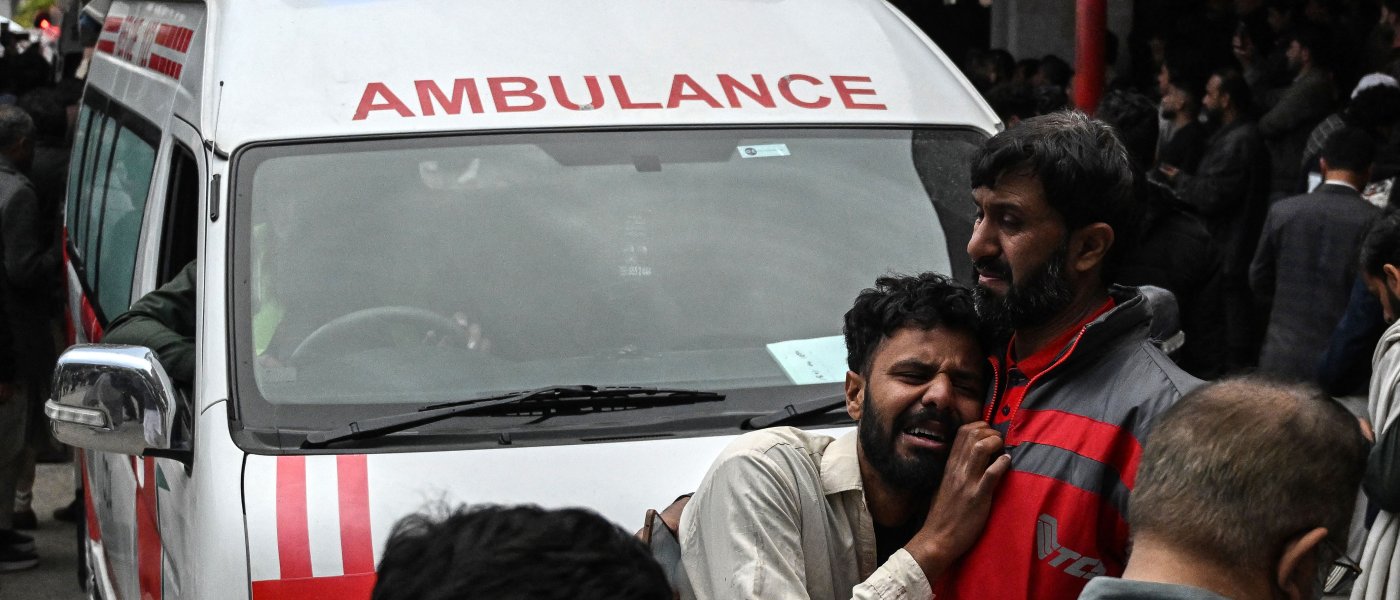
| Rescue workers transport one of the many injured victims of the bomb explosion at a mosque in Islamabad on Friday. (M.A. Sheikh/The Associated Press) |
"By the time I reached it there had already been an explosion.""Bodies were lying everywhere, some were missing arms, some missing legs.""We took the most injured in our own vehicle [to hospital]."Mosque caretaker Syed Ashfaq
"The morning of February 6, a suicide bomber attacked a Shia mosque in Islamabad, Pakistan. The attack risks worsening regional instability amid a deteriorating security situation in Pakistan. Early reports suggest the attack was carried out by a single actor, who opened fire at security personnel outside a mosque before entering and detonating a suicide vest. In an official statement, Islamabad’s deputy commissioner announced that 31 people had been killed, with another 169 people hospitalized locally, but the death toll is likely to rise.""No group has yet claimed the attack. Pakistan is home to an enormous variety of terrorist organizations: U.S. officials have identified at least 15 groups, while the Indian nonprofit South Asian Terrorism Portal has listed 44 terrorist organizations operating in the country. Most terrorist violence in Pakistan is associated with three actors: the Islamic State, Baloch militants, and Tehreek-e-Taliban Pakistan (TTP).The most likely perpetrator appears to be the Islamic State–Khorasan Province (IS-KP), which operates both in Afghanistan and Pakistan but has a significant interest in mass-casualty international attacks. The group has been implicated in a variety of recent international attacks and plots, including mass-casualty attacks against Crocus City Hall in Moscow and a memorial for Iranian General Qasem Soleimani in Tehran, and plots against the Paris Olympics, cathedrals in Cologne and Vienna, and protests outside of the Swedish parliament."Center for Strategic and International Studies
"[India -- Pakistan's eastern neighbour was] assisting the Taliban regime and threatening not only Pakistan but regional and global peace.""[Pakistan takes strong exception to the situation in Afghanistan where the Taliban regime has created conditions similar to or worse than pre-9/11, when terror organizations posed threats to global peace."Pakistan President Asif Ali Zardari
 |
| Photo: Aamir QURESHI / AFP via Getty Images |
Tension between Pakistan and the Taliban government next door are high, as Pakistan accuses the Afghan Taliban of supporting Pakistan's own Taliban. How things have changed; before and during the U.S.-led, UN-approved invasion of Afghanistan by NATO forces following the 9/11 atrocities in New York, Washington and Pennsylvania it was Pakistan through its military and its Inter-agency Intelligence group that supported and gave haven to the Afghan Taliban, at the very time that it declared itself in league with the U.S. in combating terrorism.
Afghanistan was invaded by the combined Western forces led by the U.S. because the-then-governing Taliban was sheltering al-Qaeda and its leader, Osama bin Laden. Refusing to surrender Osama bin Laden, known to have been the mastermind of 9/11, a 20-year conflict was launched when the U.S. sought the elusive al-Qaeda leader in the mountains of Afghanistan. It was, in fact, in Abbottabad, Pakistan, at a secret compound, where U.S. Navy Seal commandos found bin Laden and killed him.
That compound was not far from a Pakistan army base. It was clear that Pakistan's military knew of the presence of the secretive head of al-Qaeda and likely facilitated his stay there. Next to the compound lived a Pakistani medical doctor who suspected that his neighbour was the infamous bin Laden, and in the belief that his country was in league with the U.S. to discover his whereabouts, he confirmed to the U.S. that the man whose suspicious presence was thought to be bin Laden, really was.
For his efforts, Shakil Afridi, the Pakistan physician who had been so helpful to the U.S. was later arrested, charged and convicted in a Pakistan court of treason, and sentenced to 33 years in prison. So much for Pakistan's double game of supporting the war on terrorism while enabling it and giving haven to its leaders. It's fairly rich that now, the country overrun with terrorist groups, portrays itself as an innocent victim.
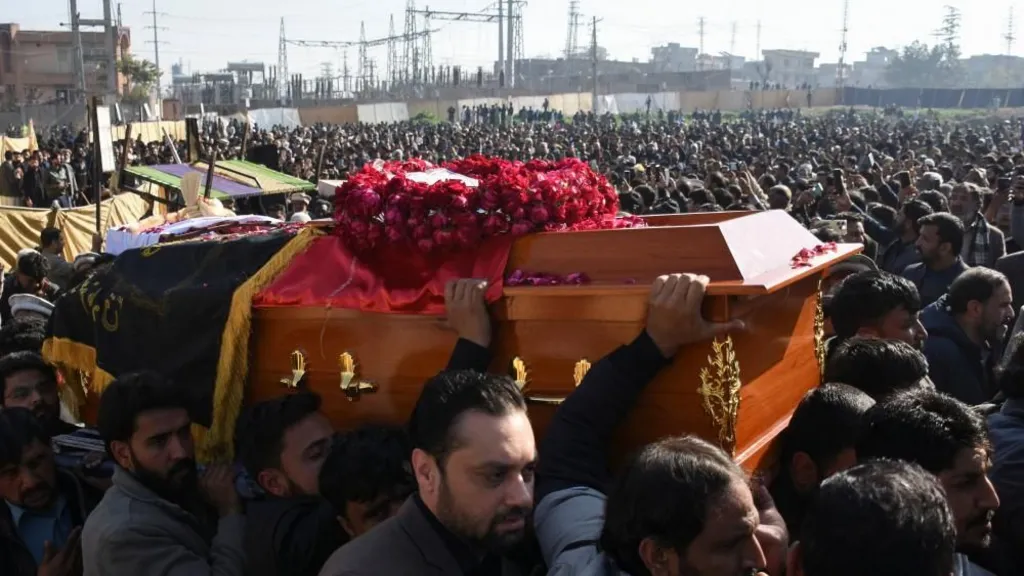 |
| Thousands gathered in Islamabad to mourn the 32 victims of Friday's attack Reuters |
Pakistan accuses India of planning terrorist attacks on Pakistan's soil, but it was a Pakistani terrorist group, Lashkar e-Taiba that conducted a 2008 attack on India's financial hub in Mumbai. A dozen coordinated attacks took place over a period of three days of chaos and violence. Fire, grenade attacks and gunfire took its terror-toll of over $1-billion in damage. No fewer than 166 innocent people died in that series of attacks, with some 300 people wounded. India has much to blame Pakistan for; not the other way around.
Last Friday's suicide bombing that took place at a Shiite mosque killing 31 worshippers and wounding 169 was the work of Pakistan's own Islamic State terrorist group, which in fact claimed the glory for the gore it had created. The assertion by Pakistan that terrorism cannot be confronted by any single country in isolation, arrived after global reaction condemning the attack, but Pakistan's role in aiding and abetting terrorists that prey on other countries reveals them for the hypocrites that they are.
The government in Afghanistan responded to the claims from Pakistan by proclaiming its innocence in the affair. Its focus is on terrifying its own population, which apparently takes up all its energies, particularly addicted to characterizing women as somewhat subhuman whose role is to complement male desires and to produce following generations, with no self-agency, no rights, no access to education or personal fulfillment.
 |
| Police commandos take positions at the site of a bomb explosion at a mosque in Islamabad, Pakistan's capital, on Friday. (Anjum Naveed/The Associated Press) |
Both New Delhi and Afghanistan's Defence Ministry separately rejected the allegation of the Pakistan government, decrying Islamabad's irresponsibility. The Taliban in Afghanistan, returned to government with the withdrawal of U.S. forces and its allies in 2011, has continued its persecution of its population and is itself the locus of the presence of other terrorist groups, including ISIS. The Pakistani Taliban, Tehrik-e-Taliban Pakistan, has also denied any link to the mosque bombing.
Pakistan's security forces arrested four suspects, among them an Afghan national accused of links to the IS group in Afghanistan, said to have assisted in masterminding the attack. The bomber's mother and brother-in-law have evidently also been detained, with the investigation ongoing.
Labels: Afghan Taliban, India-Pakistan Rivalry, Islamic State, Pakistan, Pakistan Taliban, Shiite Mosque Bombing
posted by Pieface @ 8:13 PM


0 Comments:
Post a Comment
<< Home