Coming Home to Odaka, Fukushima Prefecture
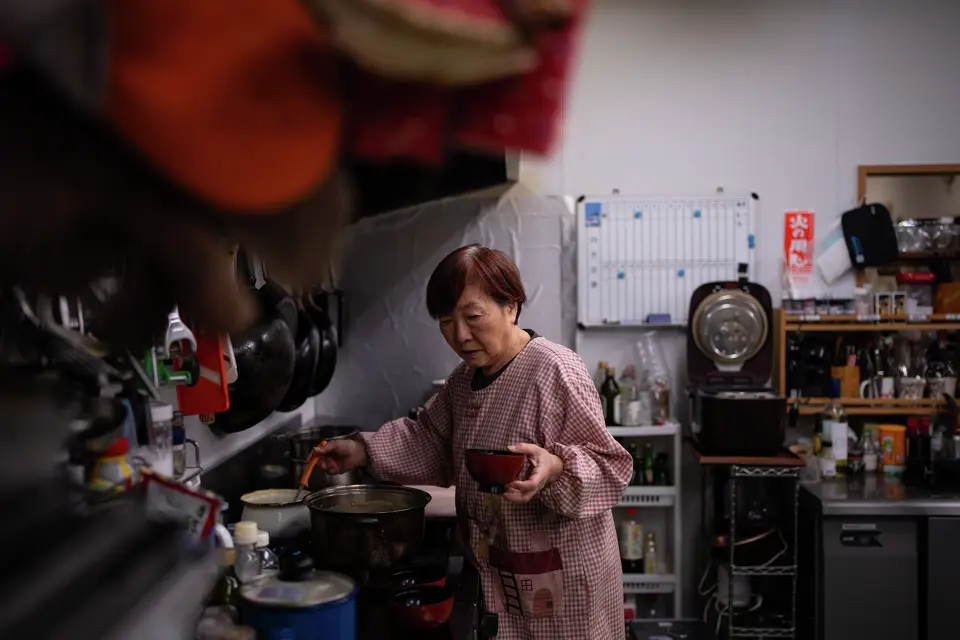 |
Tomoko
Kobayashi serves miso soup during breakfast service at Futabaya Ryokan
in Odaka, Fukushima Prefecture, Friday, Feb. 13, 2026, Louise Delmotte/AP |
"These empty lots used to be filled with shops. There used to be businesses, community activity and children playing. We used to live our ordinary daily lives here, and I hope to see that again.""The town was destroyed, and we need to rebuild it. It's a time-consuming process that cannot be accomplished in just a couple of decades.""But I hope to see the progress, with new people and new development added to what this town used to be."Tomoko Kobayashi, Odaka, northeastern Fukushima, Japan
Fifteen years have passed since Japan's 2011 nuclear disaster at the Fukushima Nuclear Plant, after a tsunami followed an earthquake to turn Japan's sense of security over energy derived from nuclear inside out and upside down. In Odaka, a town nearby the nuclear plant, the Kobayashi family still operate the family inn, the Futabaya Ryokan, in the near-deserted town. Tomoko Kobayashi, dedicated to rebuild the town to what it once was, conducts radiation surveys. She did just that before the family reopened their inn in 2016.
She and other monitors obsessed with recovering the town and its environs, share radiation data in their efforts to reconstitute the town once known as a textile hub. The magnitude 9.0 quake off Japan's northwestern coast in 2011 is a memory that Tomoko will not ever forget; that of long, violent shaking of the inn's walls. Then, an hour later the tsunami struck and water surged into the inn's kitchen "like a river". A far more destructive wave hit the Fukushima Dai-ichi nuclear plant, destroying key cooling systems and causing a meltdown at three reactors.
"I had to understand what the nuclear accident was about. I thought someone had to go back and keep an eye out. Now it has become my lifetime mission.""We are not professional scientists, but we can measure and show the data. What's important is to keep measuring, because the government maintains that it's safe, as if radiation no longer exists.""But we know for a fact that it's still there."Tomoko Kobayashi
 |
| Guests from near and far at Futabaya Ryokan Fukushima Fieldwork Report |
A day later, the No. 1 reactor building suffered a hydrogen explosion and two days after that, the Unit 3 reactor building exploded, followed by the No. 4 reactor building spewing radioactive particles contaminating the surroundings, causing hundreds of thousands of residents to flee their homes and all that was familiar to them. Tomoko and her husband, after two years of living in Nagoya, returned to the area in 2012, to live nearby in temporary housing accommodation.
Since then the town had recovered somewhat. The operated their inn and at the same time continued to measure the radiation levels in the soil, as they do now, a decade later. Twice yearly, Tomoko and others like her interested in returning to the town and opening new businesses, set aside two weeks to measure the air at hundreds of locations to enable them to produce colour-coded maps that reflect the radiation data in the areas they measure. They've set up a lab where local produce is tested to ensure that what they eat is safe.
 |
| Tomoko Kobayashi looks at a color-coded map of radiation levels created by local residents during an interview near a radiation monitoring lab in Odaka. (AP Photo/Louise Delmotte) |
The nuclear plant has seawalls built around it for the purpose of withstanding another massive tsunami. All of the plant's reactor buildings have enclosed rooftops. "Our decommissioning work at the plant is about how to reduce risks of radiation", explains head of decommissioning, Akira Ono from Tokyo Electric Power Holdings Company, the plant operator. Between them the three reactors contain some 880 tons of melted fuel debris whose radiation levels remain dangerously high.
Fukushima prefecture says all farm, fisheries and dairy products in stores are safe, having tested thousands of predistribution samples annually. At the same time harvests of fruits, mushrooms, river fish in former no-go zones remain restricted. "Radiation levels have come down significantly over the past 15 years, but I wouldn't use the word 'safe', just yet", former decontamination and radiation survey at Fukushima Dai-ichi, Yukio Shirahige, added. In testing wild boar meat it was found to be 100 times over the safety limit of contamination.
 |
| Getting a close look at Unit 2 and Unit 3 at Daiichi NPP Fukushima Fieldwork Report |
Now, since 2022, Japan has new plans to accelerate reactor restarts to bolster nuclear power as a stable energy source.
Labels: 2011 Fukushima Nuclear Meltdown, 9.0 Quake, Fukushima Prefecture, Futabaya Ryokan, Odaka, Testing for Radiation, Tsunami
posted by Pieface @ 8:27 PM


0 Comments:
Post a Comment
<< Home