A Non-Coalition of the Unwilling
"We are not at war with anyone.""[France's warship deployment's intent is to allow France] to respond to emergency situations [and evacuate French nationals if necessary.""We stand by the side of our allies and our friends. There have been some interceptions that have continued in recent days."French President Emmanuel Macron
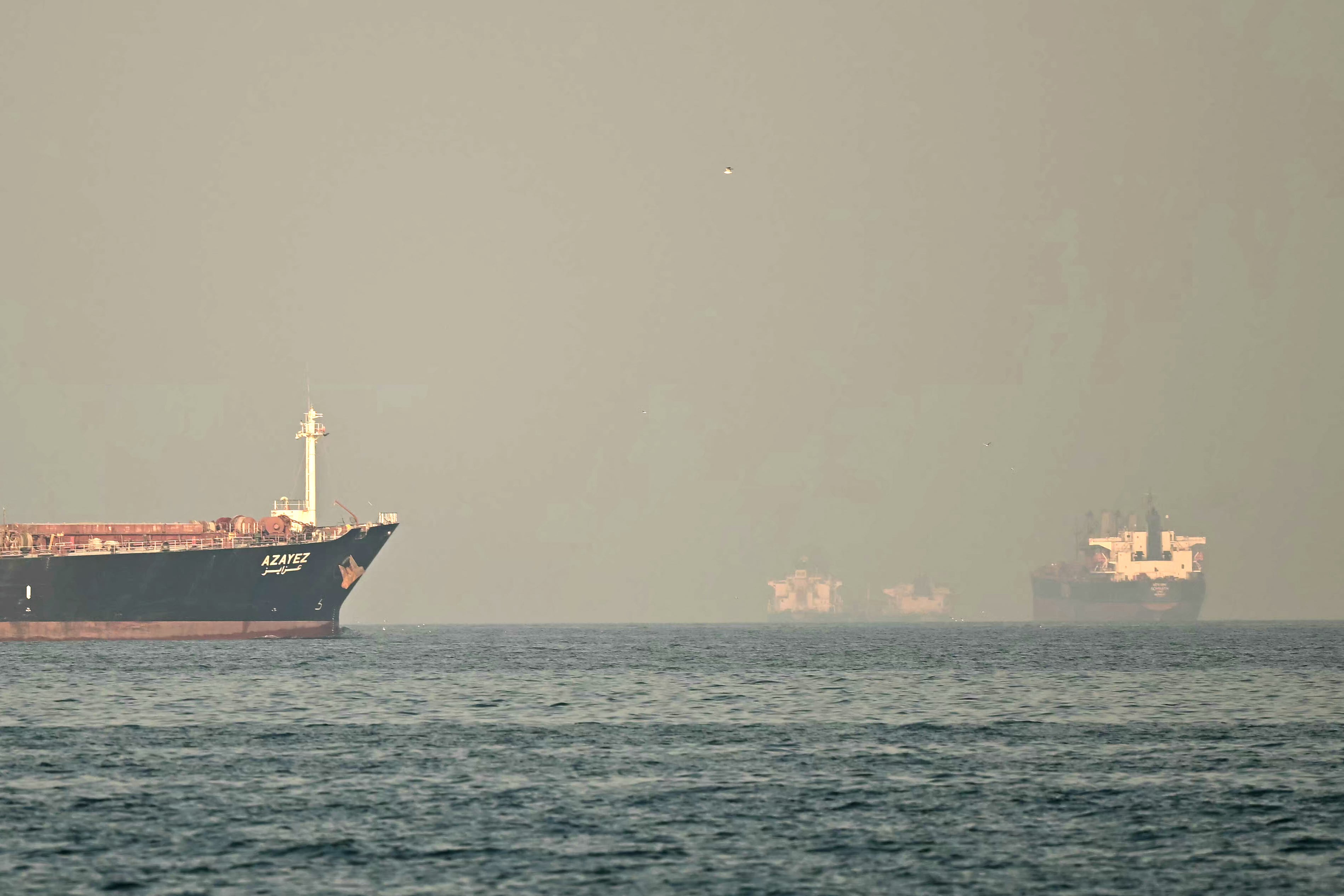 |
| Cargo ships and tankers are seen in the Strait of Hormuz on Feb. 25, 2026. (Giuseppe Cacace / AFP via Getty Images) |
"We must be careful -- it's always a risky operation -- to make sure our warships are not targeted.""Because if they are attacked, we have to fire back."Former French President Francois Hollande"It is not NATO's war. NATO is an alliance to defend the alliance area.""[Berlin has taken note but] The United States did not consult us before this war, and so we believe this is not a matter for NATO or the German government."Stefan Kornelious, spokesman for German Chancellor Friedrich Merz"It's only appropriate that people who are the beneficiaries of the strait [of Hormuz] will help to make sure that nothing bad happens there.""If there's no response or if it's a negative response, I think it will be very bad for the future of NATO."U.S. President Donald Trump
 |
| U.S. President Donald Trump speaks before signing an executive order in the Oval Office of the White House on Monday. (Julia Demaree Nikhinson/The Associated Press) |
The American President, during the U.S.-Israeli aerial strikes against the Islamic Republic of Iran and the consequential blockading by Iran of the Strait of Hormuz to the world's 1/5th most important shipping route, has asked his allies in the North Atlantic Treaty Organization and others, that includes France, China, Japan, South Korea and the United Kingdom for their assistance in securing global shipping through the strait. Thus far there have been far more demurrals than offers of assistance. Appealing to China, in any event, would be a non-starter since it has allied itself with Iran and signed a Comprehensive Strategic Partnership, in its thirst for Iranian oil.
"From our perspective, it [the Strait of Hormuz] is open -- just not for the U.S., Israel and its allies.""[There have been] delusional [claims that Iran is searching for a negotiated end to the war].""[Wrong, Iran seeks nether] truce nor talks."Iranian Foreign Minister Abbas Araghchi
 |
| Smoke can be seen in the distance from Dubai International Airport after a drone struck a fuel tank, forcing the temporary suspension of flights on Monday. (The Associated Press) |
At the present time, cargo ships are stuck waiting in the Gulf, or have the alternative of a much longer detour around the southern tip of Africa. As the war in Iran continues, there will appear shortages and price increases on a widening range of goods, beyond soaring energy prices. The wider global supply chain beyond energy includes pharmaceuticals from India, semiconductors from Asia and Middle East-derived products such as fertilizers from oil byproducts.
Foreign citizens from around the world work in the Middle East; more than any other country in Europe, France alone has over 400,000 of its citizens working there; with over 60,000 in the United Arab Emirates. Spain, Italy, the Netherlands and Greece have deployed their frigates in the region. France has signed key defence agreements with several countries; Qatar, Kuwait and the United Arab Emirates -- a permanent base in Abu Dhabi where French air and naval forces saw a doubling of Rafale fighter jets.
Typhoon and F-35 fighter jets, helicopters and air defence systems have been sent by the U.K. to assist in intercepting Iranian missiles and drones and to protect British troops stationed across the region, particularly in Cyprus and Qatar, along with Britain's other partners in the Middle East. France's Rafale jets have intercepted drones from Iran targeting the U.A.E. since the war's beginning.
France's President Macon urged Iran to halt strikes against regional countries as the first Western leader to speak directly with Iranian President Masoud Pezeshkian since the war broke out. It will be remembered that President Macron was always the first, the second and the third to speak with Vladimir Putin about his invasion of Ukraine. According to Mr. Macron "a diplomatic solution" is required to put a stop to the escalation. As a major peacemaker, Mr. Macron spoke as well with Israeli Prime Minister Benjamin Netanyahu and U.S. President Donald Trump.
The war continues.
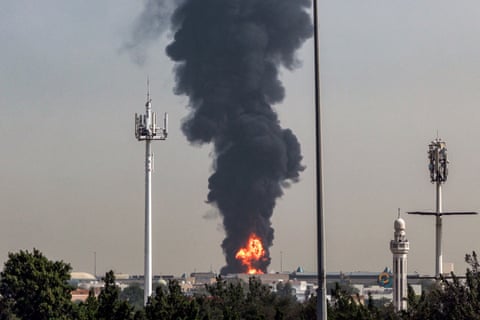 |
| Fire and smoke rise from Dubai’s international airport on Monday after a ‘drone-related incident’. Flights were disrupted. Photograph: AFP/Getty Images |
"The feeling is, this is not Europe’s war.""Of course we are allies with America, but we don’t really understand their moves recently.""We haven’t been consulted, and we don’t really understand, what are the objectives of this war.""It is in our interest to keep the Strait of Hormuz open."Kaja Kallas, EU foreign policy chief
Labels: France, NATO, Strait of Hormuz, U.S. Allies, U.S.-Israel Aerial Bombardment of the Islamic Republic of Iran, United Kingdom
posted by Pieface @ 8:03 PM


0 Comments:
Post a Comment
<< Home