Opioid Chemical Compound Papers Online Fuelling Drug Trade
"It is ten times more potent than fentanyl. We are just seeing this for the first time [on the streets].""The reality is, yes, there's always a possibility [that scientists publishing their findings for easy accessibility for other scientists, enabled a trend].""Nobody knows what's really coming next. So you can make the argument that having that information is more beneficial to us than not having the information."Alex J. Krotulski, forensic toxicologist Center for Forensic Science Research & Education, Pennsylvania laboratory"If I can access the literature [then] they [amateur chemists and illicit drug suppliers anywhere in the world] can access the literature.""[The challenge, was to be] not one step behind but one step ahead."Istvan Ujvary, Hungarian medicinal and pharmaceutical chemist
 |
| Alex J. Krotulski runs a lab tasked with identifying a growing assortment of new synthetic drugs. |
Illegal drugs today are produced in unregulated laboratories around the world, from Chinese and Indian enterprises to single-individual operations operated out of apartments. Fentanyl is just one of hundreds of synthetic compounds, growing steadily more potent, that are known as novel psychoactive substances. There are now 1,446 new psychoactive substances listed by the UN's Office on Drugs and Crime, whereas a decade earlier there were 643.
Any combination of chemicals or molecular structure published online becomes immediately available to those lurking in the wings waiting to see what has more recently been synthesized in a reputable scientific laboratory as a strictly scientific endeavour, perhaps for the purpose of finding new chemical combinations that might be useful for medical prescriptions addressing the kind of pain suffered by individuals who fail to respond to existing treatment protocols.
According to Dr. Laura Bohn, associate dean of research at Morsani College of Medicine, University of South Florida, the internet has become the 'cookbook' for the drug trade. She is herself engaged in the study and development of new opiate molecules in medical research, and her work like all others, published in online medical journals, is open to scrutiny for anyone within the scientific community, but also to those whose keen interest in new opiate potentials has a malevolent purpose.
 |
| Kettering Health |
That purpose is to synthesize new combinations of chemicals, derived from shadowing legitimate research to appropriate findings deemed useful to be mixed, substituted and adulterated on a continuous search for new street drugs to fuel the profits of drug cartels as well as individual illicit drug entrepreneurs. Some 42 percent of samples that contain fentanyl include five or more psychoactive compounds, an increase from the 23 percent found three years ago, through a recent study from the National Institute of Standards and Technology.
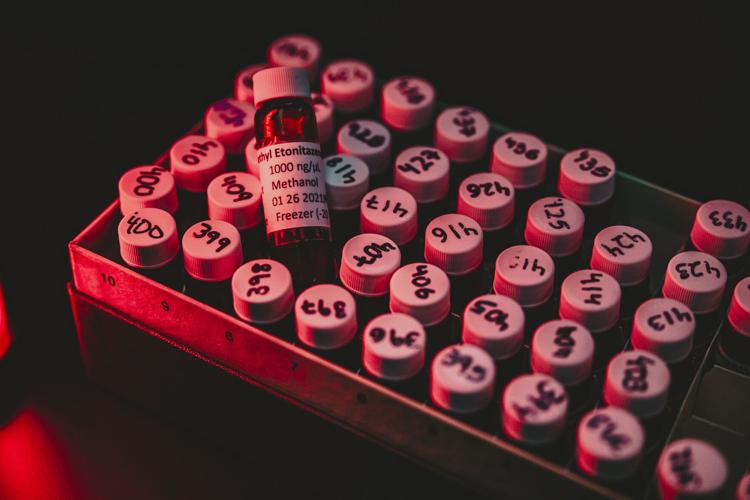
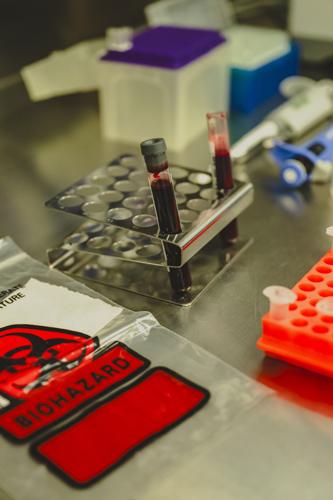
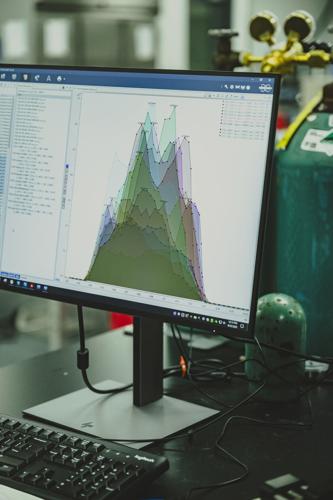
Compounds can be identified by having samples of finished products run through a high-resolution mass spectrometer to finely measure the molecular weights of compounds, which are then compared against a database of 1,200 known drug molecules. N-desethyl etonitazene is among them, from a family of synthetic opiates named nitazenes. Dr. Alex J. Krotulski became aware of this chemical group in 2019 when he and other scientists in forensic toxicology heard of a fatality in Alberta.
 |
| Kettering Health |
The Alberta fatality was caused by a nitazene variant, isotonitazene. Not long after, that very drug was implicated in deaths in Minnesota, Iowa and a few other states. These nitazene opiates were developed 70 years ago by a Swiss pharmaceutical company in the hope that scientists working there had discovered a new drug for pain. The drugs were found in fact, to dangerously suppress breathing and the old patents were shelved.
Their resurgence, it was hypothesized, related to the U.S. and China outlawing fentanyl, forcing illicit drugmakers to look elsewhere for a replacement. Istvan Ujvary is considered to be an influential prophetic scientist, capable of modelling the future of drug compounds appearing suddenly and recognizable by new deaths from street drugs. Tasked by the EU's Drug Agency for a paper to explore which nitazene substances might make a dangerous new appearance, his research was ultimately published in two journals, even while he was congnizant of the risk of street chemists making use of the research.
One of the papers written in tandem with other scholars, examined existing nitazene compounds modelled by hypothetical new compounds, exploring their interaction with the brain's opioid receptor. Some of the drugs the papers mentioned soon after began to appear on the street. One of them was N-desethyl etonitazene, found to have contributed to new deaths of unsuspecting drug users.
Kettering Health Nitazenes: The Emergence of a Potent Synthetic Opioid Threat The global unregulated drug supply faces a critical challenge with the emergence of nitazenes, a class of novel synthetic opioids (NSOs) structurally distinct from fentanyl and associated with extreme potency and high risk of fatal overdose. First synthesised in the late 1950s, etonitazene was a target of preclinical research in rats and rhesus monkeys, but it never reached clinical trials due to an unfavourable balance between therapeutic and toxic effects. Nitazenes’ consistent reappearance began in 2019 with isotonitazene, followed by a rapid proliferation of analogues worldwide, many reported to be hundreds to thousands of times more potent than morphine and, in some cases, stronger than fentanyl. This rise is fuelled by their ease of synthesis, low production costs, and evasion of regulatory controls. Nitazenes are frequently mis-sold as counterfeit medications or adulterated into other drugs, resulting in unintentional exposure and overdose, particularly among opioid-naïve users. The primary cause of death is severe and prolonged respiratory depression. Analytical challenges are significant, as traditional screening methods are ineffective, and the low concentration in biological samples requires expensive and highly sensitive liquid chromatography mass spectrometry techniques. This perspective paper highlights critical gaps in detection, clinical management, and regulatory readiness for nitazenes. Urgent efforts are needed to improve surveillance, develop robust analytical methodologies, provide clinical guidance to nitazene intoxications, and strengthen international policy to curb their proliferation.MDPI Advancing Open Science
Labels: Deadly Opioid Outcomes, Online Publications, Purloining Chemical Data, Scientific Research, Street Chemists, Synthetic Opioids
posted by Pieface @ 8:07 PM


0 Comments:
Post a Comment
<< Home