British Columbia's 2026 Wildfire Season
"This weekend we successfully completed the first drone ignition operation on a wildfire in Canada at the Brunswick Creek complex.""[The drones use a plastic sphere dispenser to drop fire into specific areas] controlling the spacing and intensity of the fires and avoiding placing firefighters in challenging or dangerous terrain.""The drone used for ignition is accompanied by observation drones outfitted with infrared and imaging capabilities, which gives us project intelligence not just during ignitions but through all phases of operations."British Columbia Wildfire Service
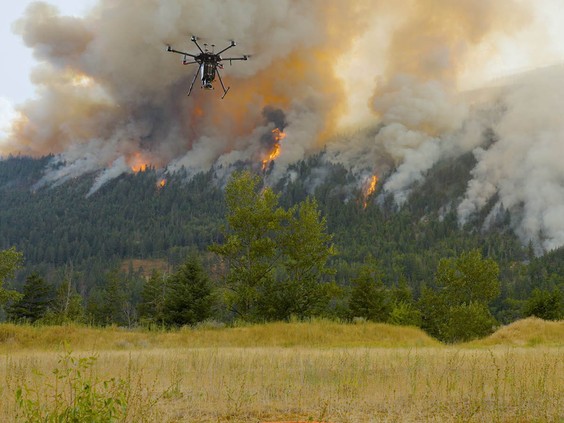 |
| The B.C. Wildfire Service used drones for the first time in July 2026 to do controlled ignitions in the battle against the Brunswick Creek complex of wildfires. Photo by B.C. Wildfire Service |
Remotely piloted aircraft systems -- drones -- were tested by the B.C. wildfire service a few years earlier -- the intention was to use them along with traditional aircraft, and for the support of ground firefighting crews. The drone systems were brought into action at the Brunswick Creek and Ainslie Creek wildfires, referred to as the Brunswick Creek complex, once firefighters and ignition specialists felt assured they could be used safely. This past weekend was their initial deployment.
Observation drones have the capacity to send live video to firefighters: "For example, it can keep crews safer by not having to work in smoke and on steep slopes", explained the service. High-resolution mapping and infrared visuals improve situational awareness "allowing us to see through the smoke to watch for ember transplant (flying embers that stretch a fire front into new areas), assess ignition effectiveness, and monitor fire behaviour".
 |
| (Image Credit: BC Wildfire Service) |
Firefighter safety and decision-making is improved by this new technology, helping the wildfire service to "better protect communities and the environment". The Matthew Creek and Tower Creek fires in the Enderby areas of southeast British Columbia, along with the two Brunswick complex wildfires are among four such fires of particular note at this time.
This past weekend saw the Brunswick Creek complex grow; Brunswick Creek is now estimated at over 42 square kilometres, while the adjacent Ainslie Creek stands estimated at roughly 165 square kilometres. Nine evacuation orders in the Boston Bar area have been occasioned by the Brunswick complex fires. Both fires have mandated evacuation alerts in surrounding areas.
Almost 34,000 lightning strikes are estimated to have hit British Columbia late last week, with dozens of new fires sparked across the province. Forests will increasingly be drier with rising temperatures and limited rain, increasing the likelihood of coming days seeing the eruption of new wildfires. The northeast and central parts of British Columbia can expect many areas to experience worsening smoky skies.
Across the province there were 85 wildfires burning, most of them having sparked in the past week alone. According to the wildfire service, 122 wildfires have been declared successfully stopped, 23 of those fires have been put out in the past 24 hours.
"Typically during this type of fire response we use helicopters to drop PSDs [plastic sphere dispenser], which ignite once they hit the ground.""We had the opportunity to trial a drone, which would be the first time in Canada that we’ve utilized this type of innovation.""I’ve been working for BC Wildfire for the majority of my life, and seeing the new technology of the drones being able to eliminate some of the risk and hazards was very impressive."Operations section chief Arlen Kanary
 |
| Aircraft will be "heavily engaged" in bucking operations at the Ainslie Creek wildfire on Tuesday (July 21), according to BC Wildfire Service. (Pattie Desjardins/Hope Standard) |
Labels: B.C. Wildfire Service, British Columbia Wildfires, Utilizing Drone Ignition
posted by Pieface @ 7:56 PM


0 Comments:
Post a Comment
<< Home