Ukraine's 'Blood Experience' Parlaying Drone Expertise for Military Technology
"One
night in March, a two-person Ukrainian crew established a record for
the Ukrainian Armed Forces by shooting down, in one engagement, 23 Russian Shahed drones
with Sting interceptor drones designed by the Ukrainian military
technology company Wild Hornets. The story is noteworthy not only for
the number of intercepted drones, but also for the operation’s cost
efficiency and Ukraine’s interceptor-production capacity behind it."
"A Sting interceptor costs about $2,500. In comparison, a single U.S.-made Patriot interceptor missile that does the same job costs
more than $3 million and requires significantly more time and resources
to build and operate than a drone. Lockheed Martin produced
approximately 600 of the most advanced PAC-3 type of Patriot missiles last year; meanwhile, the Ukrainian Armed Forces used about 700 of these interceptors in the span of only four winter months in 2025-2026."
"The conflict in the Middle East has further exposed the shortcomings
of a high-end, slow-production approach to defense systems. In March
2026, when Iran launched
hundreds of Shaheds at Persian Gulf states, countries with the most
advanced U.S.-supplied air defense systems outside NATO watched their
defense capabilities erode as their interceptor stockpiles drained
quickly. The air defense systems worked as intended, yet they were not
designed to protect against the intensity and scale of Iran’s attacks."
"Kyiv is building drones in massive quantities out of wartime
necessity against Russia’s ongoing full-scale assault, now in its fifth
year. A key part of that necessity is Russia’s large-scale use of Iranian-made Shahed drones against Ukrainian cities and infrastructure. That Russian campaign has raised serious questions about Iran’s responsibility
under international law. In response, Ukraine is rewriting the global
rules of air power and air defense, replacing sheer mass and large
stockpiles of weapons as key factors in warfare with the benefits of
quantity, speed, and the ability to learn faster than the enemy. It is a
novel and adaptive, low-cost military-industrial model that is already catching the interest of other countries."
Lesia Bidochko, Just Security
 |
| Ukrainians train with handheld drones. (Photo by Sean Gallup/Getty Images) |
"Together we can work on joint production, on making all of the components of the systems work, and provide both defense industrial bases with the impetus needed to step up investments and production [following The European Union and Ukraine's drone deal to merge Ukrainian expertise in unmanned warfare with the continent’s industrial capacity, with the goal of ramping up production of drone and counter-drone systems].""In Europe, we already have huge technological and industrial capacity that can be deployed. And we have safe and secure production sites that can help to scale up. But we do not have that battle-tested knowledge and expertise that Ukraine has forged. So the point I am making is that we need to combine our strengths. Together, we can work on joint production."European Commission President Ursula von der Leyen
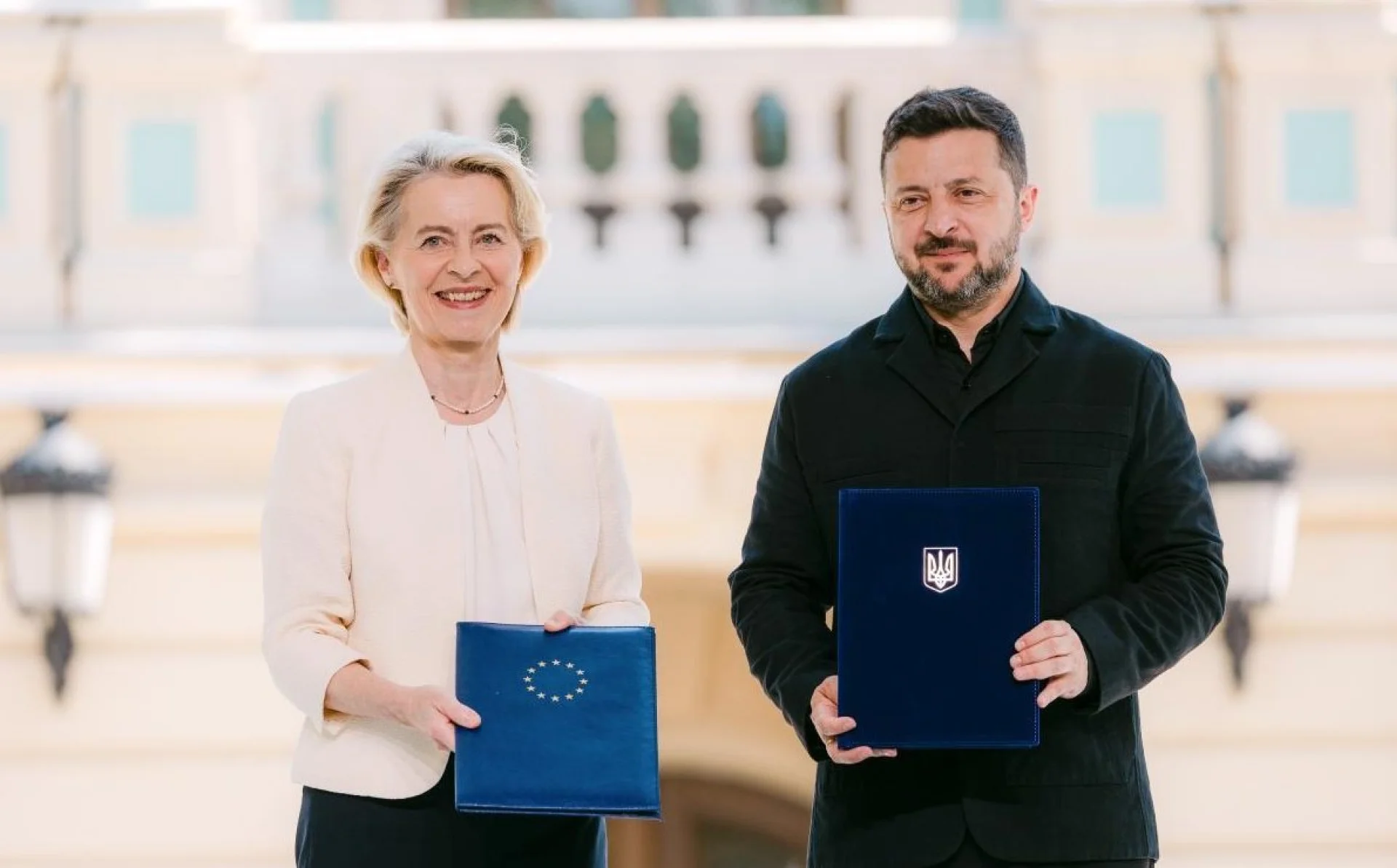 |
EU launches Ukraine defence industrial partnership, Drone Deal and disburses €1 billion for drones EU Neighbours East |
Kyiv can be credited with many outstanding features in this uneven war imposed upon Ukraine by Vladimir Putin's ambitions to restore Greater Russia; among them the courage and intestinal fortitude to counter the full-scale invasion in its fifth year and add to that the determination to win this war, whatever it takes to repel the Russian beast. And nor can its ingenuity in designing new technological weapons of its own manufacture to match anything Russia obtains from the Islamic Republic in this new era of drone warfare, much less its entrepreneurial enterprise in marketing its products and its experience be overlooked.
So while Russian drones -- the Iranian Shaheds -- have wrought their weight in deadly measure as a means to kill thousands of soldiers and civilians in Ukraine, countermeasures to Russia's innovative first-person-view vehicles, jet power, fibre-optic tethers and similar innovations have led to Ukraine developing its own versions in countering the Russian military's. EU member-states such as Croatia, Spain, Italy, Poland, the Netherlands, France, Denmark and Germany now see their own firms aligning with Ukrainian companies that specialize in first-person-view combat drones.
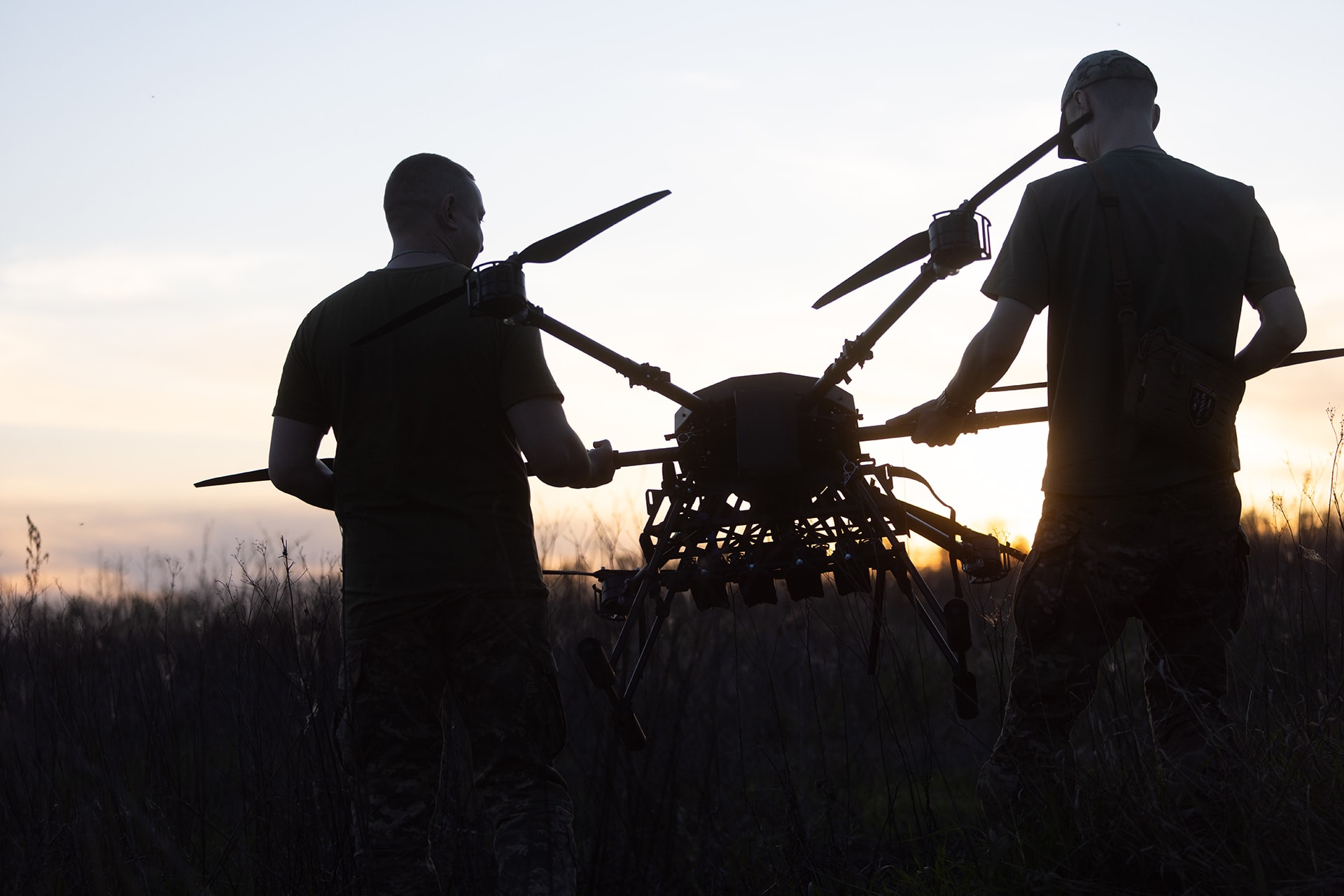 |
| Ukrainian soldiers of the 127th Heavy Mechanized Brigade carry a Heavy Shot UAV across a field on May 8, 2026, in Kharkiv Oblast, Ukraine. Yevhen Titov/Global Images Ukraine via Getty Image |
"Latvia will adopt Ukraine's unique combat experience in airspace defence against drone attacks.""[The deal includes] immediate access to technologies, but most importantly, the immediate arrival of Ukrainian anti-drone combat unit experts in Latvia.""Our skies can only be protected if we follow Ukraine's example, know-how and experience."Latvian Prime Minister Andris Kilbergs
A joint drone production facility is to be built near Latvia's border with Russia. Russia's Eastern Europe neighbours are fully cognizant of the potential danger they are in, following Ukraine's invasion, led by the Russian President's roving eye and territorial acquisitiveness. Kyiv anticipates more military and economic support, in particular American-produced Patriot missiles in short supply, given U.S. forces fighting Iran. Its breakthrough arrived when President Trump stated Kyiv would be allowed to make Patriot missiles itself in Ukraine.
"The terms must be beneficial for Ukraine, and the proceeds from exports must strengthen Ukraine's defence", stated President Zelenskyy of plans to release exports of Ukrainian drones. Reliance on early warning systems, radar, electronic warfare, mobile fire groups, helicopters, jet fighters and interceptors encompass Ukraine's anti-drone defences. Interceptors are increasingly being realized as the main line of defence for intercepting drones.
Over 100 Ukrainian companies produce interceptors. "We have approximately 15 to 20 very effective interceptors, which are also extensively used at the front", revealed Andrii Hrytseniuk, chief executive of Ukrainian government organization Bravel, providing a platform for the country's defence tech sphere.
 |
A Sting interceptor drone flies during drills at the Yatagan School for Unmanned Aerial Systems in the Kyiv region, Ukraine, Efrem Lukatsky/AP |
"There is no one single bullet. There is sort of this funny magical thinking that a lot of people are doing in terms of 'hey, just send us all your drones or your interceptors'. ""And what people are sort of missing is that is, even though there's tech and that's what everybody sees, it's only one piece of everything."Deborah Fairlamb, American investor in military technology
Labels: Drone Warfare, European Union, Joint Drone Facilities, Russian Invasion of Ukraine, Ukraine's Anti-Drone Experience, Ukrainian Counteroffensive
posted by Pieface @ 8:27 PM


0 Comments:
Post a Comment
<< Home