China's Love for 'Harmony' and Dread of 'Splitism
"It [Beijing's new 'ethnic unity' law] risks deepening restrictions on freedoms of language, education, practice of religion, culture, expression and assembly [of minorities in China].""[Eight human rights experts stated that the law could have] serious implications for Tibetans, Uyghurs and Mongolians]."Volker Turk, United Nations High Commissioner for Human Rights
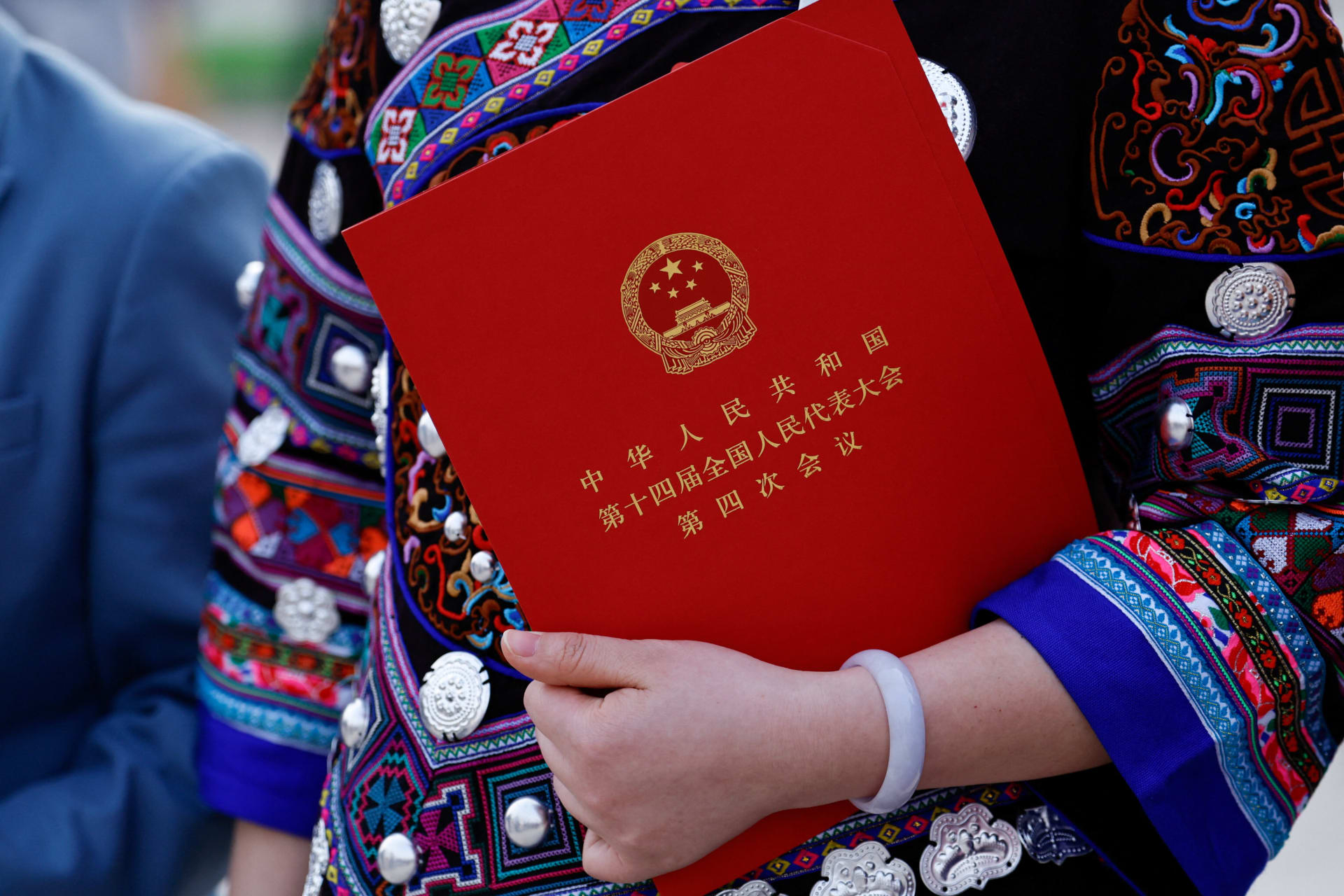 |
| A delegate in ethnic minority costume holds a document following the closing session of the National People’s Congress (NPC) at the Great Hall of the People in Beijing, China March 12, 2026. REUTERS/Tingshu Wang |
"This new law is the culmination of a policy trajectory that has been building for over a decade, dating back to the 2014 Central Ethnic Work Conference. Under Xi, Beijing is steering away from the post-1949 legal framework of nominal ethnic autonomy (albeit under tight Party control) imported from the Soviet Union. In its place, officials have steadily been pivoting towards what scholars have termed “second-generation ethnic policies”—an aggressive assimilationist approach that emphasizes a common Chinese national identity over accommodation of ethnic differences. Provincial and municipal authorities across China have enacted a wave of local “ethnic unity and progress” regulations in recent years, such as those in Xinjiang (2015) or Inner Mongolia (2021). The new national legislation elevates this approach to the level of a national statute governing all of China.""The new law’s core concept is captured in the term zhulao (铸牢) – to “forge” or “cast” metal – and its instruction that “forging the communal consciousness of the Chinese nation” is core to the Party’s ethnic policies. As James Leibold has pointed out, this phrasing reflects a hardening of Beijing’s political line under Xi Jinping – explicitly written into the Party’s Charter at the 19th Party Congress in 2017 – aimed at “melting” subnational and ethnic identities into a shared collective one."Council on Foreign Relations
China is in the throes of a wide-ranging propaganda campaign in the promotion and defence of its new "ethnic unity" law, a prime target of critics who contend that this law will continue to add to undermining the rights of Tibetans, Uyghurs and other minorities in the vast country where Han Chinese predominate. With this new law Beijing has granted itself sweeping powers in pursuit of groups and individuals living overseas viewed by the Chinese Communist Party as undermining national unity. It is these groups, claims Beijing that incite ethnic division, and not China's strict totalitarian laws.
Beijing watchers have been alerted to the potential of Chinese authorities seeking to accuse activists living abroad of crimes that would merit Beijing authorities' intimidation of those it suspects, to force them to repatriate to China with the knowledge that their family members back in China will become vulnerable to 'special notice' that could degenerate into arrest. Alternatively those who are suspect would become subject to extradition requests back to China, of the host country.
China's vice minister of justice, Hu Weilie, blames criticism of its new unity law legislation on "distorted interpretations" by Western media. The law, he emphasized, effective from July 1 is "legitimate, legal, necessary", fully in line with international norms. Guo Jiakun, a spokesmen for China's Foreign Ministry, singled out the United States and European Union for "maliciously slandering" China's policies.
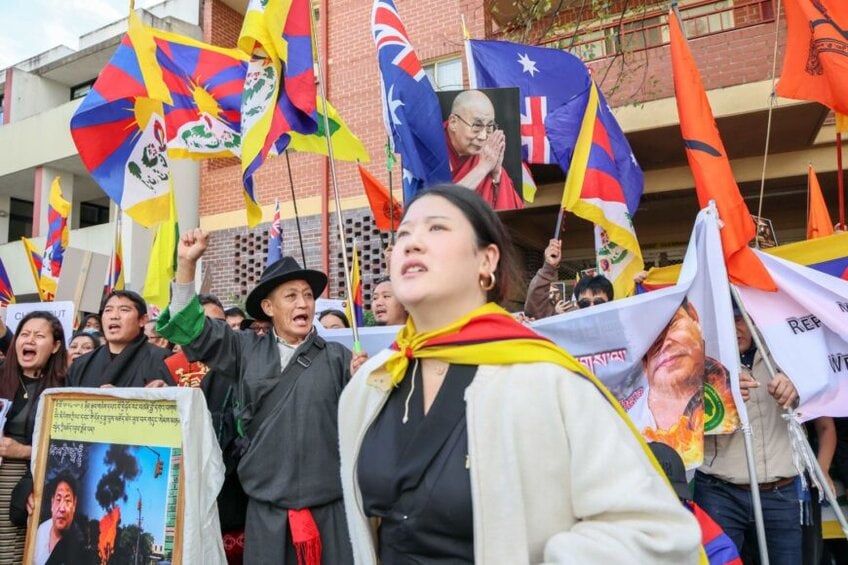 |
| Free Tibet protest against China’s Ethnic Unity law and in honour of activist Pawo Lobga Rangzen, Chinese Consulate General, Camperdown, Australia, 8 July 2026. Credit: Alexandra Buxbaum/Sipa USA |
The Chinese Communist Party under the leadership of President Xi Jinping has become increasingly sensitive to any criticism regarding treatment of ethnic minorities. The imposition of heavy crackdowns on such groups, targeting Tibetans in particular, to erode the influence of the Dalai Lama in Tibet and the Uyghurs, a Muslim Turkic minority in Xinjiang province, should be immune, according to Beijing from foreign interference.
According to Chinese government authorities, the new legislation will protect the traditions of all of the 56 officially recognized ethnic groups in China. While in point of fact, assimilation is the goal the new law is meant to achieve, for the minority groups to be swallowed whole into the culture of the majority Han Chinese. The state-operated Global Times published an editorial accusing "some Western countries and media outlets" of maligning China's ethnic policies. These reactions from outside sources "amount to nothing more than one-sided rhetoric".
Restrictions on the use of Mongolian in local schools in Inner Mongolia prompted widespread protests in 2020. With this new legislation, any acts that "undermine ethnic unity or create ethnic divisions" among Chinese people inside or outside of China and requires all of Chinese society to participate in the mission of ethnic integration are banned. Mandarin Chinese is mandated as the sole language of school instructions as well as in official communication. Parents are ordered by the legislation to "educate and guide children to love the Chinese Communist Party".
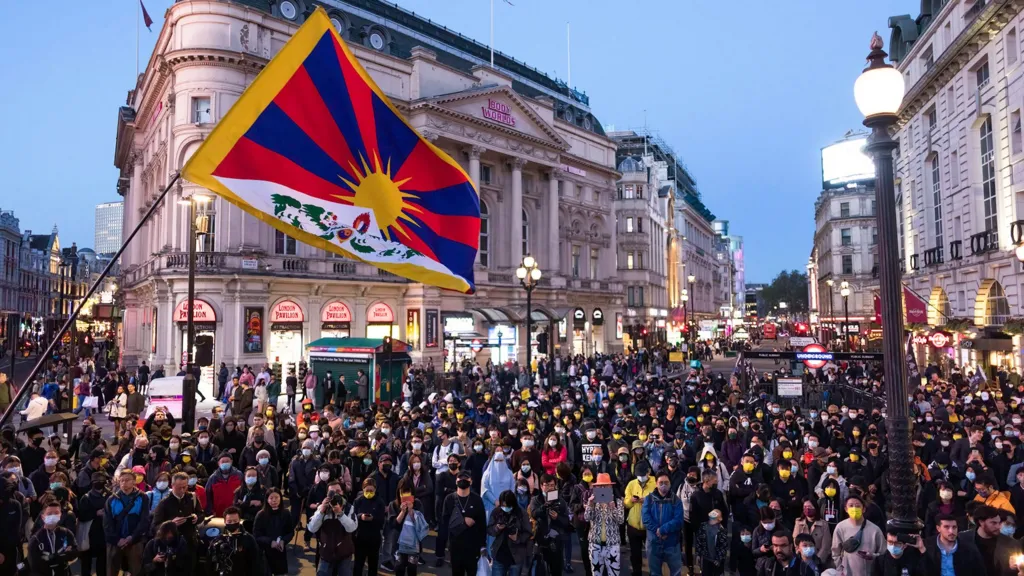 |
| Protesters in London's Piccadilly Circus gather in support of Tibet Getty Images |
Labels: Assimilationist Policy, Chinese Communist Party, Ethnic Divisions, Han Chinese Majority, National Unity, Tibetans, Uyghurs
posted by Pieface @ 7:57 PM


0 Comments:
Post a Comment
<< Home