The Gulf Nations in Iran-War Fallout Disarray
"[The U.S.-Iran agreement] rehabilitates Tehran's regime as a regional power.""[The financial benefits that it could confer] will make Iran a greater monster than it was before."Abdulrahman al-Rashed, Saudi journalist"It's left a big wound. It's going to take a long, long time to recover.""We are terrified that this is going to be an ongoing war.""[It feels like the Trump administration is looking at the Gulf] as an A.T.M. [and that] bothers a lot of people."Khalid Al-Jaber, head, Middle East Council on Global Affairs, Qatar research institute
 |
| A smoke plume rises from an ongoing fire near Dubai International Airport in Dubai on March 16, 2026. (AFP) |
Interesting that this commentator writing out of Qatar fields a singular perspective without considering that Qatar itself has invested millions upon millions upon millions in the United States, as though its treasury was unlimited, in indebting U.S. colleges and universities, to the Middle East country for its generosity. And to believe that this is done simply for a love of America by an oil-rich Gulf state is to be naive beyond redemption. Qatar, in seeking influence for its 'philanthropy' in America does in fact, resemble an A.T.M.
"Why has a country of just 330,000 citizens that is half the size of New Jersey and a leading patron of the Muslim Brotherhood plowed $400 billion dollars into the United States? This amounts to approximately $1.2 million per Qatari citizen — an enormous sum.""Some Americans may welcome the generosity of the Qatari regime. After all, one could argue that a great many of these investments — spanning energy, defense, biotech and other important sectors — serve to benefit the U.S. economy and U.S. citizens. One could also argue that Qatar, like Japan, Canada, or other countries that sink billions in the United States, simply seeks return on investment.""But Qatar is different. There are more than a few reasons to question the largesse of the Qatari government. At the end of the day, Qatar is ruled by an Islamist, autocratic regime; Freedom House consistently ranks the country as “Not Free” in its annual Freedom in the World survey. And Doha’s failure to guarantee the rights of its citizens is not the biggest problem.""Rather, it is the country’s tendency to support jihadi causes in the Middle East that raises significantly more concern. The country’s horrific track record in this regard distinguishes Qatar from other Gulf states that spread their wealth in America."Jonathan Schantzer, Foundation for Defense of Democracies
That little quibble dispensed with, one can indeed feel a level of sympathy for the newly-occurring plight of wealthy Gulf Arab nations, witnessing and experiencing a regional war too close to home for comfort.
Few countries in the Middle East view the Islamic Republic of Iran through a lens of tender brotherhood. Those that do stand out from say, the United Arab Emirates, Bahrain, Kuwait and Saudi Arabia. Qatar and Oman, on the other hand, have a pronounced soft spot for the truculent totalitarian Islamist government that the entire Middle East views as a threat to peace and stability.
 |
| A building damaged in a reported Iranian drone strike, amid the US-Israeli conflict with Iran, in Seef, Manama, Bahrain, March 10, 2026. (Reuters) |
In the region most exposed to Iran's firepower, suddenly normality has been upended. The violence of Iran's chastising its near neighbours for accepting American bases on their soil, expressed by Iran's disruptive drone and missile attacks has disabused its neighbours of the attitude that this is Israel's and the United States' conflict with Iran, nothing to do with them, even while they have been hoping that the Iranian regime would fall and relieve the regional tension and threats emanating from Iran with a changeover to a new, non-threatening regime.
And to further compound matters, the economic hits courtesy of Iran's closing of the Strait of Hormuz, the main international waterway for exporting oil, fertilizer, LNG and other products globally has been deliberately constrained creating an economic dilemma of no mean proportions. American bases on Kuwaiti soil, UAE and Saudi Arabian soil and elsewhere made them surprised sitting ducks for Iranian blowback. Suddenly the Gulf countries realize that despite their enormous oil wealth their defense capabilities are minimal, necessitating an upsurge on spending for military hardware and defense.
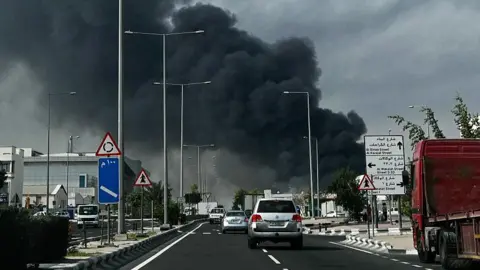 |
| Iran has attacked Gulf states in retaliation for Israeli and US bombing on its country AFP via Getty Images |
No other course of action is feasible with Dubai and Doha having suffered immense missile hits leaving their luxury towers smoldering. Incoming missile alerts have introduced a new, unwelcome reality to Iran's neighbours, suddenly vulnerable to unexpected attack. The Emirates were forced to close their schools for weeks, while foreign residents fled. Interception of most of the thousands of missiles and drones out of Iran succeeded in keeping damage and lives lost to a relative minimum, but no country and no population appreciates living with this level of uncertainty.
Each of the targeted countries went their own way, there was no unified reaction. Qatar as usual presented itself as a key mediator between the United States and Iran, alongside Pakistan for the same purpose...supporting Iran and convincing the U.S. that a ceasefire is infinitely preferential to ongoing kinetic hostilities, punishing to the Gulf States and placing U.S. servicemen in ongoing danger.
Negotiations amidst the uncertainty and tension have led the Emirates to strengthen alliances with both the United Sates and Israel. A pre-conflict rift between the UAE and Saudi Arabia has seen the Saudis keeping options open; maintaining channels with Iran, while attempting to influence American decision-making. Attesting to the medieval-era relational strains, Saudi Arabia and Iran are at loggerheads over Mecca, and the threat posed by Iran toward Saudi Arabia historically seems to have petered out for the present.
Gulf nations are now busy planning how best to proceed with uninterrupted passage of oil, food and other goods shipped out of the Middle East to global destinations. A new strategy of "zero Hormuz dependency" has persuaded the Emiratis to expand its ports outside the critical Strait susceptible to further closures by Iran, and to build oil pipelines and railways. Oman with its ports on the Arabian Sea far from the Strait is now seen as a crucial logistics hub trucking goods overland for its neighbours.
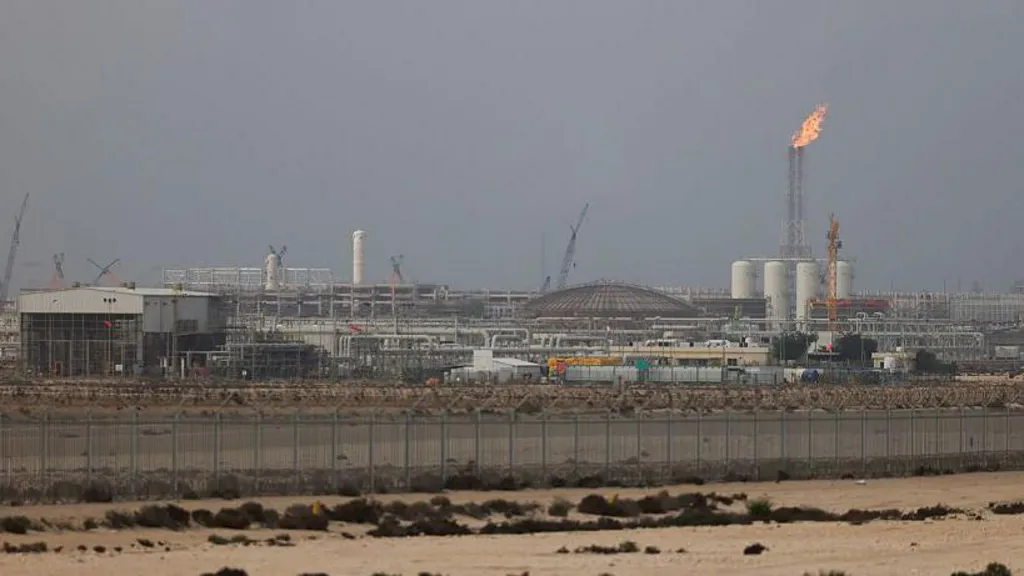 |
| Qatar has become one of the biggest exporters of natural gas AFP via Getty Images |
Labels: Critical Shipping Route, Gulf Neighbours, Iranian Drones and Missiles, Strait of Hormuz, U.S.-Israel Conflict With Iran
posted by Pieface @ 8:13 PM


0 Comments:
Post a Comment
<< Home